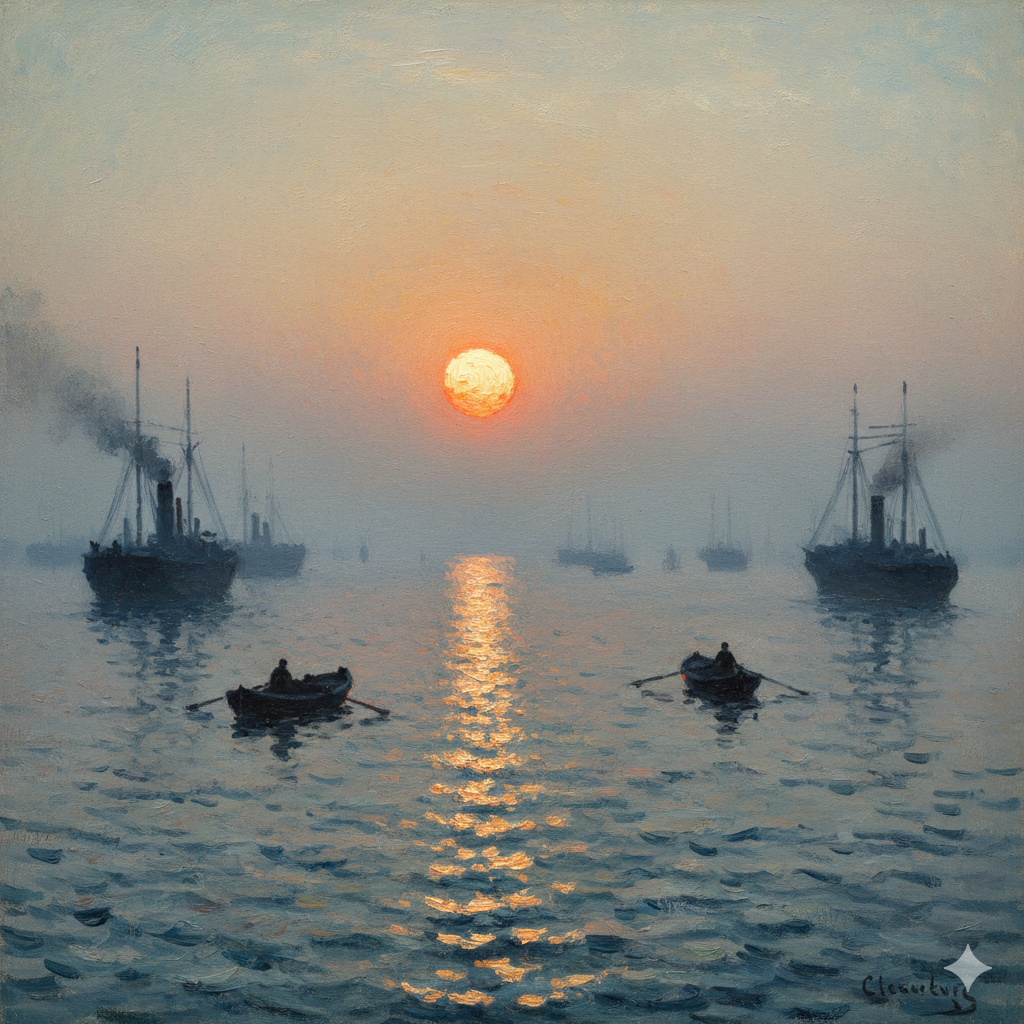

The history of art is filled with ironies, but perhaps none is greater than this: the most beloved, valuable, and influential art movement in history was named after a joke. When Claude Monet first unveiled his hazy, orange-spotted harbor scene in 1874, critics didn’t just dislike it; they laughed at it. One critic famously declared that “wallpaper in its embryonic state” was more finished than Monet’s seascape.
Yet, that “unfinished” sketch, titled Impression, Sunrise (or Impression, soleil levant), survived the laughter. It survived financial ruin, decades of obscurity, and even a brazen gunpoint heist in 1985 involving the Japanese Yakuza.
Today, this masterpiece is not just a painting; it is a manifesto of light, a victim of crime, and a scientific marvel that has recently been decoded by forensic astronomers. In this deep dive, we will explore the Impression Sunrise meaning, the science behind its shimmering sun, and the true story of how a single canvas changed the way the world sees.
Key Facts: Impression, Sunrise
Before we unravel the mystery, here are the essential statistics you need to know about this iconic work.
| Metric | Value | Notes |
|---|---|---|
| Artist | Claude Monet | Painted at age 32 |
| Creation Date | Nov 13, 1872 | Calculated by astrophysicist Donald Olson |
| Creation Time | 07:35 AM | Local Mean Time |
| Dimensions | 48 cm × 63 cm | (18.9 in × 24.8 in) |
| Medium | Oil on Canvas | Painted en plein air (mostly) |
| Initial Price (1874) | 800 Francs | Buyer: Ernest Hoschedé |
| Resale Price (1877) | 210 Francs | Buyer: Georges de Bellio (Distress Sale) |
| Current Est. Value | ~$250–350 Million | Based on comparable Monet sales |
| Stolen | Oct 27, 1985 | Musée Marmottan Monet |
| Recovered | Dec 1990 | Porto-Vecchio, Corsica |
The Birth of a Masterpiece: Le Havre, 1872
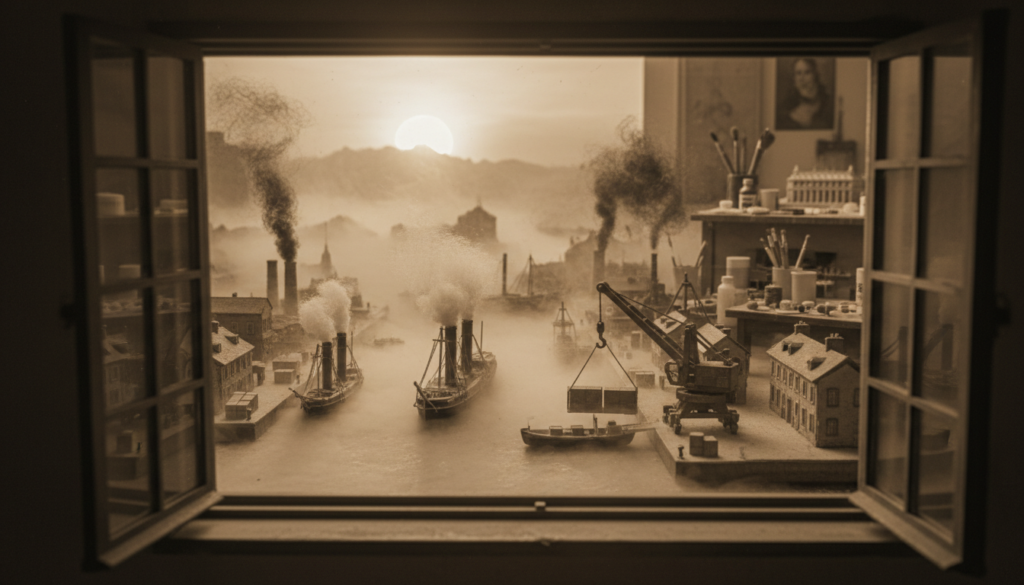
To understand why Impression, Sunrise was so revolutionary, we have to look at where it was born. In late 1872, Claude Monet returned to his hometown of Le Havre, a bustling port city in Normandy. He checked into the Hôtel de l’Amirauté and set up his easel by a window overlooking the harbor.
For decades, art historians viewed this painting as a romantic, misty ode to nature. However, modern analysis reveals a gritty industrial reality. This wasn’t a quiet beach; it was the engine room of the Industrial Revolution. If you look closely through the haze, you can identify the silhouettes of packet steamers, heavy cranes, and smoking chimneys.
Monet employed a technique known as pochade—a quick sketch intended to capture a fleeting moment. He wasn’t trying to paint the ships perfectly; he was trying to paint the atmosphere between his eye and the ships. This approach is central to what is Impressionism: the prioritization of light and color over form and detail.
By leaving the canvas “unfinished” by 19th-century academic standards, Monet was making a bold choice. He was asserting that the sensation of a sunrise is more truthful than a photographic representation of it. This daring approach is a prime example of how location inspires artists to break conventions.
Forensic Art History: Solving the “Sunrise vs. Sunset” Mystery
For over a century, a debate raged in the art world: Was it a sunrise or a sunset? And when exactly was it painted? The title says “Sunrise,” but Monet date-stamped it “72,” and archival records were messy.
Enter Donald Olson, an astrophysicist from Texas State University known as the “Celestial Sleuth.” Olson approached the painting not as art, but as data. He teamed up with the Musée Marmottan Monet to conduct a forensic analysis that would make Sherlock Holmes proud.
Olson analyzed three key elements:
- The Sun’s Position: He calculated the azimuth of the sun rising over the specific topography of Le Havre.
- ** The Tide:** The painting shows the lock gates of the harbor are open. In Le Havre, these massive gates only opened at high tide to let large ships pass.
- The Ships: Historical weather reports and maritime logs tracked the movement of specific ships visible in the harbor.
Combining these factors, Olson narrowed the possibilities down to a single minute. The verdict? Impression, Sunrise was painted on November 13, 1872, at 7:35 a.m. local mean time.
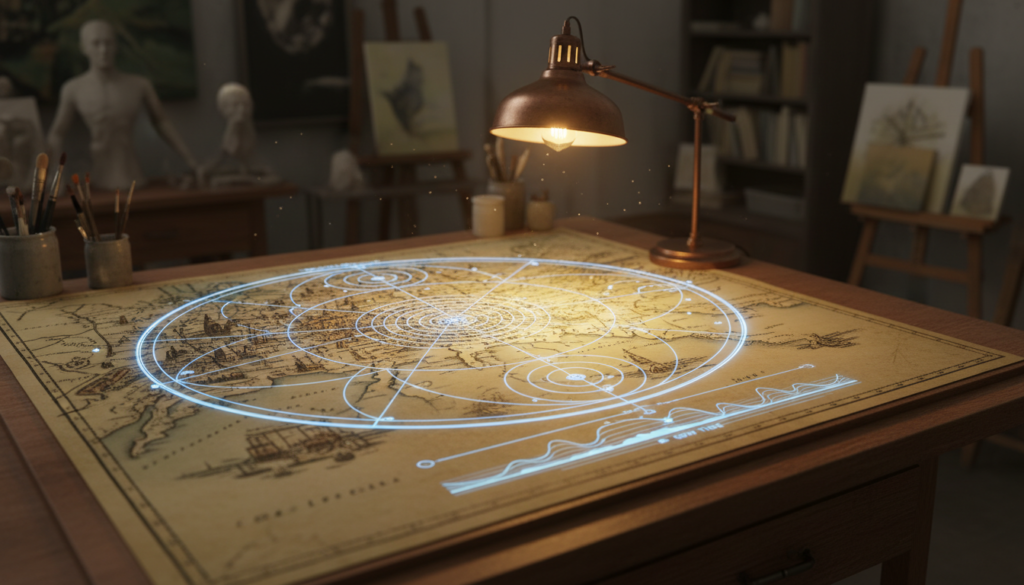
This intersection of science and creativity highlights how does science influence art, turning a beautiful image into a precise historical document.
The 1874 Exhibition: A Scandalous Debut
Two years after painting it, Monet joined forces with Pissarro, Degas, Renoir, and others to hold an independent exhibition. They wanted to bypass the jury of the official Salon, which had rejected their work for years. They rented the former studio of the photographer Nadar for their show in April 1874.
The exhibition was a disaster. The public came to jeer. But the most significant moment came from a critic named Louis Leroy, writing for the satirical newspaper Le Charivari.
Looking at Monet’s harbor scene, Leroy wrote a dialogue between two fictional visitors. Upon seeing the painting, one character exclaims:
“Impression, I was certain of it. I was just telling myself that, since I was impressed, there had to be some impression in it… and what freedom, what ease of workmanship! Wallpaper in its embryonic state is more finished than that seascape.”
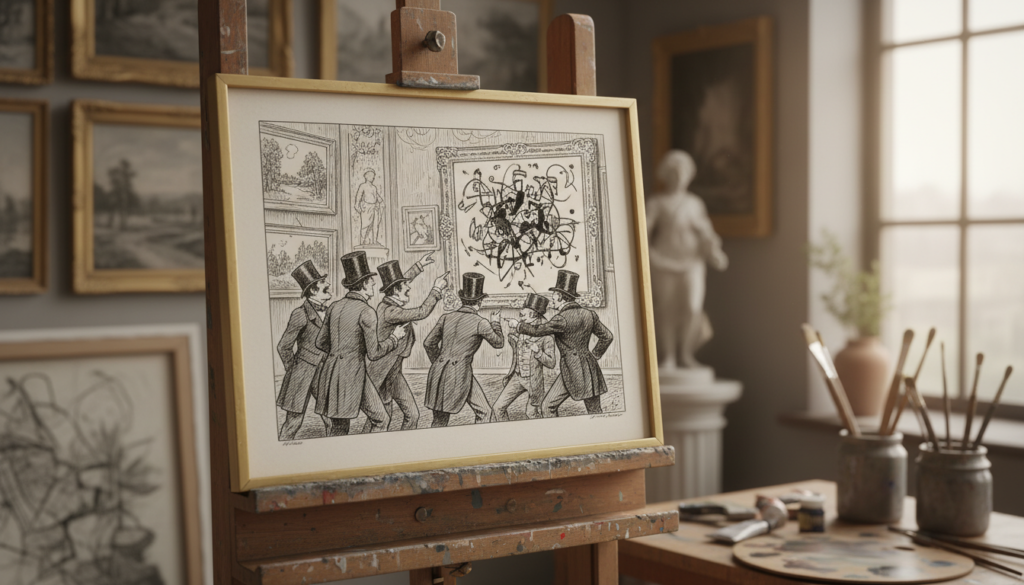
Leroy titled his review “The Exhibition of the Impressionists,” intending it as a biting insult. He meant to call them “sketchers” or “incompetents.” Instead, the group embraced the name.
Interestingly, the title itself was an afterthought. When the cataloger, Edmond Renoir (Pierre-Auguste’s brother), complained that “View of Le Havre” was too boring for a title, Monet shrugged and said, “Put down Impression.” That casual remark gave birth to one of the most famous art periods in history.
Artistic Analysis: Light, Color, and Equiluminance
Why does the sun in Impression, Sunrise seem to pulsate? If you stare at the orange sphere, it appears to shimmer or float against the grey sky. This isn’t magic; it’s neurobiology.
Margaret Livingstone, a neurobiologist at Harvard Medical School, discovered that the effect is due to equiluminance.
Here is how it works:
- The Palette: Monet used a “Limited Palette” consisting of Lead White, Cobalt Blue, Viridian, Vermilion, and Chrome Orange.
- Luminance vs. Chromaticity: While the colors (orange and blue) are direct opposites on the color wheel, their luminance (brightness) in this painting is exactly the same.
The human brain has two separate systems for processing vision:
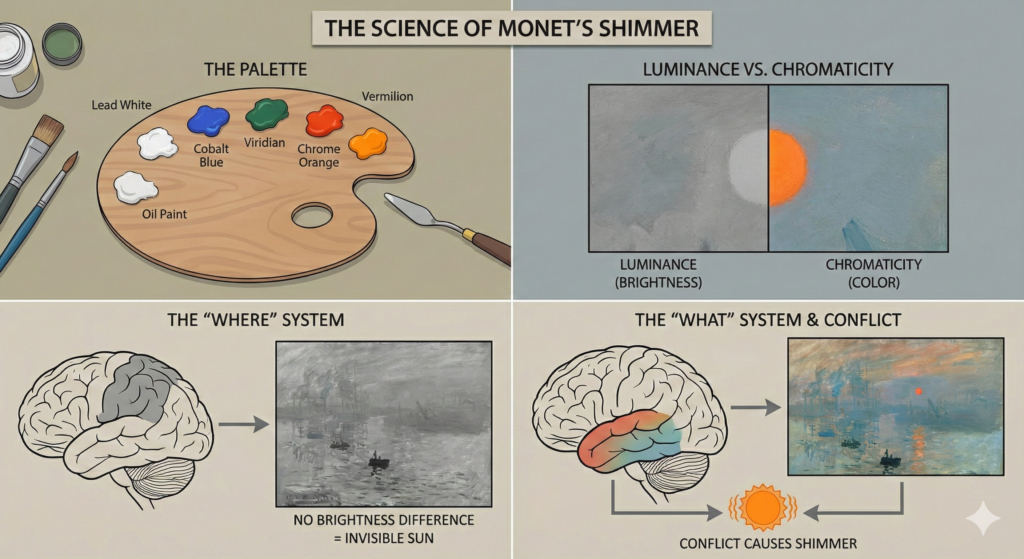
- The “Where” System: An older, colorblind part of the brain that detects depth, motion, and position based on brightness differences.
- The “What” System: A newer part of the brain that recognizes color and objects.
Because the sun and the sky have the same brightness, the “Where” system cannot distinguish the sun from the background—to that part of your brain, the sun is invisible. However, the “What” system sees the bright orange clearly. This conflict between the two systems causes the sun to vibrate or “shimmer” in your perception.
This mastery of light is a hallmark of mastering Impressionism light techniques, proving that Monet was an intuitive scientist of vision.
The “Heist of the Century”: The 1985 Theft
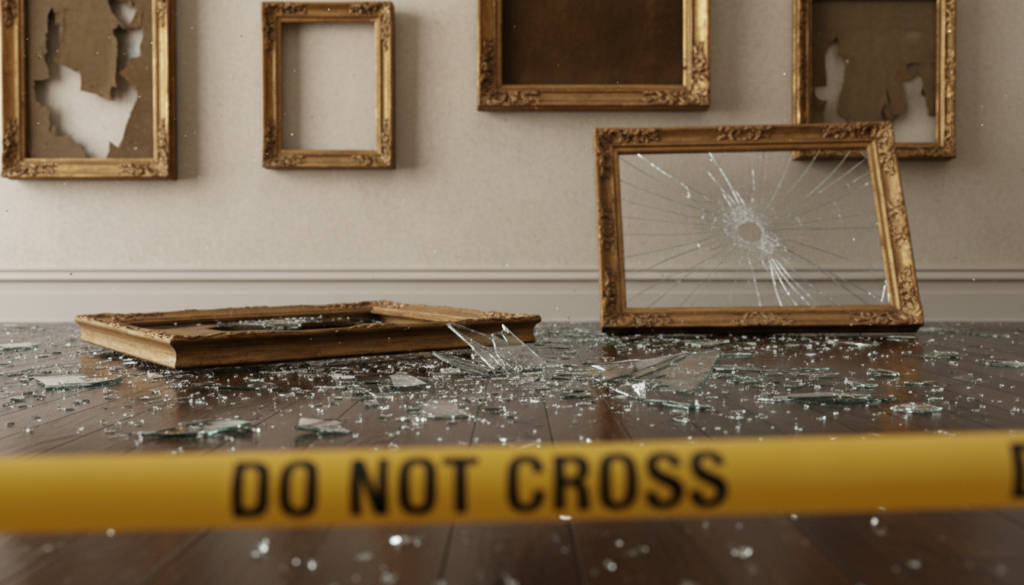
While Impression, Sunrise is famous for its aesthetic, it also stars in a real-life crime thriller. On October 27, 1985, five masked gunmen stormed the Musée Marmottan Monet in Paris during opening hours.
They forced security guards and visitors to the floor at gunpoint. In a surgical operation, they ripped Impression, Sunrise and eight other masterpieces (including works by Renoir and Morisot) off the walls. It was a shocking event, ranking high among famous art thefts.
For five years, the painting was lost. The investigation led police into the dark underworld of the Japanese Yakuza. A gangster named Shuinichi Fujikuma had allegedly ordered the heist to impress associates. However, the painting was too famous to sell. It became a “hot potato.”
In December 1990, acting on a tip-off, police raided a villa in Porto-Vecchio, Corsica. There, wrapped in plastic and hidden in a damp corner, they found the paintings.
The thieves had applied a layer of varnish to the canvas, perhaps to disguise it or preserve it poorly, which had turned yellow over the years. Conservators had to painstakingly remove this layer to restore Monet’s original cool, misty morning light.
Provenance and Valuation
The financial journey of Impression, Sunrise is as dramatic as its visual history. Today, we associate Monet with record-breaking auction prices, but it wasn’t always so.
In 1874, the painting was purchased by Ernest Hoschedé, a department store magnate and early patron of Monet, for 800 francs. To put that in perspective, it was a respectable sum for a young artist but hardly a fortune.
However, Hoschedé went bankrupt. In 1877, his collection was auctioned off in a distress sale. Impression, Sunrise sold for a mere 210 francs to Georges de Bellio. The painting had lost nearly 75% of its value in three years.
The painting was eventually bequeathed to the Musée Marmottan in 1940, where it has remained (except for its brief “holiday” with the Corsican mob). Because it is in a French national museum, it can never be sold. However, insurance valuations and market comparisons give us a clue.

With Monet’s Meules selling for $110.7 million and other works soaring, experts estimate that if Impression, Sunrise ever hit the market, it would command between $250 million and $350 million. It is a stark reminder of the importance of artwork provenance research.
Frequently Asked Questions (FAQ)
Is Impression Sunrise a sunrise or sunset?
It is definitely a sunrise. Donald Olson’s forensic astronomy confirmed the sun’s position in the east, rising over the Le Havre harbor at 7:35 a.m. on November 13, 1872.
Why is the sun orange in Impression Sunrise?
Monet used a mix of Chrome Orange and Vermilion to cut through the dense grey/blue atmosphere. The orange color also serves as a complementary contrast to the blue, making the sun “pop” visually.
Where is Impression Sunrise located?
The painting resides permanently at the Musée Marmottan Monet in Paris. It is rarely loaned out due to its fragility and immense value.
Did critics like Impression Sunrise when it was first shown?
No. Most critics mocked it. Louis Leroy used it to coin the term “Impressionism” as an insult, suggesting the work was unfinished and crude.
What is the size of Impression Sunrise?
It is relatively small, measuring 48 cm × 63 cm (18.9 in × 24.8 in). This small size facilitated the en plein air technique, allowing Monet to paint quickly.
Conclusion
From a hotel window in Le Havre to a hideout in Corsica, Impression, Sunrise has traveled a long road. It started as a rebel yell against the art establishment, was dismissed as a bad sketch, and eventually became the defining image of the modern era.
Monet did not just paint a harbor; he painted the act of seeing. By focusing on light, atmosphere, and the fleeting nature of time, he unlocked a new visual language. Whether you appreciate it for its Impressionist light techniques, its scientific brilliance, or its survival against the odds, Impression, Sunrise remains a beacon of artistic freedom.
It reminds us that sometimes, the things critics laugh at today are the masterpieces of tomorrow.