You don’t need innate talent to learn how to paint. Painting is a teachable mechanical skill backed by neuroplasticity. With deliberate practice and a willingness to make mistakes, anyone can train their hands and eyes to create compelling art. Grab a brush and focus on consistent, focused repetition to build your confidence and lower your stress levels right now.
Most people stare at a blank canvas and immediately decide they lack the genetics for it. They assume artists pop out of the womb with an innate understanding of color theory and brush control. That is simply not true. Painting is a mechanical and observational skill you can learn through repetition.
When you hold a brush for the first time, your brain has to build entirely new neural pathways. It feels clumsy. You make muddy colors. Your lines wobble. That awkwardness is not a lack of talent. It is just the normal friction of learning a new physical movement.
The myth of the natural-born artist stops millions of people from ever trying. You don’t need a magical gift to mix blue and yellow. You just need patience and a solid introduction to painting to guide you. Once you accept that bad art is a mandatory part of the process, the intimidation fades. Anyone can learn to paint if they approach it as a trainable habit instead of a divine calling.
Can Anyone Learn to Paint, or Is It Pure Talent?
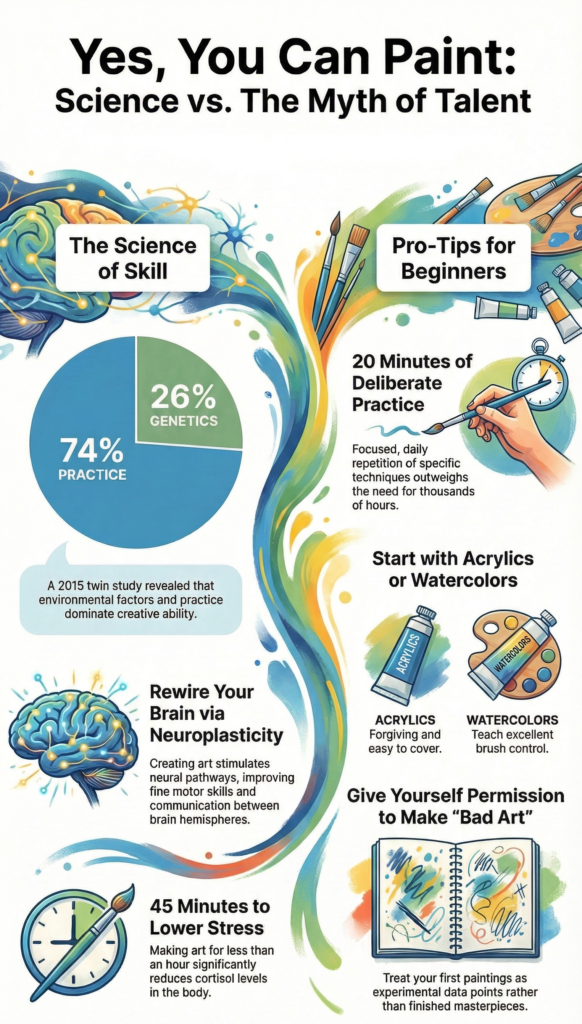
Yes, anyone can learn to paint. A 2015 twin study revealed that environmental factors and practice shape 74% of creative drawing ability. Artistic skill is a combination of trained observation, fine motor control, and repetitive problem-solving rather than a rare genetic gift.
The idea that creativity is entirely inherited is factually incorrect. Creative ability is actually a problem-solving skill present in everyone, not an exclusive physical gift given to a lucky few. Think of painting like driving a car. You didn’t know how to steer or parallel park on your first try. You had to learn the mechanics.
Every brushstroke is a decision. You look at a subject, mix a color, and apply it. Over time, that sequence becomes second nature. A study showed that environmental factors heavily outweigh genetics in creative drawing. Practice is what actually puts paint on the canvas.
How Does Painting Actually Rewire Your Brain?
Painting actively rewires your brain by stimulating neural pathways and promoting neuroplasticity. The act of mixing colors and moving a brush improves communication between the left and right hemispheres while significantly reducing cortisol levels and stress.
Your brain changes when you learn a new physical task. Handling a paintbrush actively increases fine motor skills and dexterity. It forces your eyes and hands to work together in ways they usually don’t. Research shows that creating visual art stimulates active neuroplasticity and strengthens the connections in your mind.
Furthermore, making art enhances communication between your left and right brain hemispheres. This helps you process visual information more effectively. There is also a massive mental health component. Taking time to create art for mental well-being is incredibly effective. In fact, making art for just 45 minutes significantly lowers cortisol levels in your body.
The 10,000-Hour Rule vs. Real Painting Progress
You don’t need thousands of hours to paint something you feel proud of. The famous 10,000-hour rule is widely misunderstood. Psychologist Anders Ericsson, who originally conducted the research, clarified that deliberate practice matters far more than arbitrary time minimums.
Mindless repetition won’t make you a better painter. Focused, intentional practice will. We spend a lot of time debunking the 10,000-hour rule because it creates unnecessary anxiety for beginners. If you dedicate 20 focused minutes a day to practicing a specific technique, you will see massive improvement in just a few weeks.
What Are the Best Painting Mediums for Beginners?
Acrylics and watercolors are the best painting mediums for beginners. Acrylics dry quickly and allow you to easily paint over mistakes. Watercolors teach brush control and water-to-paint ratios while requiring minimal setup and cleanup.
Choosing the right paint removes a lot of initial friction. Acrylics are incredibly forgiving. If you paint a shape you hate, you can simply wait ten minutes and paint right over it.
Watercolors are a bit wilder but just as accessible. Getting started with watercolors teaches you how to let the medium do some of the work for you. Working with watercolor requires learning specific brush control rather than relying on natural talent. Find a medium that fits your workspace and budget, and stick with it until you understand how it behaves.
Why Making Bad Art Is the Secret to Getting Good
Your first ten paintings will probably look terrible. That is completely fine. Every ugly painting is just a collection of valuable data points. You learn what happens when you use too much water. You discover how muddy colors get when you mix complementary pigments.
Some of the most famous painting mistakes actually led to incredible breakthroughs. When I started teaching, I noticed my students were terrified of ruining a fresh sheet of paper. We had to actively practice making ugly marks just to break the tension. You have to give yourself permission to create garbage. It is the only reliable path to creating something good.
The only real hurdle to painting is the false belief that you need permission from your genetics. You don’t. Painting is a physical habit accessible to anyone willing to pick up a brush and make a mess. Stop waiting to feel talented. Set up a small workspace, squeeze out three primary colors, and start putting paint on a surface. If you want a structured way to begin without the pressure of perfection, check out my video tutorials at ProminentPainting.com and start building those new neural pathways today.
Frequently Asked Questions
Is it too late to learn to paint as an adult? No, adult brains maintain neuroplasticity. You can learn the physical mechanics of painting at any age through deliberate practice and observation.
Do I need to know how to draw before I learn to paint? Drawing helps with proportion, but it is not a strict requirement. Many painters start directly with brushwork and focus on color and shapes instead of precise lines.
How long does it actually take a beginner to learn to paint? You can learn the basic mechanics of mixing and applying paint in a single afternoon. Developing a distinct style and mastering complex techniques usually takes several months of consistent, deliberate practice.
What is the easiest type of paint for a complete beginner? Acrylic paint is highly recommended for beginners. It is water-soluble, dries quickly, and allows you to easily cover up any mistakes by painting over them.
How do I get past the fear of ruining a blank canvas? Start by intentionally making random marks on the canvas to break the perfectionism. Treat your first few paintings as experimental exercises rather than finished masterpieces.