When a painting worth millions of dollars hangs in a prestigious museum, how do we know it’s really painted by the famous artist whose name appears on the label? The answer lies in something called a catalogue raisonné – a comprehensive scholarly book that serves as the ultimate authority for art authentication provenance. These detailed compilations are like birth certificates for artworks, providing the documentary proof needed to separate genuine masterpieces from clever fakes.
In today’s art world, where forgeries can fool even experienced collectors, the catalogue raisonné has become more crucial than ever. It’s not just a book – it’s the cornerstone of trust in the art market, protecting collectors, museums, and investors from costly mistakes while preserving the integrity of artistic heritage.
Key Points Summary
- Catalogue raisonnés are scholarly compilations that document every known work by an artist
- They provide essential provenance documentation that proves artwork authenticity
- Inclusion in a catalogue raisonné significantly increases an artwork’s market value
- Modern digital versions are making authentication more accessible to collectors
- These publications integrate with scientific methods for comprehensive verification
- Even catalogue raisonnés can make mistakes, leading to costly authentication errors
Understanding Catalogue Raisonnés: The Scholar’s Ultimate Reference
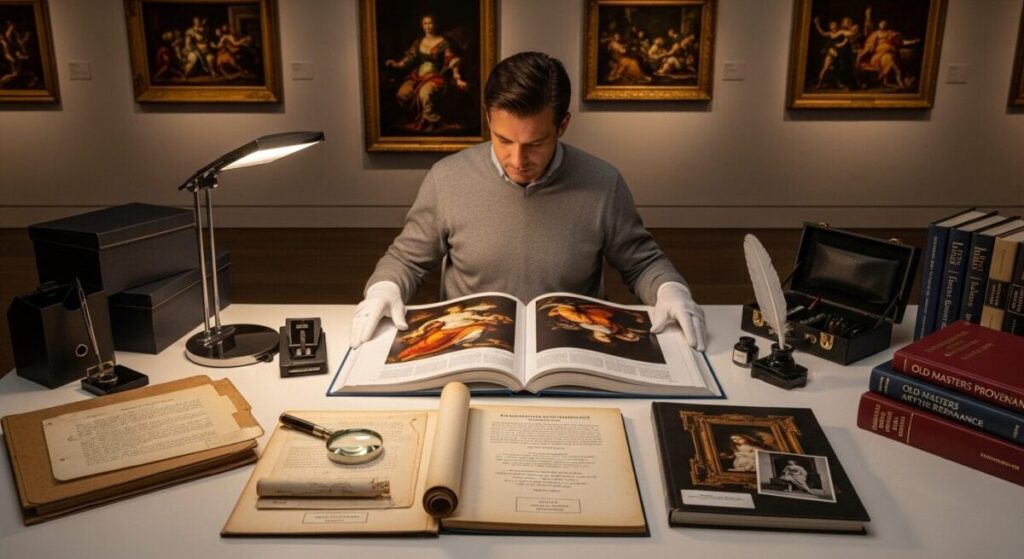
A catalogue raisonné is much more than an art book you might find in a museum gift shop. Think of it as a detective’s case file combined with a scientist’s research journal. Scholarly compilations like these document every single known work by an artist, whether it’s hanging in the Louvre or sitting in someone’s living room.
Creating a catalogue raisonné is like putting together the world’s most complex puzzle. Art historians spend years, sometimes decades, researching every painting, drawing, or sculpture an artist ever created. They examine archival documentation, study old exhibition catalogs, interview collectors, and even track down works that have been lost or stolen.
As François Duret-Robert, a leading expert in art historical documentation, explains:
“A catalogue raisonné is the ultimate scholarly reference that establishes the complete body of work for an artist, providing the foundation upon which all authentication decisions are built.”
The process requires incredible attention to detail. Researchers must verify when each artwork was created, who owned it throughout history, where it was exhibited, and how experts have analyzed it over time. This chain of ownership becomes crucial evidence for proving authenticity.
Art Authentication Provenance: A Multi-Layered Investigation Process
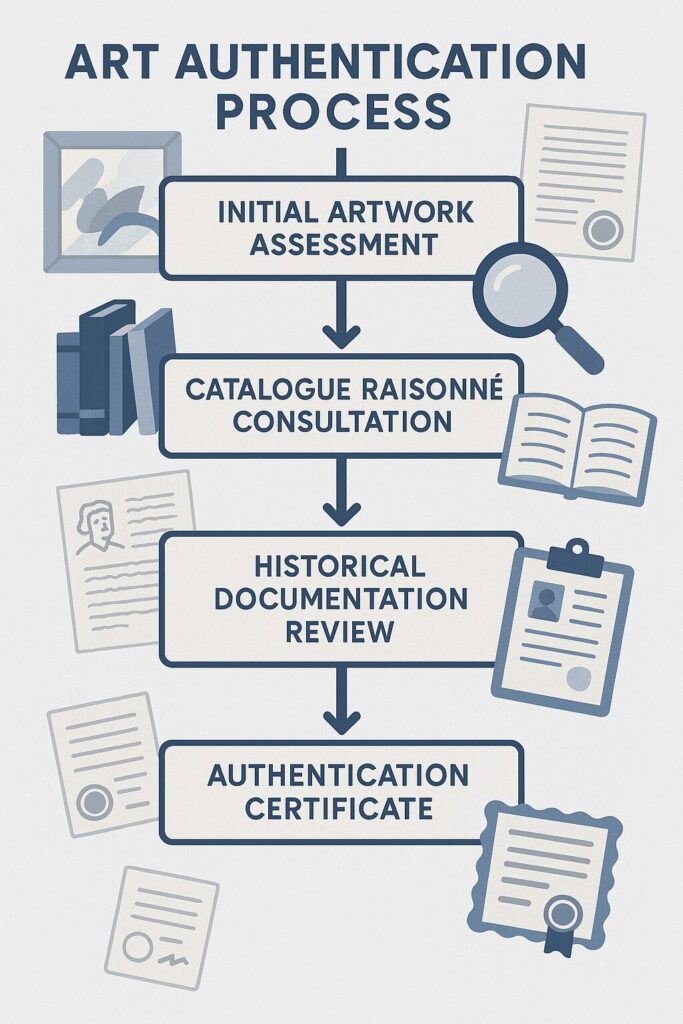
Art authentication methods have evolved far beyond simply looking at a painting and deciding if it “looks right.” Today’s authentication process combines traditional scholarship with cutting-edge science, and the catalogue raisonné sits at the center of this complex investigation.
The authentication process typically follows these steps:
| Step | Method | Purpose |
|---|---|---|
| Initial Assessment | Visual examination | Identify obvious red flags |
| Catalogue Consultation | Research existing documentation | Find previous authentication records |
| Provenance Research | Historical documentation review | Trace ownership history |
| Scientific Analysis | Technical examination | Analyze materials and techniques |
| Expert Opinion | Specialist consultation | Get authoritative attribution |
When art experts begin investigating a questionable artwork, they first check if it appears in the relevant catalogue raisonné. This reference provides crucial documentary proof about the work’s history, including where it’s been exhibited, who has owned it, and what other scholars have said about it.
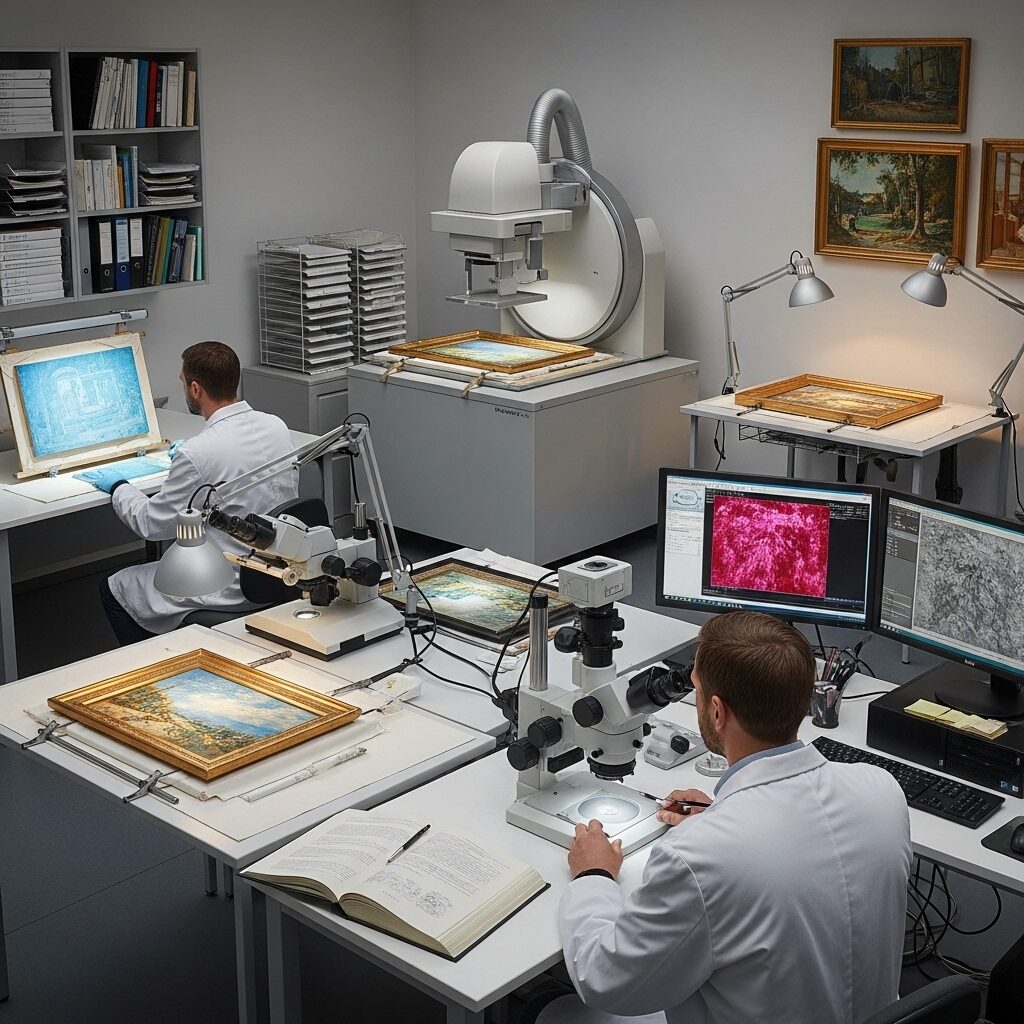
But catalogue raisonnés don’t work alone. Modern authentic artwork verification combines this scholarly research with scientific methods for art authentication. Experts might use X-rays to see underlying paint layers, analyze pigments to confirm they match the artist’s period, or examine brush strokes under microscopes.
The art authentication process also involves consulting with artist estates, museums, and other experts who specialize in that particular artist’s work. These authentication boards often have the final say in whether a work gets included in the official catalogue raisonné.
Authentication isn’t just about proving what’s real – it’s about protecting the entire art ecosystem from fraud and ensuring that genuine artistic legacies are preserved for future generations.”
Dr. Sarah Mitchell, Art Authentication Expert
Are They Always Right? When Authentication Goes Wrong
Despite their scholarly reputation, catalogue raisonnés are created by humans, and humans make mistakes. Some of the art world’s most expensive errors have involved works that were incorrectly included in or excluded from these authoritative publications. These authentication failures serve as important reminders that even expert scholarship isn’t infallible.
The Van Gogh Museum’s $10 Million Mistake
In 2013, the Van Gogh Museum in Amsterdam made headlines when they had to admit that a painting they had authenticated and displayed for years wasn’t actually by Vincent van Gogh. “Sunset at Montmajour” had been excluded from the official Van Gogh catalogue raisonné for decades before new research seemed to prove its authenticity. The museum celebrated the “discovery” with great fanfare, only to face embarrassment when further investigation revealed serious doubts about the attribution.
The Knoedler Gallery Scandal
One of the most shocking authentication failures involved the prestigious Knoedler Gallery in New York. For over a decade, they sold paintings attributed to famous Abstract Expressionist artists like Jackson Pollock and Mark Rothko, with some works appearing to have scholarly support. The scandal broke when it was discovered that all the paintings were sophisticated forgeries created by a single forger in Queens. The gallery closed in 2011 after 165 years in business, and collectors lost over $80 million.
Monet’s Changing Fortune
A painting called “Effet de Neige” spent years being rejected by Monet catalogue raisonné committees. Collectors couldn’t get insurance, and auction houses wouldn’t sell it. Then, in 2014, new research and scientific analysis proved it was indeed authentic. The painting’s value jumped from around $200,000 to over $15 million virtually overnight, simply because scholarly opinion changed.
The Basquiat Authentication Crisis
The Jean-Michel Basquiat authentication committee dissolved in 2012 after facing multiple lawsuits from collectors whose works were rejected. The committee had refused to authenticate numerous paintings, leaving owners with potentially worthless canvases. Some of these rejected works later sold for millions when alternative authentication methods proved their legitimacy.
These cases highlight several problems with the traditional authentication system:
Personal Biases: Authentication committees sometimes include dealers or collectors with financial interests in limiting an artist’s authenticated works to maintain scarcity and high prices.
Conservative Approach: Committees often prefer to err on the side of caution, rejecting questionable works rather than risk including a fake. This protects their reputation but can harm owners of legitimate pieces.
Limited Scientific Analysis: Traditional authentication relied heavily on visual analysis and documented provenance, sometimes ignoring scientific evidence that could prove authenticity.
Legal Liability: Fear of lawsuits has led some authentication boards to become overly restrictive or to dissolve entirely.
The solution isn’t to abandon catalogue raisonnés but to understand their limitations. Smart collectors now seek multiple forms of authentication evidence, combining scholarly opinion with scientific analysis and thorough provenance research methods.
Market Impact: How Authentication Affects Art Value
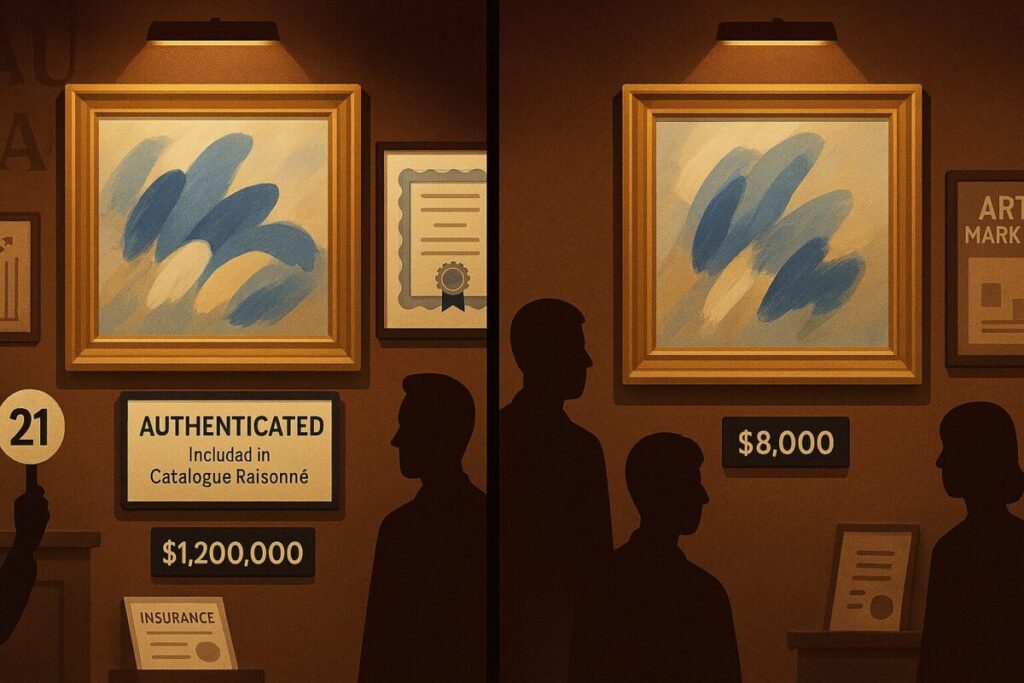
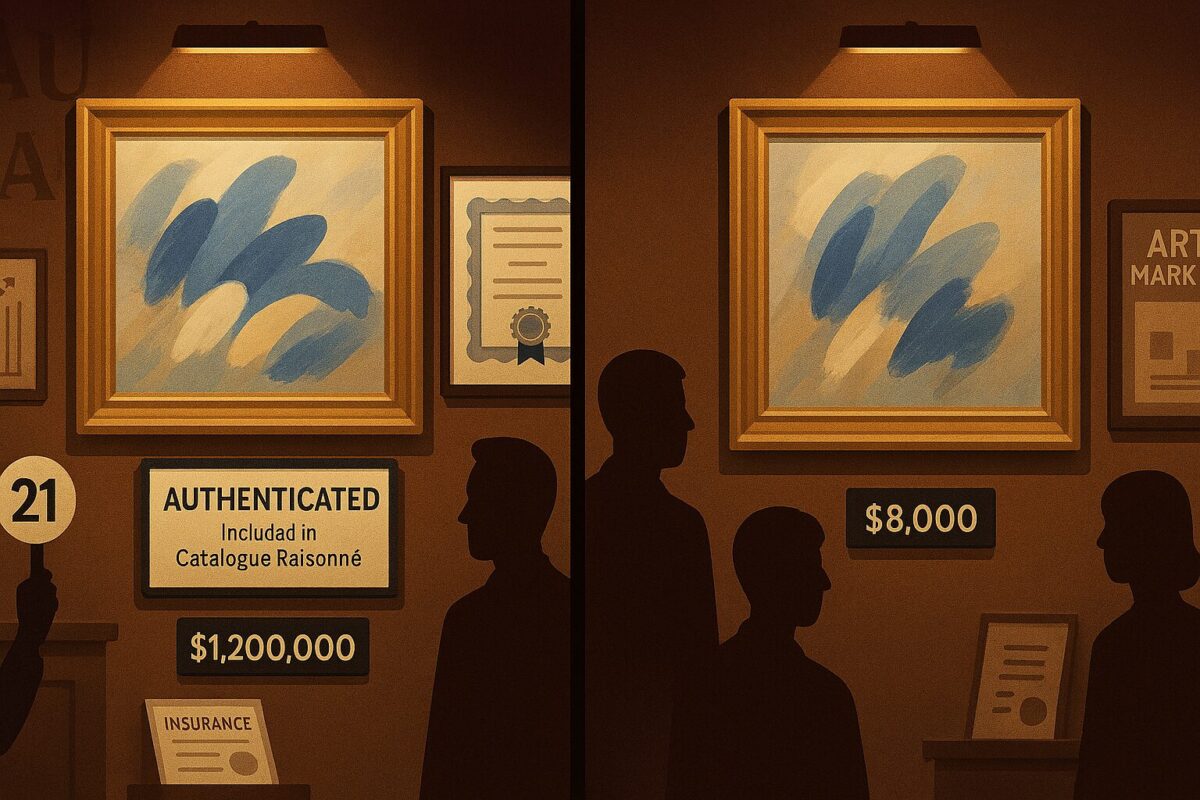
Money talks in the art world, and nowhere is this more obvious than when examining how art market authentication affects prices. A painting included in a catalogue raisonné can be worth ten times more than an identical work that lacks this scholarly approval.
Consider this real-world example: Two paintings that appear to be by the same famous artist come up for auction. One is included in the artist’s catalogue raisonné with full provenance documentation. The other has questionable origins and no scholarly authentication. The authenticated piece might sell for $2 million, while the unverified work struggles to reach $200,000 – even if they’re virtually identical to the untrained eye.
This dramatic price difference reflects several market realities:
Insurance and Legal Protection: Museums and serious collectors need authentication certificates for insurance purposes. Without proper documentation, artwork becomes nearly impossible to insure at full value.
Resale Confidence: Future buyers want assurance that they’re purchasing genuine works. Current art market trends show increasing demand for thoroughly documented artworks.
Due Diligence Requirements: Auction houses and galleries now face legal liability if they sell fake works. Catalogue raisonné inclusion provides crucial legal protection.
Investment Security: Art collectors increasingly view authenticated pieces as safer long-term investments, driving up demand and prices for properly documented works.
The financial stakes explain why some catalogue raisonné projects receive funding from collectors and dealers who own significant works by particular artists. Everyone benefits when authenticity gets properly established and documented.
Understanding what makes paintings valuable helps explain why authentication carries such weight in determining market prices.
Modern Developments: Digital Revolution in Authentication
The digital age is transforming how catalogue raisonnés work, making art authentication provenance research more accessible and comprehensive than ever before. Traditional printed volumes are giving way to interactive online databases that can be updated in real-time as new discoveries emerge.
Digital catalogue raisonnés offer several advantages over their printed predecessors:
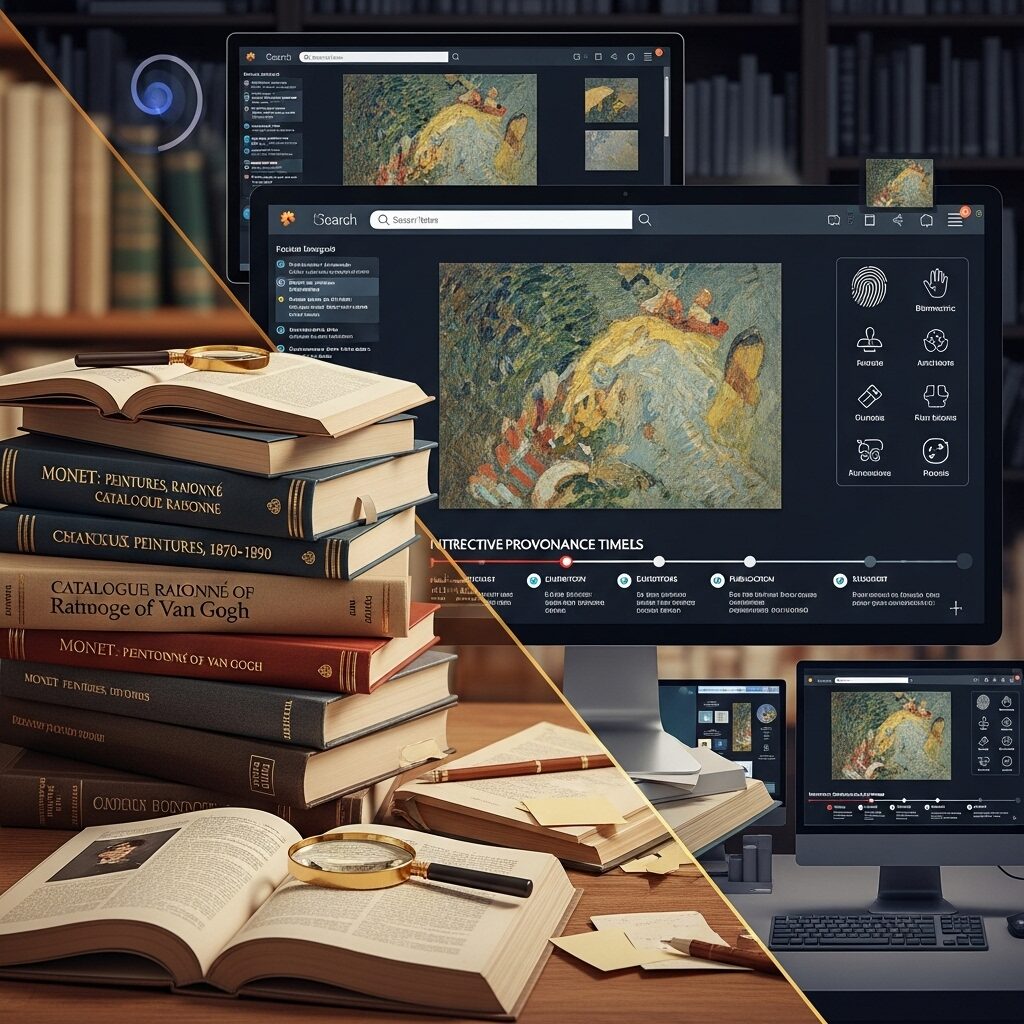
Searchable Databases: Instead of flipping through hundreds of pages, researchers can instantly search by date, size, subject matter, or current location.
High-Resolution Images: Online versions can display artwork details that would be impossible to reproduce in print, allowing for more detailed analysis.
Regular Updates: When new works are discovered or attributions change, digital catalogs can be updated immediately rather than waiting for a new print edition.
Global Access: Scholars worldwide can access the same information simultaneously, improving international collaboration in authentication research.
Some cutting-edge projects are even experimenting with blockchain technology to create tamper-proof authentication records. These systems could eventually provide an unalterable digital chain of ownership that follows artworks throughout their entire history.
Artificial intelligence is also beginning to play a role in authentication. Computer programs can analyze thousands of artworks by the same artist, identifying subtle patterns in brushwork or composition that might escape human notice. While AI can’t replace human expertise, it provides valuable supporting evidence for authentication decisions.
The International Foundation for Art Research (IFAR) maintains one of the most comprehensive authentication databases, combining traditional scholarship with modern technology to serve museums, collectors, and researchers worldwide.
These technological advances are making authentication more democratic. Previously, only major museums and wealthy collectors could afford comprehensive provenance research. Now, anyone with internet access can begin researching their artwork’s history and authenticity.
For collectors interested in building their knowledge, understanding how to identify different art movements can provide valuable context for authentication decisions.
The Future of Art Authentication Provenance
As we look ahead, art authentication provenance will continue evolving with new technologies and methodologies. The catalogue raisonné remains the gold standard, but it’s becoming part of a larger ecosystem that includes scientific analysis, digital documentation, and global collaboration.
For art collectors, understanding the importance of catalogue raisonnés is essential for making informed purchasing decisions. Whether you’re buying your first painting or building a major collection, always ask about authentication and documentation. Look for works that appear in established catalogue raisonnés, and be cautious of pieces with incomplete or questionable provenance.
The art world’s commitment to authentication protects everyone involved – artists’ legacies remain intact, collectors make sound investments, and cultural heritage gets preserved for future generations. As authentication methods continue advancing, the catalogue raisonné will undoubtedly adapt and evolve, but its fundamental purpose will remain unchanged: serving as the authoritative record that separates authentic masterpieces from convincing copies.
Remember, in art authentication, documentation isn’t just helpful – it’s absolutely crucial for establishing trust, value, and authenticity in an industry where millions of dollars can hang on a single scholarly opinion. However, smart collectors understand that even the most respected art authentication provenance sources can make mistakes, making it essential to seek multiple forms of verification when investing in significant artworks.
FAQs: Art authentication provenance
What is a catalogue raisonné in art authentication? A catalogue raisonné is a comprehensive scholarly publication that documents every known work by a specific artist, providing detailed information about each piece’s creation, ownership history, and authenticity. It serves as the primary reference for art authentication and provenance research.
How does provenance research authenticate artwork? Provenance research traces an artwork’s complete ownership history from creation to present day. By documenting the chain of ownership through historical records, exhibition catalogs, and sales receipts, researchers can verify authenticity and identify potential red flags that might indicate forgery.
Why are catalogue raisonnés important for art collectors? Catalogue raisonnés provide collectors with essential authentication that significantly affects artwork value, insurability, and resale potential. Inclusion in a catalogue raisonné offers legal protection and market confidence that can increase an artwork’s value by several times.
How long does art authentication take? Art authentication timelines vary widely depending on the complexity of the research required. Simple cases might take a few weeks, while comprehensive authentication involving multiple experts and scientific analysis can take months or even years to complete.
Can you authenticate art online? While initial research can be conducted online through digital catalogue raisonnés and databases, complete authentication typically requires physical examination by qualified experts. Online resources are valuable starting points but shouldn’t replace professional authentication services.
What happens if artwork is found to be fake? If artwork is discovered to be inauthentic after purchase, legal remedies may be available depending on the circumstances of the sale. Many reputable dealers and auction houses offer guarantees of authenticity and will provide refunds for proven forgeries within specified time periods.
Additional Resources
- International Foundation for Art Research (IFAR) – Comprehensive art authentication database and research services
- Art Loss Register – Database of stolen and missing artworks worldwide
- Getty Research Institute – Scholarly resources for art historical research
- Smithsonian Institution Research – Museum-quality authentication and conservation resources
- College Art Association – Professional organization for art historians and authentication experts
- Association of Art Museum Directors – Guidelines and standards for museum authentication practices
- Authentication in Art (AiA) – Legal and scholarly resources for art authentication disputes