
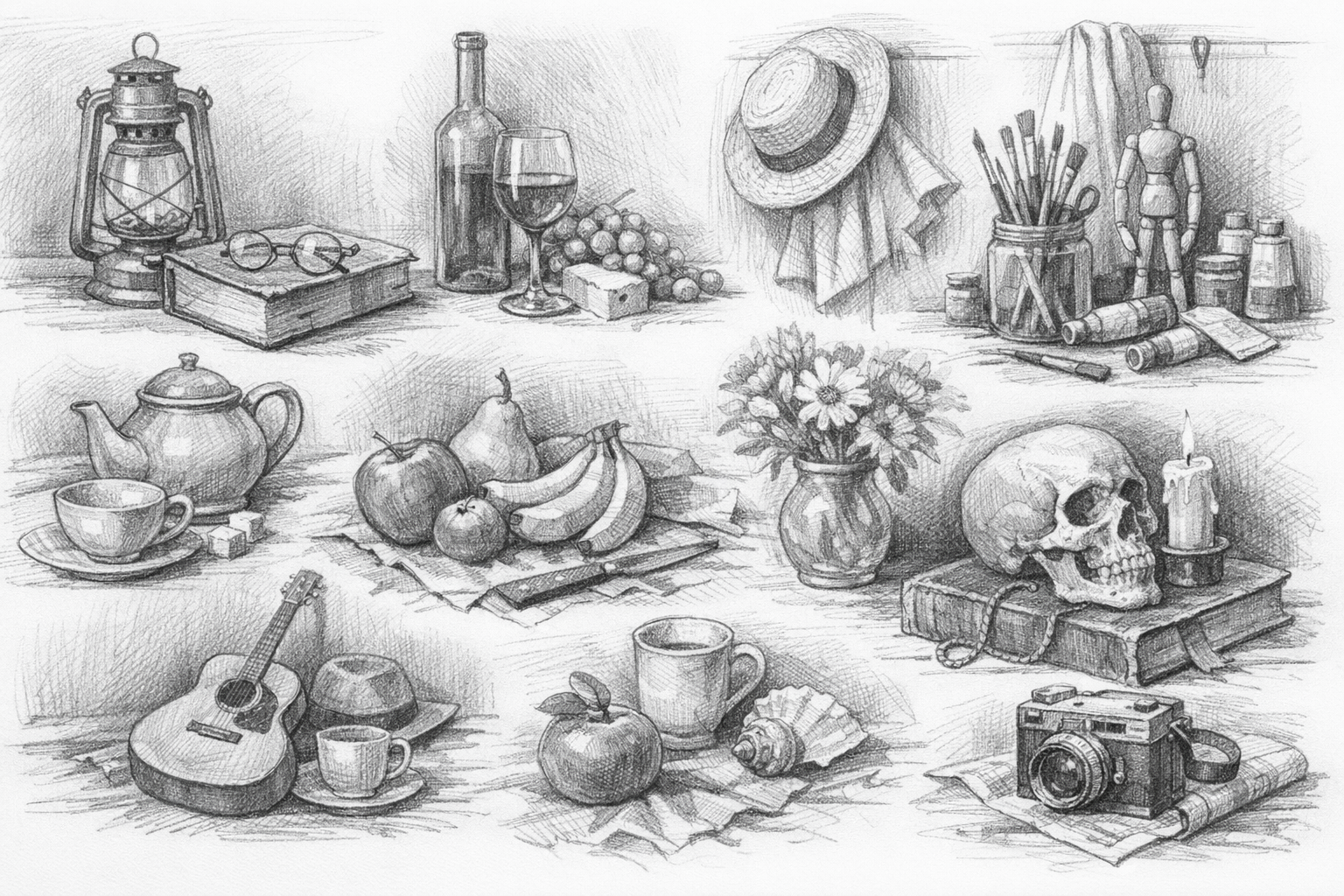
Summary: Finding fresh still life drawing ideas often feels harder than the actual drawing process. This post breaks down fifteen accessible concepts to help you build composition skills and master lighting. Grab your sketchbook and start looking at everyday clutter as your next great artistic challenge.
You stare at a blank page. The graphite feels heavy in your hand. Finding compelling still life drawing ideas is a notorious hurdle for beginners. You do not need a classical fruit bowl or a skull to practice fundamental skills. The best subjects are already sitting on your desk. Still life practice forces you to slow down. It trains your eyes to see shapes instead of labels. According to the Tate gallery, this genre historically allowed artists to experiment with composition and lighting without the pressure of a live model. We will explore fifteen practical concepts to elevate your daily sketching routine. These ideas focus on accessibility. You will learn to manipulate light, group objects, and find beauty in the mundane.
What Are the Best Everyday Objects for Still Life Drawing Ideas?

The best everyday objects for still life drawing ideas are simple items with varied textures, such as crumpled paper, metallic spoons, and glass jars. These ordinary items provide excellent practice for capturing reflections, mastering shadows, and understanding basic geometric forms.
Start with the things you touch daily. A coffee mug offers a perfect cylinder. A pair of reading glasses challenges your perspective skills. Keys provide intricate, hard-edged details. These items are brilliant for mastering still life drawing techniques. They remove the intimidation factor.
- 1. The Morning Coffee Ritual: Draw your mug, spoon, and a crumpled napkin.
- 2. Pocket Dump: Arrange your keys, coins, and wallet.
- 3. The Workspace: Sketch your computer mouse alongside a tangled charging cable.
Lighting Techniques That Transform Simple Shapes
Lighting dictates the mood of your artwork. A flatly lit apple looks like a cartoon. An apple lit by a single, strong directional light becomes a dramatic study in volume. You need to manipulate your light source. Use a simple desk lamp to create hard cast shadows. This helps in mastering shadow in art.
Move the lamp around your setup. Notice how the core shadow shifts. The Museum of Modern Art notes that dramatic lighting was a cornerstone of early modernist still life studies.
- 4. Single Spotlight: Place a desk lamp directly above a single piece of fruit.
- 5. Window Backlight: Position a glass bottle in front of a sunny window to study translucency.
- 6. Candlelight: Use a small candle to cast warm, flickering shadows on a metallic object.
How Do You Create a Meaningful Still Life Composition?
You create a meaningful still life composition by arranging objects in odd numbers, varying their heights, and establishing a clear focal point. Using overlapping shapes creates depth, while negative space guides the viewer’s eye through the arrangement naturally.
Do not just line things up like soldiers. You must consider the essential elements of composition. Overlap a tall vase with a short cup. Let a piece of fabric drape off the table. This creates visual pathways.
- 7. The Triangle Setup: Arrange three objects of different heights into a pyramid shape.
- 8. The Storyteller: Group items that belong to a specific person, like gardening gloves and a trowel.
- 9. The Top-Down View: Arrange tools flat on a table and draw them from a bird’s-eye perspective.
Can Organic Textures Improve Your Shading Skills?
Yes, drawing organic textures dramatically improves your shading skills because natural objects lack perfect symmetry. Items like tree bark, woven baskets, or root vegetables force you to observe subtle tonal shifts rather than relying on formulaic shading patterns.
Nature offers endless complexity. A simple potato has more surface variation than a plastic ball. Drawing these imperfections builds confidence. It forces you to look closely. The Royal Academy of Arts frequently highlights the importance of observational drawing from raw nature.
- 10. The Kitchen Vegetable: Draw a garlic bulb with its papery skin.
- 11. Houseplants: Focus on the overlapping leaves of a potted succulent.
- 12. Foraged Finds: Sketch a pinecone or a textured rock you found outside.
Breaking the Rules with Unconventional Angles
Change your physical position. We usually draw things from a standard seated angle. This limits your perspective. Stand up and look down. Put the objects on the floor and lie next to them. Changing your viewpoint completely alters the shapes you see. It is a fantastic method for understanding rhythm in art by changing how forms interact.
A shoe looks entirely different from the bottom. A chair becomes a complex grid of lines when viewed from underneath. Force your brain to interpret unfamiliar angles.
- 13. The Ant’s View: Place an object on a table and draw it while sitting on the floor.
- 14. The Extreme Close-Up: Zoom in so close that the object becomes unrecognizable and abstract.
- 15. The Inside Out: Draw the interior of a complex object, like an open mechanical watch or a halved bell pepper.
You have everything you need right in front of you. Finding the right subject is simply about changing your perspective. Stop waiting for the perfect vase of flowers. Grab a pencil and draw the device you are reading this on. Commit to sketching one ordinary item today. Your skills will improve with every mark you make on the page. Now, set up your desk lamp and get to work.
What should I draw today?
FAQs: Still Life Drawing Ideas
What pencil is best for a beginner still life?
A standard HB pencil is perfect for sketching outlines. You should also keep a 2B or 4B pencil nearby to push your dark shadows. This combination allows for a full range of values.
How long should a still life drawing take?
A quick study can take ten minutes. A highly detailed rendering might take several hours. Beginners should aim for twenty-minute sessions to build a habit without feeling overwhelmed.
Do I need a formal easel to draw a still life?
No. A simple sketchbook resting on your lap or a flat desk works perfectly. The most important thing is keeping your paper at a comfortable angle to avoid distortion.
How do I stop my drawings from looking flat?
You must increase your contrast. Push your darkest shadows darker and leave your highlights completely white. Flat drawings usually suffer from having too many mid-tones.
Can I use photographs for still life drawing ideas?
Drawing from life is always superior because you see the true three-dimensional form. Photographs flatten the image and distort shadows. Use photos only when drawing from life is absolutely impossible.

Olly
Olly Farmer M.Sc, B.Sc, PGCE 25 years experience of Watercolor Painting and AI Art; teacher for 13 years; Creator of Art Tools; Art Gallery Contributor of Art Articles to Medium.com, LinkedIn and Facebook
Continue exploring

PROMINENT PAINTING
Keep your creative momentum
Get new painting guides, practical techniques and artist stories delivered without the noise.
Occasional emails. Unsubscribe whenever you like.