Summary: Staring at a blank canvas is intimidating. The grid method eliminates the fear of poor proportions by breaking complex references into manageable squares. This guide covers how to scale photos accurately, choose the right tools, and use the upside-down drawing trick. You will learn how to transfer your reference photo perfectly so you can focus purely on painting.
Staring at a blank white canvas can paralyze even the most enthusiastic beginner. You have a beautiful reference photo. You know exactly what you want to paint. But the thought of free-handing a complex subject and getting the proportions totally wrong stops you before you even pick up a brush.
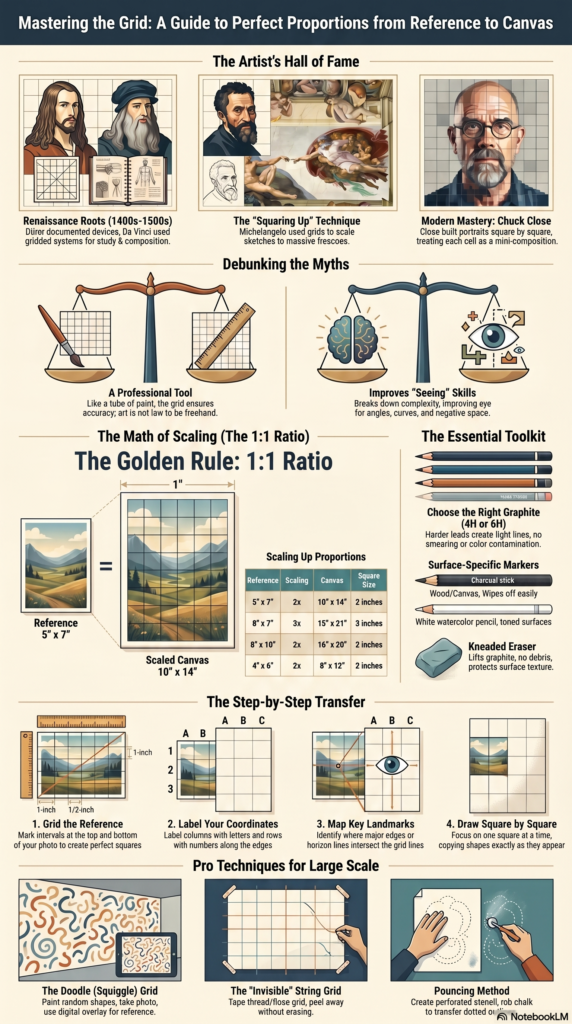
This fear is completely normal. Even the old masters struggled with scale. Leonardo da Vinci used physical string grids to map out his compositions accurately. You do not need to be a human photocopier to create stunning art. You just need a reliable system.
The grid method is a classic technique that guarantees perfect proportions. It bridges the gap between studying anatomy and executing a complex piece. By dividing your reference photo into small squares, you stop looking at an overwhelming whole. Instead, you focus on simple lines and shapes inside a tiny box. This is the ultimate tool to demystify painting and empower people to start creating without intimidation.
Here is how to set up your grid, scale your image without distortion, and secure a guaranteed win on your canvas.
What Is the Grid Method in Art?
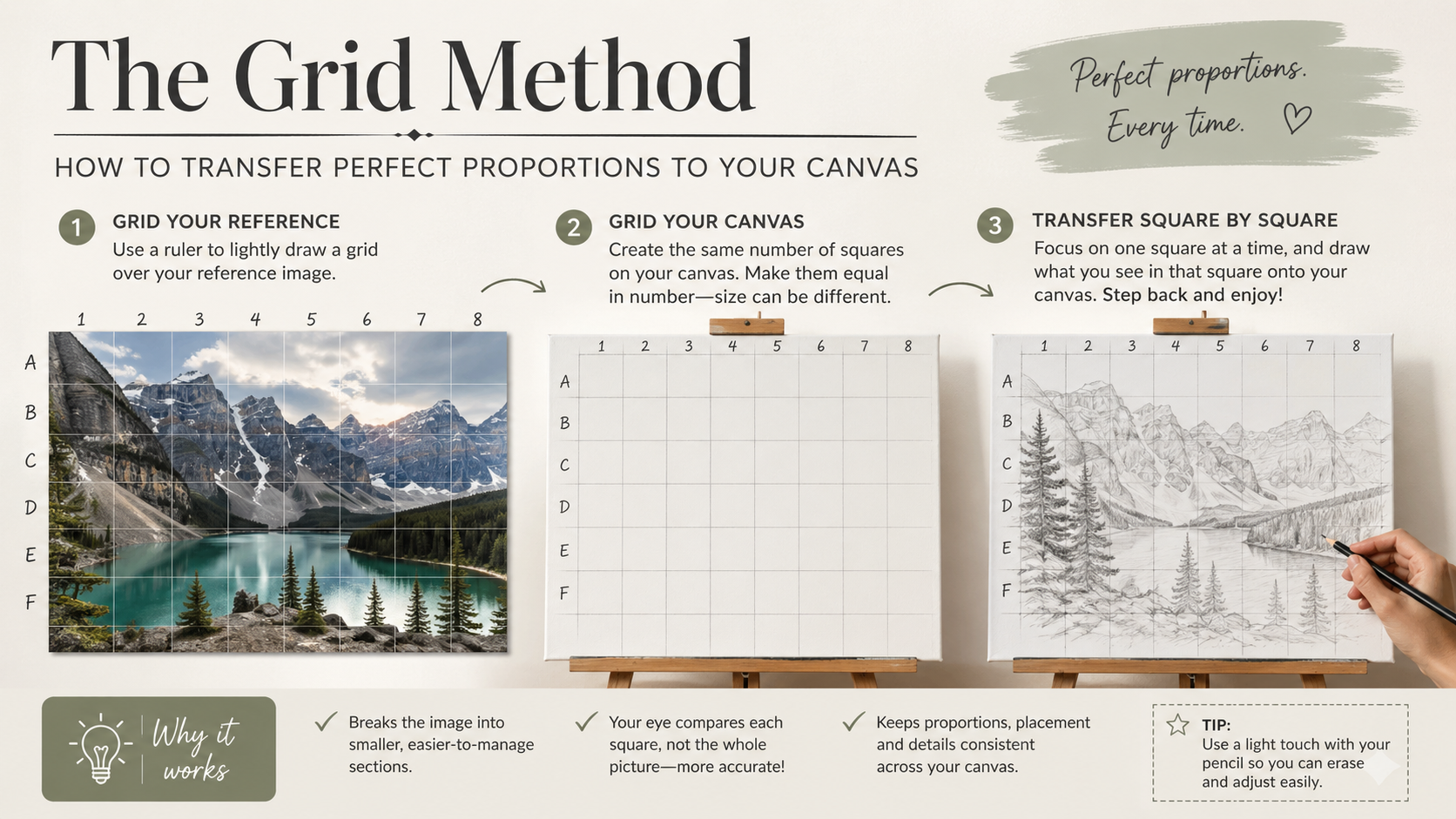
The grid method is a scaling technique that involves drawing a grid over a reference photo and a matching proportional grid on your working canvas. You then copy the image square by square. This breaks complex subjects into small, manageable pieces and ensures perfect proportions.
When you look at a portrait, your brain panics. When you look at a single square containing a curved line, your brain says it can handle that. This approach is heavily featured in drawing for beginners because it removes guesswork. You simply replicate what you see in square A1 onto square A1 of your canvas.
How Do You Calculate Grid Proportions?
You calculate grid proportions by matching the ratio of your reference photo to your canvas size. If your photo is 4×6 inches, the ratio is 2:3. You can scale this perfectly to an 8×12 or 16×24 inch canvas without distorting the image.
Math can feel counterintuitive to creativity. However, getting your ratio right is vital. If your photo is a square, your canvas must be a square. If your ratios do not match, you will have to crop your image or deal with awkward blank space.
| Reference Photo Size | Aspect Ratio | Matching Canvas Sizes |
| 4×6 inches | 2:3 | 8×12, 12×18, 16×24, 24×36 |
| 5×7 inches | 5:7 | 10×14, 15×21, 20×28 |
| 8×10 inches | 4:5 | 11×14 (approx), 16×20, 24×30 |
Once your proportions match, draw a 1-inch grid on your photo. Then, draw a proportionally larger grid on your canvas. For a 4×6 photo scaling to a 16×24 canvas, each 1-inch square on the photo becomes a 4-inch square on the canvas.
The Upside Down Drawing Trick
Beginners often struggle because their brain interferes with their eyes. When you draw an eye, your brain wants to draw a generic almond symbol. It ignores the actual unique shapes in front of you.
To fix this, turn your gridded reference photo and your canvas upside down.
This simple psychological trick forces your brain to stop recognizing the subject. The face becomes a meaningless collection of abstract lines and shadows. You will find yourself copying the exact angles perfectly. This technique is incredibly helpful when learning how to draw faces.
What Pencil Should You Use for a Canvas Grid?
The best pencil for a canvas grid is a hard graphite pencil like a 2H or 4H, or a light watercolor pencil. These create very faint lines that will not smudge easily or mix into your paint layers later.
Never use a standard HB or 2B pencil for your grid. The soft graphite will turn to a muddy gray paste the moment wet paint touches it. As part of your canvas preparation, keep your grid lines whisper-thin. You only need to see them just enough to guide your drawing.
Erasing the Evidence and Starting to Paint
Once your sketch is transferred, you might want to remove the grid. If you painted with a watercolor pencil, a damp brush will melt the lines away. If you used hard graphite, gently dab the lines with a kneaded eraser to lighten them before applying paint.
Do not scrub the canvas. Scrubbing damages the tooth of the surface. Once the grid is faint, you can confidently move from sketch to first painting knowing your framework is flawlessly accurate.
Next Steps for Your Canvas
As an arts educator, I have seen hundreds of students transform their confidence using this simple tool. Stop letting the fear of a blank canvas hold you back. Grab a ruler, draw your grid, and start your next piece today. Download a free grid overlay app for your phone, map out your favorite reference, and share your initial sketches in our community gallery.
Your First Grid Method Exercise: The 4×4 Apple
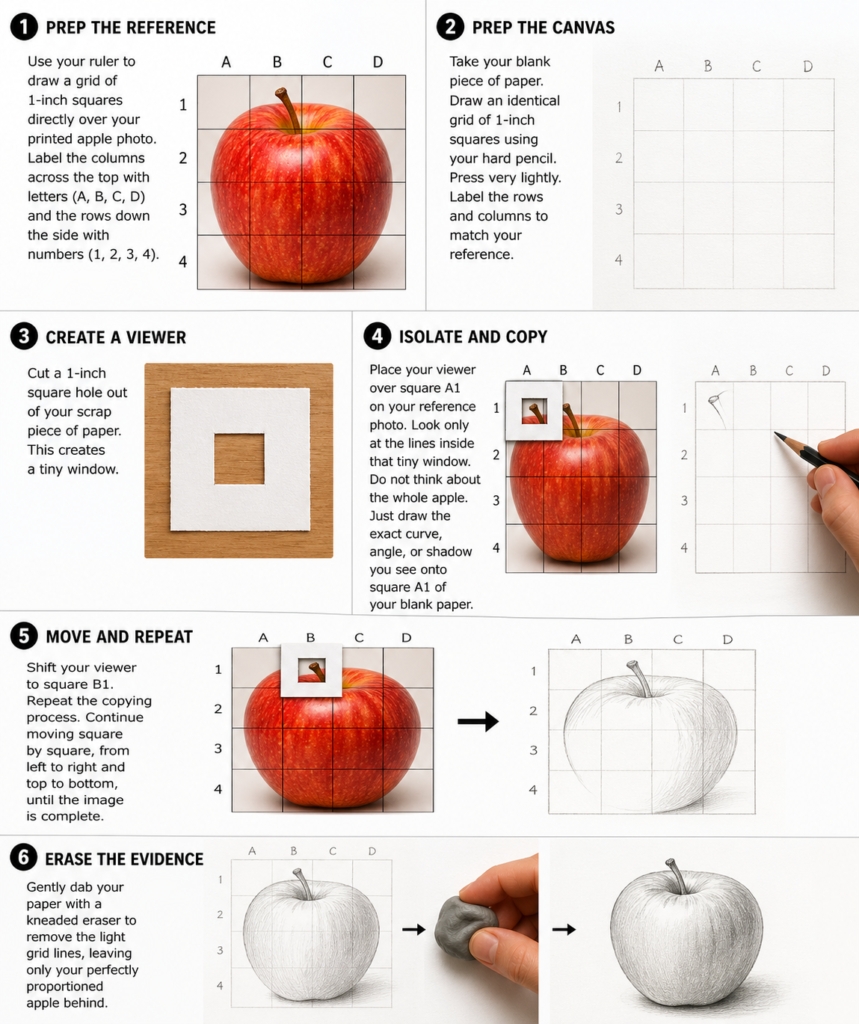
Let us start with something completely stress-free. This simple exercise proves how easily you can capture perfect proportions without guessing. By focusing on one small box at a time, you trick your brain into drawing exactly what is there rather than what you think should be there.
What You Need
- A simple printed photo of an apple (roughly 4 by 4 inches in size)
- A ruler
- A hard pencil (like a 2H) for drawing your grid lines
- A standard pencil (like an HB) for sketching the subject
- A blank piece of drawing paper
- A small scrap piece of paper
Step-by-Step Instructions
- Prep the Reference: Use your ruler to draw a grid of 1-inch squares directly over your printed apple photo. Label the columns across the top with letters (A, B, C, D) and the rows down the side with numbers (1, 2, 3, 4).
- Prep the Canvas: Take your blank piece of paper. Draw an identical grid of 1-inch squares using your hard pencil. Press very lightly. Label the rows and columns to match your reference.
- Create a Viewer: Cut a 1-inch square hole out of your scrap piece of paper. This creates a tiny window.
- Isolate and Copy: Place your viewer over square A1 on your reference photo. Look only at the lines inside that tiny window. Do not think about the whole apple. Just draw the exact curve, angle, or shadow you see onto square A1 of your blank paper.
- Move and Repeat: Shift your viewer to square B1. Repeat the copying process. Continue moving square by square, from left to right and top to bottom, until the image is complete.
- Erase the Evidence: Gently dab your paper with a kneaded eraser to remove the light grid lines, leaving only your perfectly proportioned apple behind.
Ready to Map Your Masterpiece?
Ready to test the grid method without drawing all over your original reference photo? I built this free interactive grid generator to make your setup process completely stress-free.
Upload your favorite image right from your phone or computer. You can adjust the square size and change the line color so it stands out perfectly against your subject.
Once it looks right, just hit print. You will have a flawless template ready to guide your perfect proportions on canvas. Give it a try below.
Interactive Grid Maker
Artists Who Used the Grid Method
| Artist Name | Era / Movement | How They Used the Grid Method |
|---|---|---|
| Albrecht Dürer | Northern Renaissance | Dürer built a physical "perspective machine." He placed a glass frame strung with a grid of black threads between himself and his subject to trace and map perfect proportions onto his gridded paper. |
| Leonardo da Vinci | High Renaissance | Da Vinci used a drawing frame divided by strings to study complex foreshortening. This allowed him to accurately scale human anatomy and architecture before committing to the final canvas. |
| Vincent van Gogh | Post-Impressionism | Van Gogh struggled with perspective early in his career. He built a custom wooden frame with wire strung across it, taking it out into fields to accurately map out his famous sweeping landscapes. |
| Chuck Close | Photorealism | Close is the ultimate modern master of the grid. He drew grids over small reference photos and scaled them up to massive canvases. He painted square by square to create towering, hyper-realistic portraits. |
Frequently Asked Questions
Is using the grid method considered cheating in art?
No. The grid method is a traditional tool used by professional artists and old masters for centuries. It is a legitimate technique for learning proportions and training your eye.
Can I use an app to put a grid on my photo?
Yes. There are many free grid overlay apps available for smartphones and tablets. These allow you to apply a perfect digital grid over your reference photo without printing it out.
How do I hide the grid lines in my final painting?
Draw your grid very lightly using a hard pencil. You can also dab the lines with a kneaded eraser before painting to make them barely visible. Opaque paints like acrylic or oil will cover them easily.
What if my canvas size does not match my photo ratio?
You must crop your reference photo to match the canvas ratio before adding the grid. Otherwise, your squares will become rectangles and your drawing will stretch and distort.
Does the grid method work for watercolor painting?
Yes, but you must be extremely careful. Watercolors are transparent, so dark grid lines will show through. Use a very light watercolor pencil so the grid dissolves into your first wash.