Summary This guide teaches beginners how to complete an oil painting in a single session using the alla prima technique. You will learn how to bypass frustrating drying times, apply the thick over thin rule, and avoid creating muddy colors. Set up a small canvas this weekend and leave your studio with a fully finished piece.
Block out just two hours this weekend. Set up a small canvas, grab your oils, and commit to leaving the room with a finished piece. You do not have to wait weeks for layers to dry. You do not have to abandon half-finished canvases to the dusty corner of your studio. The secret is a technique that captures your immediate creative energy and bottles it in one session. We are talking about alla prima. This method strips away the intimidating, multi-week drying rules. It empowers you to start creating without intimidation and finish a beautiful piece before your motivation fades. If you want to experience the sheer joy of spontaneous brushwork, this guide will show you exactly how to do it.
What Is Alla Prima Painting?
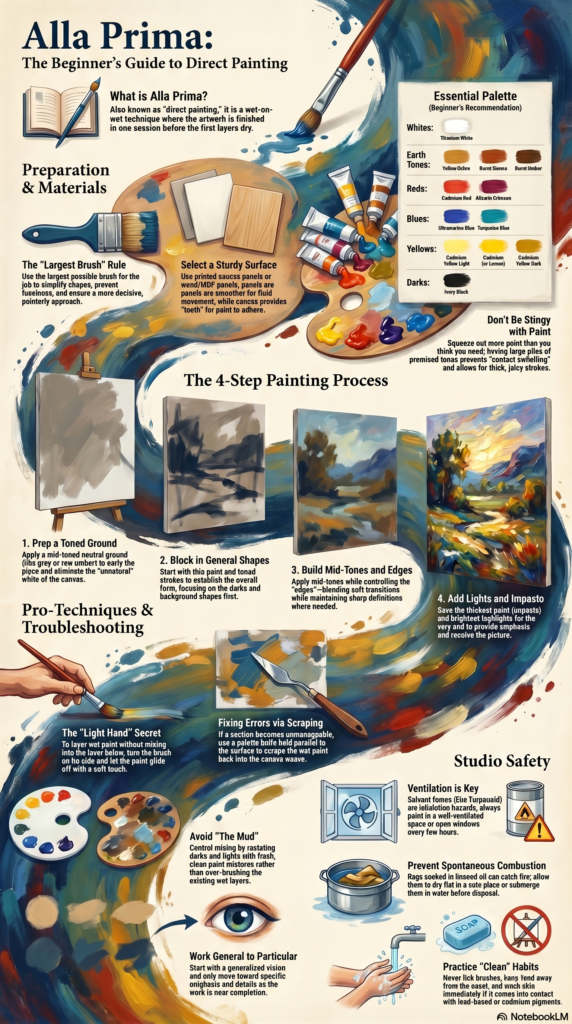
Alla prima is an oil painting technique where the entire artwork is completed in a single session while the paint is still wet. Translated from Italian as “at first attempt,” it is also commonly known as the wet-on-wet technique.
This approach removes the tedious wait times associated with traditional layering. Instead of building up glazes over weeks, you apply fresh paint directly into wet paint. This allows for spontaneous, expressive brushwork. It is the perfect antidote for artists who struggle with patience.
Why Do Beginners Struggle With Traditional Oil Painting?
Beginners often struggle with traditional oil painting because the required drying time between layers kills their creative momentum. Waiting days or weeks to add the next layer leads to lost inspiration and abandoned, half-finished canvases.
When you are just starting, you want to see results. You have an image in your head and the energy to create it right now. The wet-on-wet method solves this pacing issue. By finishing the piece in one sitting, you bypass the complicated drying timelines. If you are exploring oil painting for beginners, adopting this fast-paced method can completely transform your practice.
The Crucial Thick Over Thin Rule
Even in a single session, you need a loose roadmap to keep your paints from sliding off the canvas. You must follow a basic principle: paint thick over thin. This is one of the foundational rules of oil painting.
Your first foundational strokes should be very thin. Use a solvent to thin your paint for these initial block-ins. As you progress, gradually use thicker paint with less solvent. The final highlights should be applied with thick, buttery paint straight from the tube. This ensures the heavy highlights sit beautifully on top without mixing into the wet layers below.
How Do You Prevent Muddy Colors When Painting Wet-On-Wet?
You prevent muddy colors in wet-on-wet painting by thoroughly wiping your brush on a rag between every single stroke. Avoid over-blending directly on the canvas, which quickly turns vibrant, distinct colors into a dull, muddy grey.
This is a matter of discipline. It is tempting to push the paint around on the canvas to soften edges. Resist that urge. Mix your colors cleanly on the palette, place the stroke confidently on the canvas, and leave it alone. If you are trying to mix realistic skin tones, wiping your brush is mandatory to keep the values clean. Make a habit of keeping a paper towel in your non-dominant hand at all times.
Choosing the Perfect Canvas Size
Your canvas size dictates your timeline. If you choose a massive canvas, you will simply run out of energy before the session is over. We recommend keeping alla prima studies very small.
An 8×10 canvas or a simple 6×6 panel is perfect. These dimensions guarantee you can actually cover the entire surface and refine the details in a couple of hours. Proper canvas preparation also helps; a smooth, well-primed surface allows the brush to glide easily. Pick a small surface, select the right types of paint brushes, and set yourself up for an easy win.
You now have the tools to bypass the waiting game. Oil painting does not require a month of patience or a complicated drying schedule. It just requires a small canvas, a rag to wipe your brush, and the courage to lay down thick paint. Clear off your desk this Saturday morning. Squeeze out your primary colors and commit to a single, focused session. Paint until it is done, sign your name, and step back to admire your work.
Famous Alla Prima Artists
| Artist | Era / Movement | Notable Alla Prima Characteristics |
|---|---|---|
| John Singer Sargent | 19th–20th Century / Impressionism & Realism | Renowned for his exceptional technical facility and ability to draw with a brush. He applied swift, confident strokes directly into wet paint to capture the essence and texture of his subjects in single sessions. |
| Frans Hals | 17th Century / Dutch Golden Age | Considered a pioneer who popularized the technique during the Baroque era. He perfected a loose, fluent, and highly expressive style of applying color directly to the canvas without refined underdrawings. |
| Diego Velázquez | 17th Century / Spanish Baroque | A master whose technique heavily influenced later alla prima painters. He used bold brushwork in his character studies and portraits for the Spanish royal court. |
| Vincent van Gogh | 19th Century / Post-Impressionism | Characterized by highly dynamic, loose brushwork and emotive color. He harnessed wet-on-wet applications to blend heavy textures directly on the canvas to express immediate emotions. |
| Claude Monet | 19th–20th Century / Impressionism | Used the wet-on-wet technique extensively while painting plein air, allowing him to quickly capture the fleeting impressions of natural light and bold colors. |
| Édouard Manet | 19th Century / Transition from Realism to Impressionism | Emphasized loose, broken painting strokes and an unrefined look to create a modern alla prima aesthetic. |
| Bob Ross | 20th Century / Contemporary TV Instructor | Highly famous for popularizing the wet-on-wet technique for the general public on television, showing how a painting could be finished in a single application without an underpainting. |
Frequently Asked Questions
What does alla prima mean?
Alla prima is an Italian phrase meaning “at first attempt.” In art, it refers to a painting completed in one single session while the paint is entirely wet.
Do I need special oil paints for wet-on-wet?
No, you do not need special paints. Standard student or professional grade oil paints work perfectly fine. You just need to manage the thickness of the paint as you apply layers.
How long does an alla prima painting take to dry?
Because the paint is applied thickly and all at once, it can take anywhere from a few days to a couple of weeks to be completely dry to the touch. The exact time depends on the ambient humidity and the thickness of your strokes.
Can I use acrylics for the alla prima technique?
While acrylics dry very quickly, you can try a similar one-sitting approach. However, true alla prima relies on the slow-drying nature of oils to allow the paint to blend wet-into-wet on the canvas.
What medium should I use for my first layer?
Use an odorless mineral spirit to thin your paint for the very first layer. This keeps the base layer lean, allowing the subsequent thicker layers of oil paint to adhere properly.