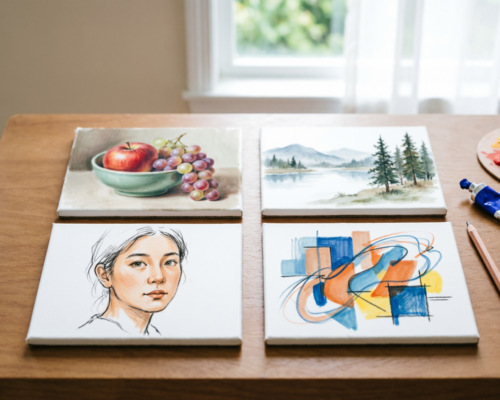
Choosing an art genre for a new project doesn’t need to feel overwhelming. A genre is simply the subject or category of your painting, such as landscapes, portraits, still life, or abstract.
For most beginners, still life is the easiest starting point because you control the setup and the pace. This guide walks you through every major genre, helps you match your personality to the right one, and gives you the confidence to just start painting. 🎨
You’re staring at a blank canvas. You want to paint. But you have no idea what to paint about. Sound familiar? You’re not alone. Choosing an art genre for a new project is one of the first big decisions every new painter faces, and it stops more beginners in their tracks than any brush or paint ever could.
But here’s the thing: it doesn’t need to be complicated. Whether you’re part of the 12.4 million painters in the United States or just starting your creative journey, you’re contributing to a worldwide movement of creative expression. And every single one of those artists had to answer this exact question once. Let’s make it easy for you. By the end of this guide, you’ll know exactly which genre suits you, why it matters, and how to pick up that brush with real confidence.
What Is an Art Genre, Exactly?
An art genre is the category or subject matter of a painting. It describes what you’re painting, not how you’re painting it.
The method of classifying paintings according to genre was established in the early 1600s by the great European Academies and was first formally announced in 1669 by French art theoretician André Félibien. Back then, genres were ranked in a strict hierarchy. History painting sat at the top. Still life sat at the bottom. Today, that ranking means nothing. Every genre is a valid, powerful choice. What matters is which one lights you up.
The five classic painting genres are history and religious painting, portraiture, landscape, everyday-life scenes, and still life. In modern times, abstract painting has become its own major genre too. You can read more about how these categories evolved in our painting genre and subject matter guide.
Think of a genre as your canvas’s “address.” It tells you what neighbourhood you’re working in. Everything else, such as your style, your medium, and your technique, comes after.
Why Does Choosing a Genre Matter So Much?
Picking a genre before you start gives you direction, and direction is everything when you’re new.
Without a genre in mind, you’ll face what designers call “blank canvas paralysis.” You want to paint, but you don’t know where to point your brush. Choosing a genre solves that problem immediately. It narrows the infinite world of “anything” down to one focused corner you can actually explore.
There’s a practical reason, too. Different genres teach different skills. Landscape painting focuses on depicting natural scenery and capturing mood and atmospheric elements. Still life allows artists to explore the effects of light and shadow on surfaces and textures. And portrait painting captures a person’s likeness, expressions, and personality. So the genre you pick will shape what skills you build first. Choose wisely, and your learning will snowball fast.
The good news? There’s no wrong answer. Every genre has produced some of the most celebrated paintings in history. Explore our introduction to painting for beginners to see how all of these pieces fit together when you’re just starting out.
The Main Painting Genres Explained Simply
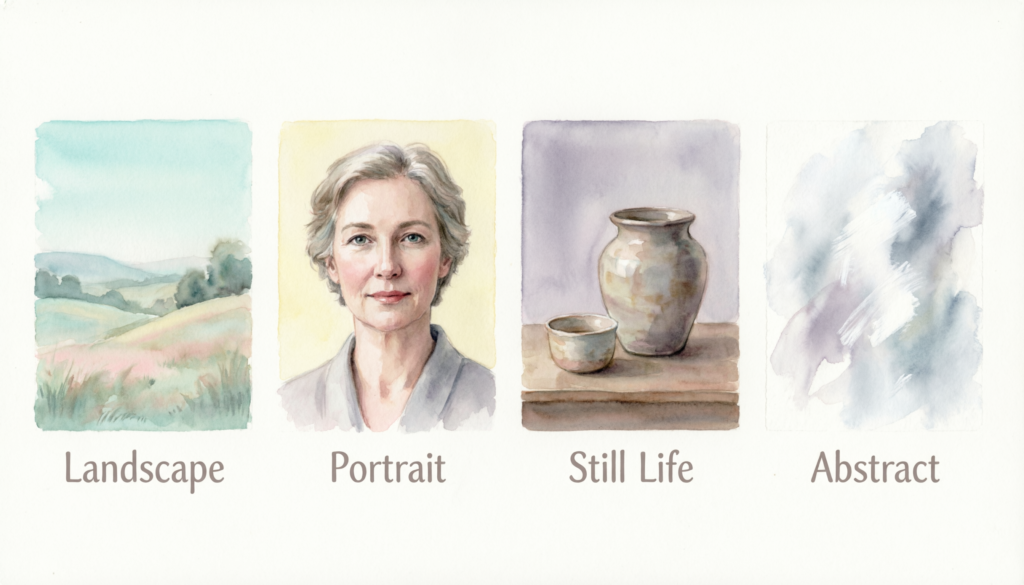
Here’s a quick breakdown of the genres you’re most likely to consider as a new painter.
Still Life is the painting of inanimate objects, such as fruit, flowers, bottles, and books. Still life paintings are a way to practice techniques like the way colours change as light and shadow drape across an object. You set up the scene. You control everything. That control makes it forgiving and deeply satisfying for beginners. Explore more on our still life painting page.
Landscape is painting natural or outdoor scenes, from rolling hills and forests to stormy seascapes. Landscape painting generally involves more light and colour variety than portrait or still life work. It’s visually rich and endlessly inspiring.
Portrait is painting people, capturing their face, expression, and personality on canvas. It’s technically demanding, but incredibly rewarding. Our portraits category is packed with inspiration if you feel drawn to faces.
Abstract Painting moves away from recognisable subjects and uses colour, shape, and form to express emotion. Abstract painting does not attempt to represent an accurate reality; instead, it uses shapes, colours, forms, and gestures to achieve its effect. It’s one of the most freeing genres for beginners who don’t want to worry about “getting it right.” Browse our abstract painting category for ideas.
Seascape and Everyday Life Scenes are also popular choices. Seascapes focus on water, coastal scenes, and skies. Everyday life scenes, sometimes called genre painting, capture real moments from daily human experience.
Which Genre Is Best for Beginners?
Still life is widely considered the best starting genre for new painters, because you control the subject, the lighting, and the composition completely.
Still life painting is considered the easiest of the three main types of painting. It’s perfect for beginners to start with and then expand into landscape painting and portraits further down the line. Why? Because when you paint a bowl of fruit, those objects don’t move. The light doesn’t change unless you change it. You can paint slowly, stop for a snack, and come back exactly where you left off. That level of control removes a huge amount of pressure.
Landscape painting is a brilliant second step. Painting from reference photos when starting out is a great approach before venturing outdoors with your paints and brushes. So you don’t even need to go outside to get started with landscapes. Just find a photo you love and work from that.
Portrait painting is the most technically demanding of the three. Humans are extremely good at spotting when a face looks slightly “off,” which makes portraits a tough challenge for absolute beginners. That said, if faces are what excite you most, don’t let anyone stop you from trying. Experimentation is essential to discovering an authentic art style, and not every approach you explore will be a success, but figuring out what does and doesn’t work helps you form a more articulated aesthetic.
How to Match a Genre to Your Personality
The best genre isn’t the easiest one. It’s the one that makes you want to pick up a brush.
Here’s a simple way to think about it. Ask yourself three questions. First: what do I love to look at? If your phone’s camera roll is full of sunsets and countryside walks, landscapes are calling you. If you fill your home with plants and interesting objects, still life might be your thing. If you love people-watching and you’re fascinated by faces, portraits are your natural home.
Second: how do I want to feel when I paint? If you want calm and control, still life is ideal. If you want freedom and energy, abstract is a wonderful choice. If you want to connect with the natural world, landscapes will deliver that feeling every single time.
Third: what do I want to learn? Finding your signature style is a journey, and it’s okay if you don’t yet know what your view of art is. Start with a genre that teaches the skills you’re most curious about. Color theory? Still life. Perspective and depth? Landscapes. Human anatomy and proportion? Portraits.
Our guide on how to find your painting style digs deeper into this process, and it’s well worth a read once you’ve settled on a genre to explore first.
What If You Want to Try More Than One Genre?
Most painters don’t stick to a single genre forever, and you don’t have to either.
Many of history’s greatest artists explored several genres throughout their careers. Cézanne painted still life and landscapes. Hockney painted portraits, still life, and landscapes. With 60% of today’s artists being self-taught, there’s never been a better time to pick up a brush and start your artistic journey. Self-taught painters especially tend to roam freely between genres as their confidence grows.
The smartest approach is to start with one genre for your first few paintings. Give it a proper chance. Paint at least five or six pieces in that genre before moving on. This focused repetition is where the real learning happens. You’ll build specific skills fast, and you’ll start to feel what you love and what you don’t. Understanding color theory basics will also support you across every genre you explore, so it’s worth bookmarking that resource too.
Once you have some foundations, mixing genres becomes one of the most exciting things you can do. A portrait in an abstract style. A still life inside a landscape. The combinations are endless.
Common Mistakes Beginners Make When Choosing a Genre
Here are the traps to avoid so you start strong and stay motivated.
Picking the “hardest” genre to impress people. Portraits look impressive when done well. But if you choose portraits purely to show off, and then struggle endlessly, you’ll lose motivation fast. Choose what genuinely interests you, not what looks good to others.
Switching genres too quickly. It’s tempting to abandon a genre the moment a painting doesn’t go well. But one bad painting doesn’t mean the genre is wrong for you. It means you’re learning. Give any genre at least three to five paintings before deciding it’s not your fit.
Overthinking the choice entirely. In 2024, 71% of U.S. adults engaged in a craft project. The people who got most out of that creative work? They started. They didn’t wait for the perfect plan. You can always switch genres later. But you can’t improve a painting you haven’t made yet.
Ignoring what actually excites you. The best genre is the one that pulls you in. If you feel a flutter of excitement when you look at a bowl of peaches on a windowsill, that’s data. Trust it.
🎨 Ready to Start? Pick Your Genre and Begin Today
Choosing an art genre for a new project comes down to three things: what you love to look at, how you want to feel while painting, and what skills you want to build first.
If you’re a complete beginner, start with still life. It’s forgiving, flexible, and a fantastic teacher. If you love the outdoors, go straight to landscapes. If faces fascinate you, try a portrait. And if rules feel like a cage, dive headfirst into abstract. There’s no wrong door here.
The only mistake is staying outside and not walking through any of them. So pick a genre today. Set up your first scene. And let’s create something beautiful together. 🖌️
Frequently Asked Questions
What is a painting genre, and how is it different from a painting style? A painting genre refers to the subject matter of a painting, such as landscape, portrait, still life, or abstract. A painting style refers to the artistic approach used to create it, such as impressionism, realism, or expressionism. You can paint a landscape in an impressionist style, or a portrait in a realist style. Genre answers “what are you painting?” while style answers “how are you painting it?”
What is the easiest art genre for complete beginners? Still life painting is widely considered the easiest genre for beginners. You set up the objects yourself, control the lighting, and paint at your own pace without the scene changing on you. Because you’re focused on a small number of objects in a controlled environment, you can keep compositions simple while still learning core skills like light, shadow, colour mixing, and composition.
Can I mix two art genres in one painting? Absolutely. Many paintings naturally blend genres. A portrait set against an outdoor backdrop combines portraiture and landscape. A bowl of fruit on a windowsill with a view combines still life and landscape. Mixing genres is actually a great creative exercise once you have some experience in each. There are no rules that say you must stay within one genre per painting.
How many paintings should I do before switching genres? Try to complete at least five to six paintings in one genre before switching. This focused repetition is where the most important learning happens. You’ll develop specific skills fast and begin to understand what you enjoy and what challenges you. Switching too early means you’ll miss the deeper lessons each genre has to teach, and you may end up feeling like you’re never progressing.
Do professional artists stick to one genre? Most professional artists develop a signature focus over time, but many explore several genres throughout their careers. Artists like Cézanne, Hockney, and Vermeer all worked across multiple subjects at different points in their lives. Genre specialisation often emerges naturally through experience, preference, and the commercial market. As a beginner, there’s no pressure to commit permanently to any one genre.