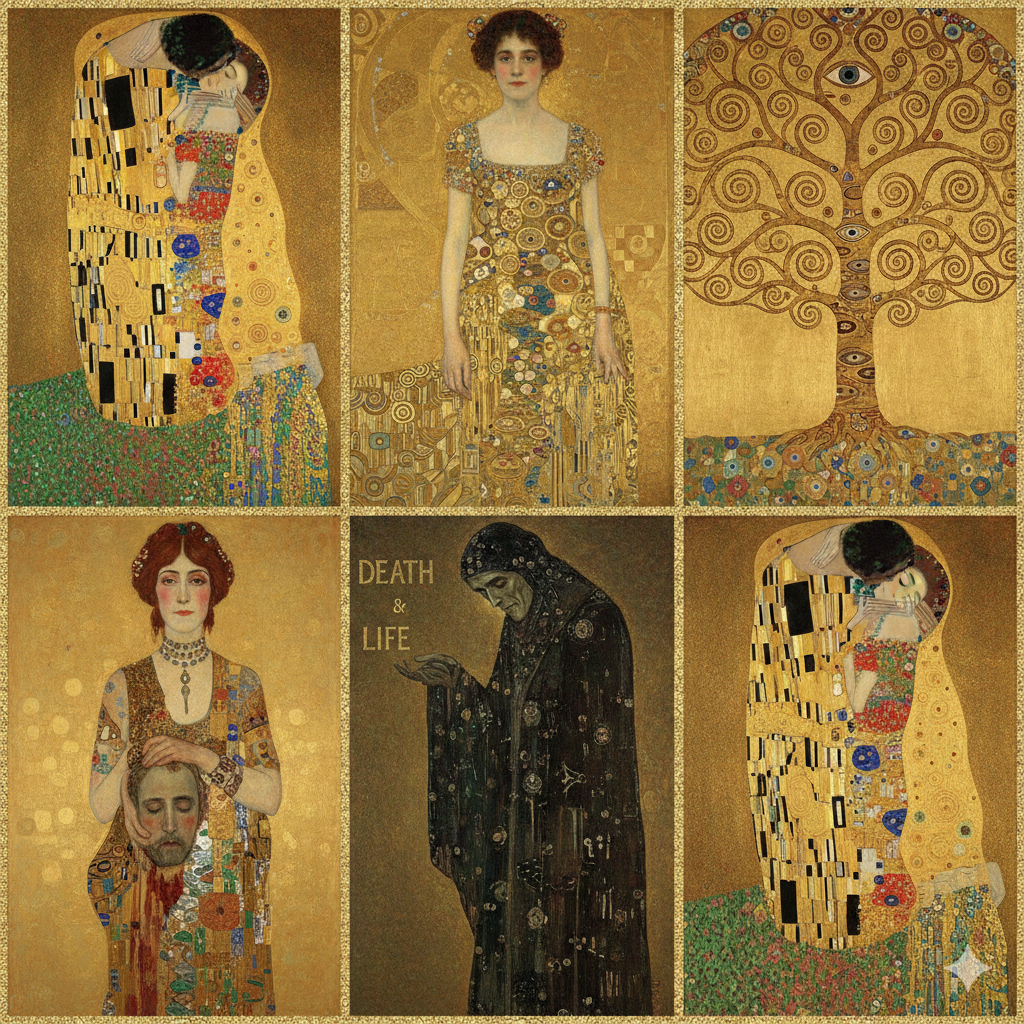
Step into a world that glitters with gold and emotion! We are about to explore the dazzling universe of Gustav Klimt, a revolutionary Austrian artist who wasn’t afraid to break the rules. His work is the superstar of the Art Nouveau movement, famous for its shimmering surfaces, intricate patterns, and deep symbolism. This guide will walk you through the top 10 Gustav Klimt paintings, uncovering the stories and secrets that make his art unforgettable. From passionate embraces to powerful portraits, get ready to see why Klimt’s masterpieces continue to capture imaginations over a century later.

The Kiss (1908)

The iconic embrace in The Kiss by Gustav Klimt, a masterpiece of the Golden Phase.
Description: Perhaps the most famous embrace in art history, The Kiss shows a couple locked in a passionate moment, wrapped in a golden robe that makes them seem like a single, divine being. They kneel in a field of flowers, lost in their own world. The man’s robe has strong, rectangular patterns, while the woman’s is soft with circles and flowers, showing a beautiful balance of masculine and feminine energy. This painting is the ultimate symbol of love and is considered the masterpiece of Klimt’s ‘Golden Phase’. Despite its romantic appearance, the painting was considered quite scandalous when first created due to its raw sensuality.
Painting Techniques: Oil paint and applied layers of gold leaf on canvas, a technique inspired by Byzantine mosaics Klimt had seen in Italy. The use of real gold gives the painting a luminous, otherworldly quality.
Location: Österreichische Galerie Belvedere, Vienna, Austria
Estimated Value: Priceless
Portrait of Adele Bloch-Bauer I (The Woman in Gold) (1907)
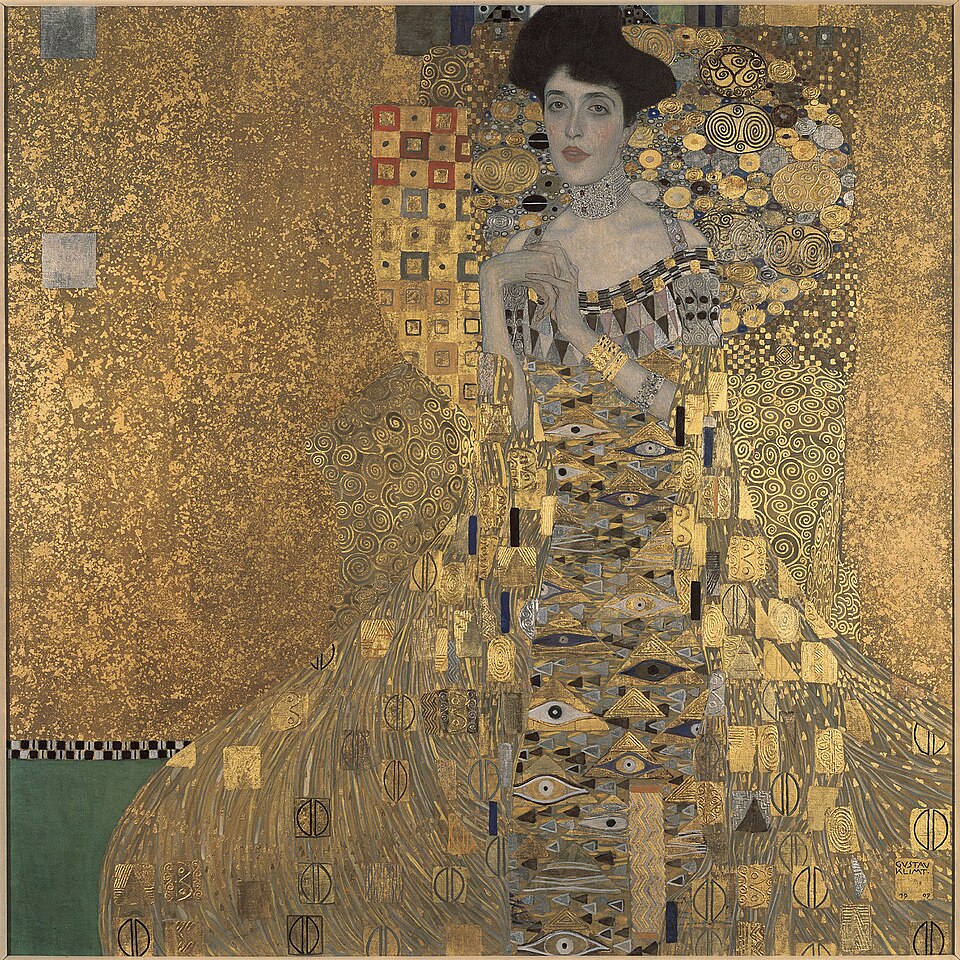
The stunning Portrait of Adele Bloch-Bauer I, Gustav Klimt’s ‘Woman in Gold’.
Description: Famously known as ‘The Woman in Gold,’ this portrait is a breathtaking example of Klimt’s ability to merge a person with pure decoration. Adele Bloch-Bauer, a wealthy Viennese socialite, seems to float in a sea of gold, her gown and the background swirling together with eyes, triangles, and spirals. Only her face and hands emerge realistically from the shimmering mosaic. The painting was famously looted by the Nazis during WWII and was only returned to Adele’s niece after a long legal battle. It took Gustav Klimt three years to complete this complex and lavish portrait.
Painting Techniques: Oil and gold leaf on canvas, featuring complex patterns and textures created by applying gesso to the canvas before adding the gold.
Location: Neue Galerie, New York, USA
Estimated Value: Sold for $135 million in 2006 (estimated value today is much higher).
The Three Ages of Woman (1905)
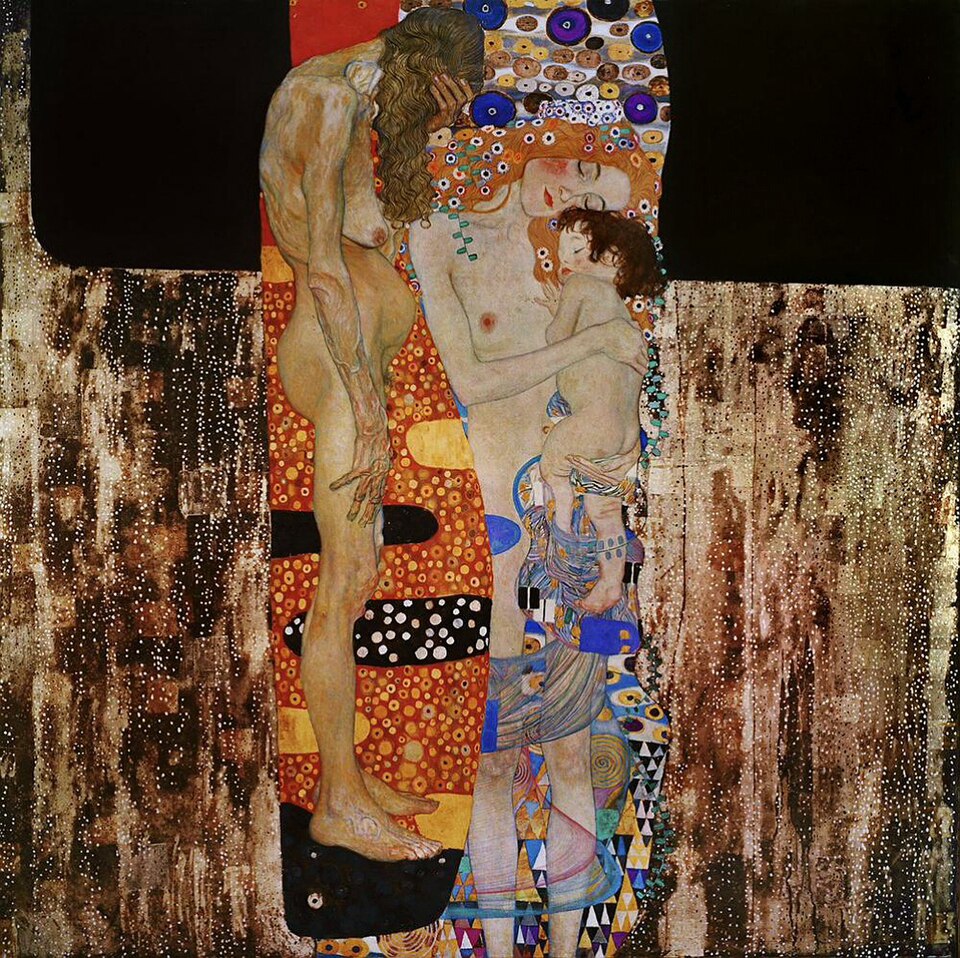
A symbolic journey through life in The Three Ages of Woman by Gustav Klimt.
Description: This powerful painting tells the story of life’s journey in three stages: infancy, motherhood, and old age. A young mother lovingly holds her baby, both cocooned in a colorful, patterned wrap, symbolizing youth and vitality. Standing beside them is an elderly woman, her head bowed and face hidden, representing the harsh realities of aging and the passage of time. It’s a beautiful yet honest look at the circle of life. Klimt won a gold medal for this painting at an international exhibition in Rome in 1911.
Painting Techniques: Oil on canvas, utilizing contrasting styles. The young figures are rendered softly, while the older woman is depicted with more texture and harsher lines, emphasizing the different stages of life.
Location: Galleria Nazionale d’Arte Moderna, Rome, Italy
Estimated Value: Priceless
Judith and the Head of Holofernes (1901)
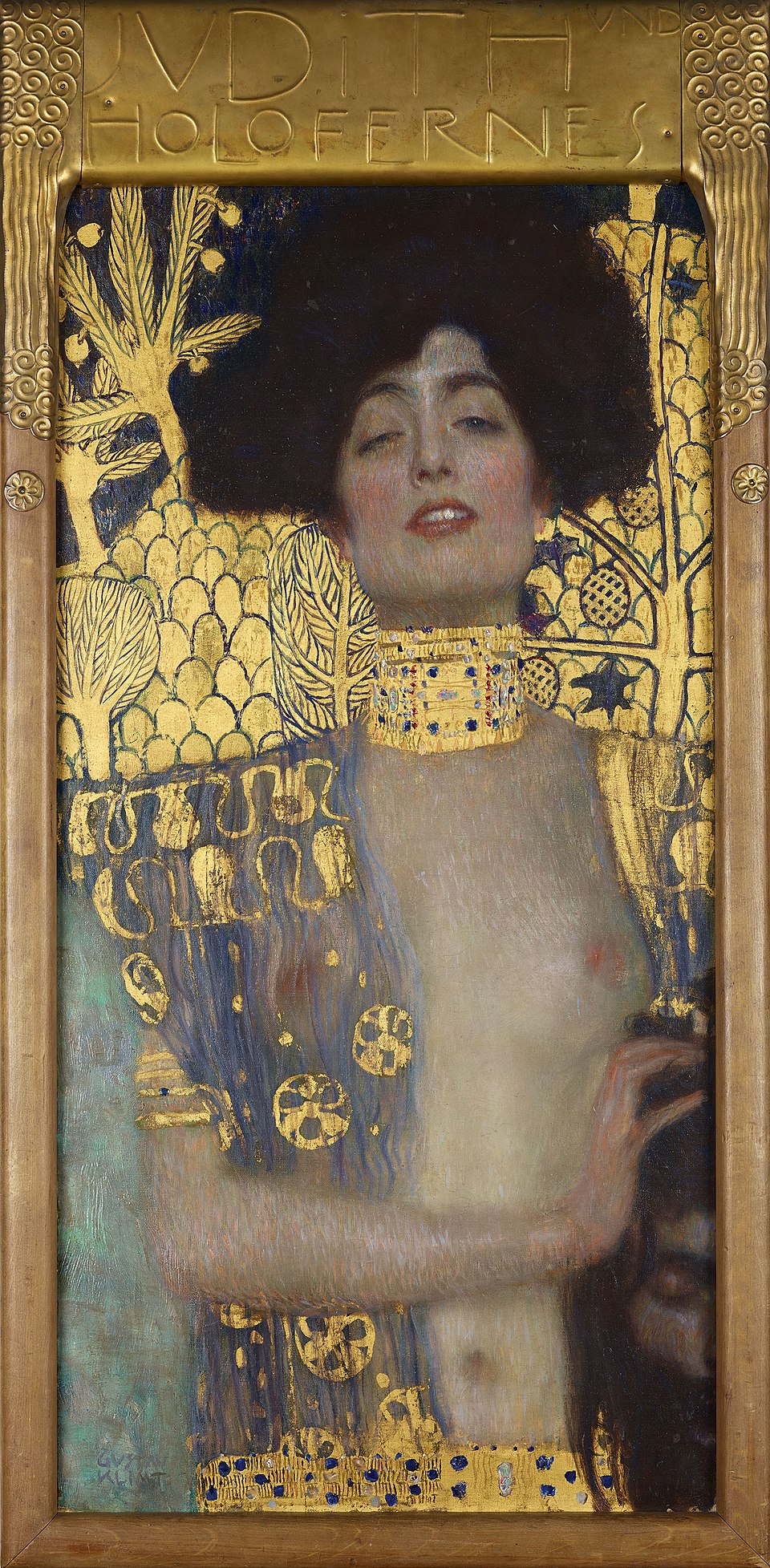
The powerful and alluring Judith and the Head of Holofernes by Gustav Klimt.
Description: This is not your typical historical painting. Klimt portrays the biblical hero Judith as a powerful and seductive Viennese woman of his time. With a look of defiant triumph, she holds the severed head of the general Holofernes. The rich gold background and her elaborate jewelry make her seem more like a goddess than a mere mortal. Klimt challenged tradition by focusing on Judith’s power and sensuality rather than her piety. The model for Judith is believed to be the same woman from ‘The Woman in Gold,’ Adele Bloch-Bauer.
Painting Techniques: Oil and gold leaf on canvas. Klimt uses the gold to frame Judith’s face and create an intricate, almost hypnotic background that contrasts with her realistic features.
Location: Österreichische Galerie Belvedere, Vienna, Austria
Estimated Value: Priceless
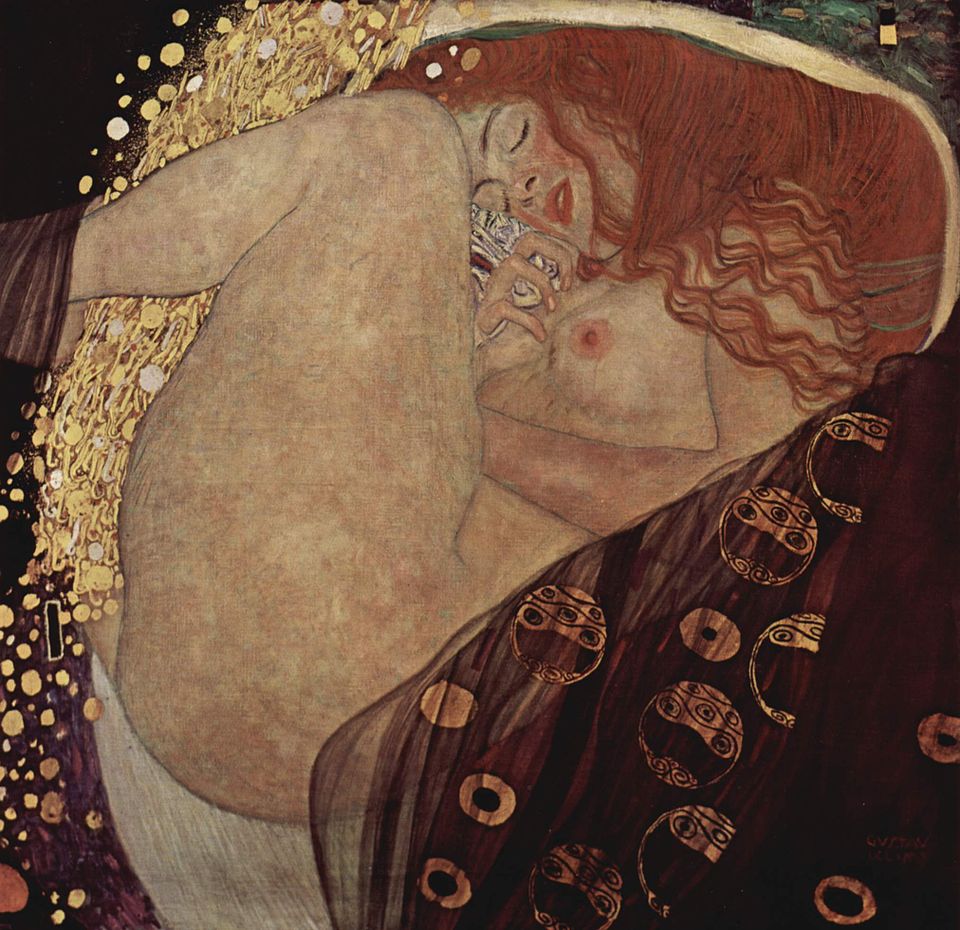
Danaë (1907)
Description: This painting depicts a famous moment from Greek mythology. Danaë is curled up in a luxurious, dream-like state as Zeus, the king of the gods, visits her as a shower of golden rain. It’s a very intimate and sensual work, focusing on the moment of divine conception. Klimt uses swirling patterns and rich colors to create a feeling of intense, private ecstasy, making it one of his most daring and celebrated mythological works. The shower of gold coins flowing between her legs is one of the most direct and symbolic representations of divine union in art history.
Painting Techniques: Oil on canvas, employing a square format that was unusual for the time. The composition is filled with swirling lines and rich colors, creating a dynamic and enclosed atmosphere.
Location: Leopold Museum, Vienna, Austria
Estimated Value: Priceless
Death and Life (1915)
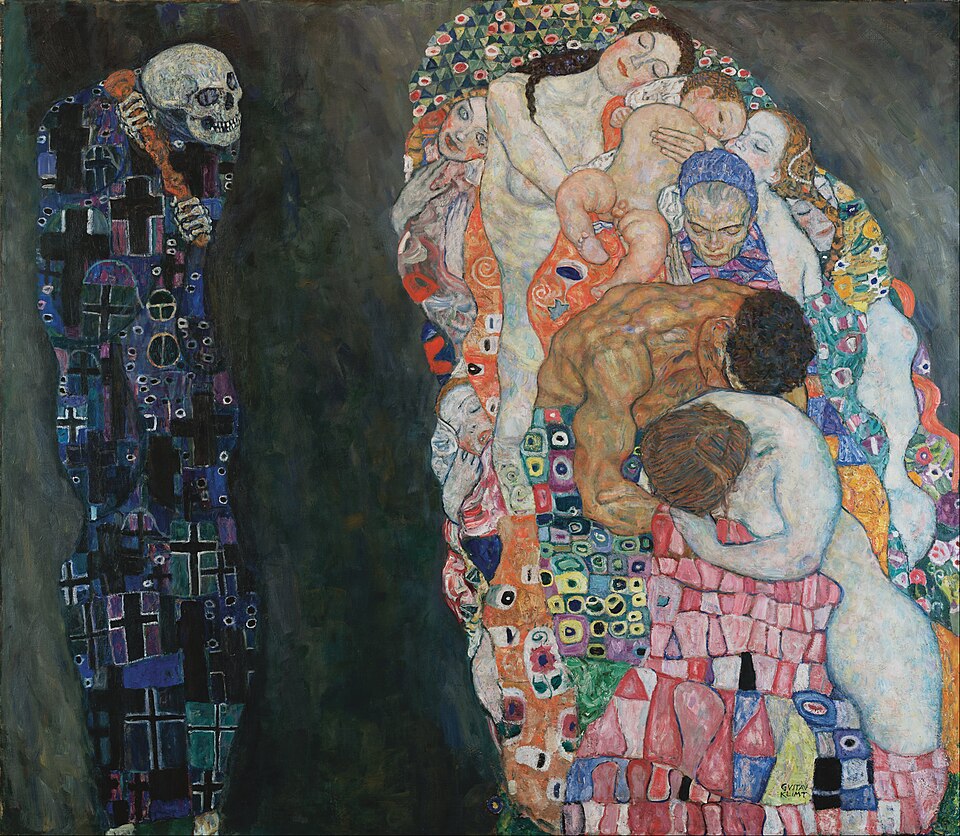
The profound contrast between existence and mortality in Death and Life by Gustav Klimt.
Description: On one side of the canvas, we see a tangle of human figures—men, women, and children of all ages—huddled together in a vibrant, colorful embrace representing Life. On the other side, the lonely, menacing figure of Death, draped in a dark robe covered in crosses, looks on. It’s a profound statement on mortality, suggesting that while death is always near, life is a powerful, connected, and beautiful force. Klimt considered this to be his most important figurative work and even modified it after it was first exhibited.
Painting Techniques: Oil on canvas, using the Art Nouveau style to depict the figures of Life with vibrant colors and patterns, contrasting sharply with the dark, solemn figure of Death.
Location: Leopold Museum, Vienna, Austria
Estimated Value: Priceless
Beethoven Frieze (1902)

A monumental story of humanity’s search for joy: the Beethoven Frieze by Gustav Klimt.
Description: This isn’t a single painting but a massive, room-sized work of art created for an exhibition celebrating the composer Ludwig van Beethoven. It tells a story across three walls, depicting humanity’s search for happiness. The journey battles against hostile forces (like a giant, gorilla-like monster named Typhoeus) and ends with a choir of angels and a loving embrace, a ‘kiss to the whole world.’ It’s like a graphic novel telling the story of Beethoven’s Ninth Symphony. The Frieze was painted directly onto the walls of the exhibition hall and was never intended to be permanent, but it was thankfully preserved.
Painting Techniques: Casein paint, stucco, gold leaf, and inlaid semi-precious materials on plaster panels. This mixed-media approach allowed for incredible texture and detail.
Location: Secession Building, Vienna, Austria
Estimated Value: Priceless
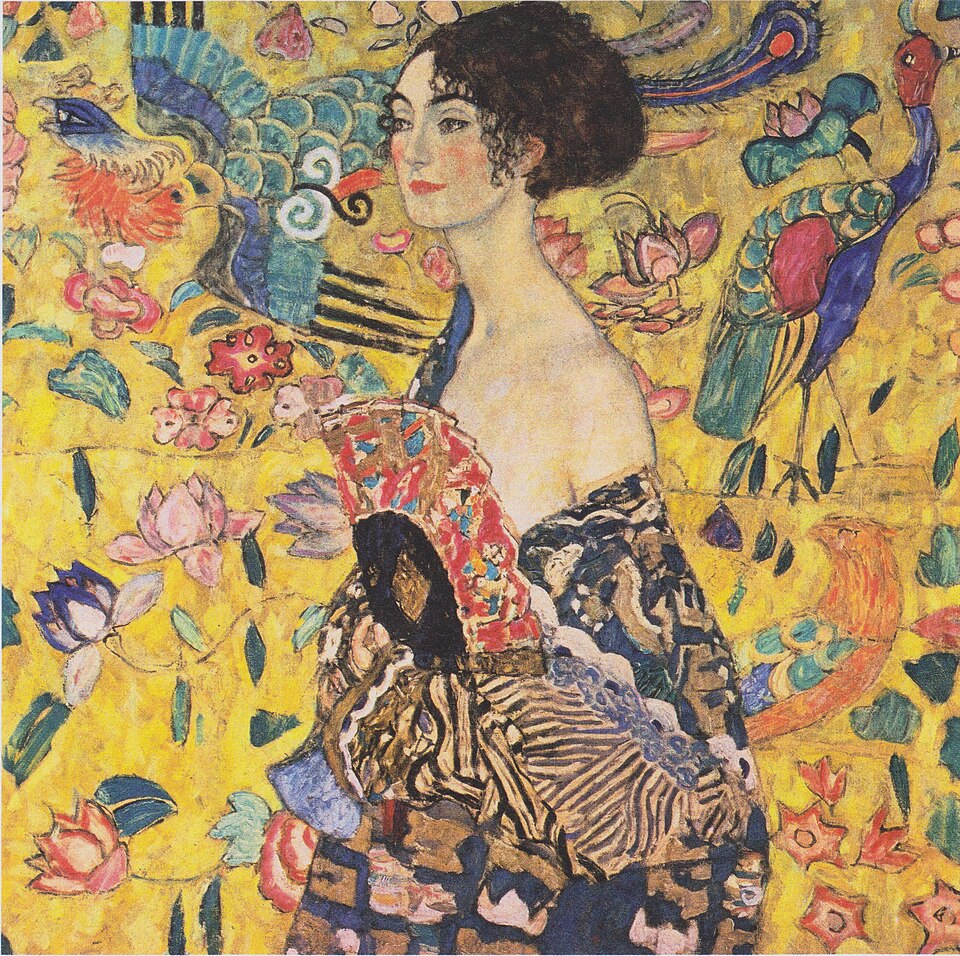
The Lady with a Fan (1918)
Description: This was the last portrait Klimt was working on when he died, found on an easel in his studio. It shows an unidentified woman holding a fan, her shoulder elegantly exposed. Unlike his golden portraits, this piece is full of vibrant color and is heavily influenced by Chinese and Japanese art, visible in the background motifs of a phoenix and lotus blossoms. The painting feels spontaneous and full of life, a final burst of creative energy. Because the painting was still in his studio upon his death, it offers a rare glimpse into his unfiltered artistic process.
Painting Techniques: Oil on canvas, showcasing Klimt’s later style which was more expressive and colorful, moving away from the heavy use of gold leaf and incorporating strong Asian artistic influences (Japonisme).
Location: Private Collection (Sold at auction in 2023)
Estimated Value: Sold for £85.3 million ($108.4 million) in June 2023, making it the most expensive artwork ever sold at auction in Europe.
Water Serpents II (1907)
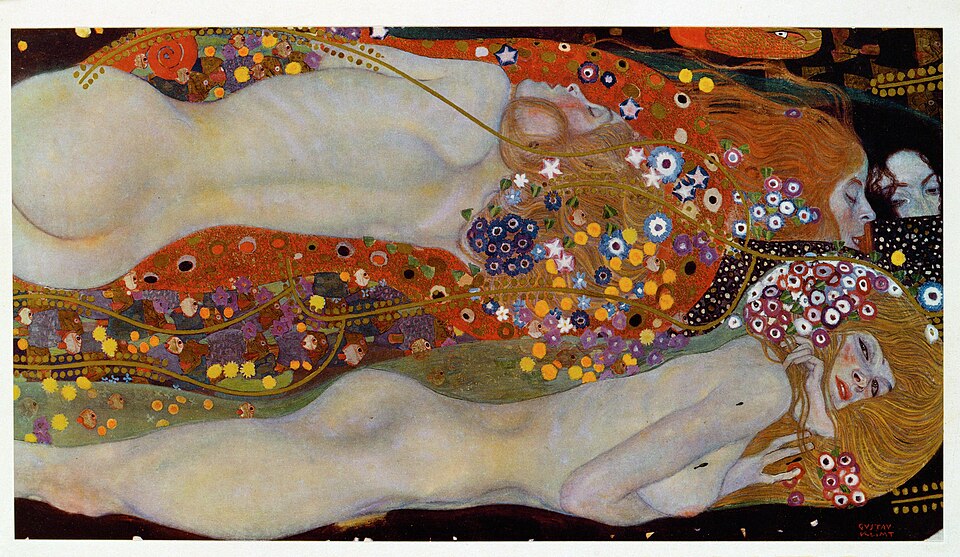
A mystical underwater dance in Water Serpents II by Gustav Klimt.
Description: A mesmerizing and mystical painting, Water Serpents II depicts several female figures floating weightlessly in a dreamlike underwater world. Their bodies intertwine in a sensual, flowing dance. The painting explores themes of female love and harmony with nature. It has a complicated history, having been stolen by the Nazis and only recently sold after a long restitution case. The painting was once owned by Jenny Steiner, a prominent Jewish art collector in Vienna, before being confiscated by the Nazis.
Painting Techniques: Oil on canvas. This work is a prime example of Klimt’s decorative style, using rich colors and complex patterns to create a fluid, otherworldly environment.
Location: Private Collection
Estimated Value: Sold for $112 million in a private sale in 2015.
The Virgin (1913)
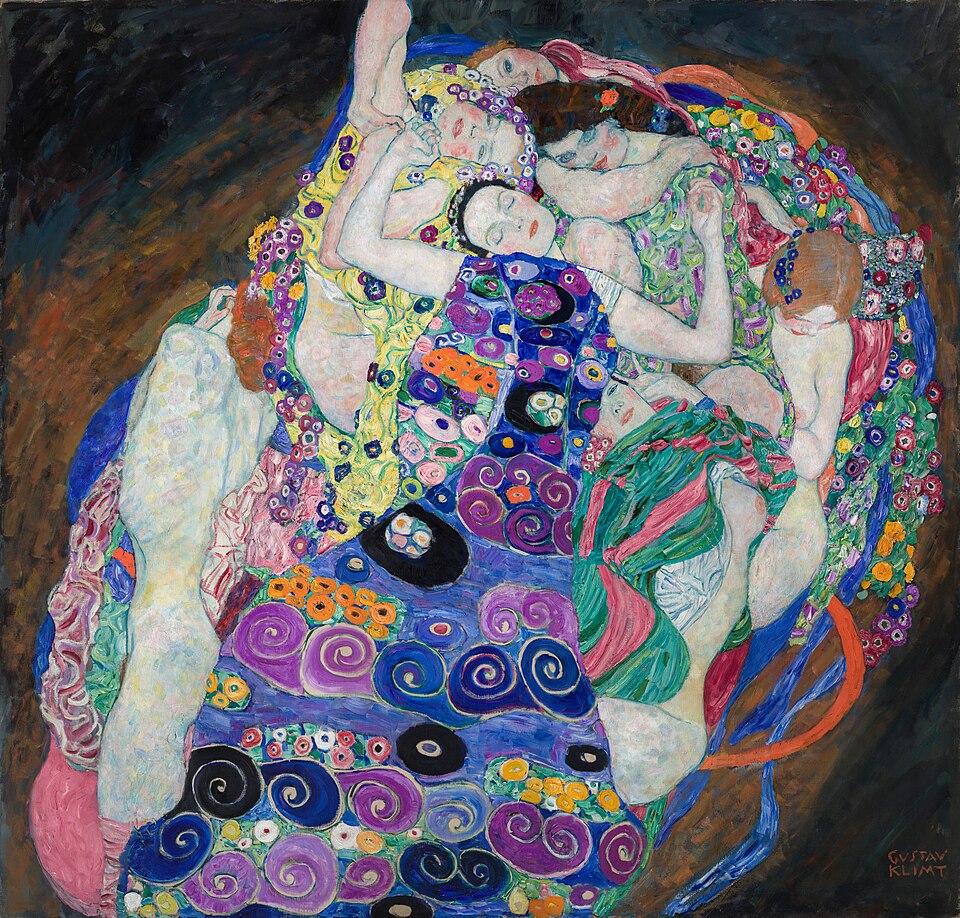
A vibrant celebration of womanhood in The Virgin by Gustav Klimt.
Description: Imagine a kaleidoscope of color and life, and you have The Virgin. This painting shows a pile of sleeping women, their bodies tangled together under a massive, colorful quilt. The central figure, ‘the virgin,’ is just awakening to life and love. The work is a vibrant celebration of the transition from girlhood to womanhood, filled with symbols of fertility and transformation. The circular arrangement of the figures and patterns creates a feeling of a blooming flower, symbolizing blossoming womanhood.
Painting Techniques: Oil on canvas, characterized by its exceptionally vibrant, almost Fauvist color palette and swirling, circular composition that draws the viewer’s eye around the canvas.
Location: National Gallery Prague, Prague, Czech Republic
Estimated Value: Priceless

The latest major sale of a Gustav Klimt artwork was the Portrait of Elisabeth Lederer, which sold for $236.4 million (including fees) at Sotheby’s in New York on Tuesday, November 18, 2025.
Inspiration and Legacy
Gustav Klimt didn’t create his unique style in a vacuum. He was deeply inspired by a wide range of sources, including the gilded art of Byzantine mosaics he saw in Ravenna, Italy, and the elegant, flowing lines of Japanese woodblock prints (a style known as Japonisme). He also drew from the work of European Symbolist painters who believed art should represent ideas rather than the natural world. In turn, Klimt’s own revolutionary style had a massive impact. He became a mentor to a new generation of Austrian artists, most notably the expressive and raw painter Egon Schiele, whose work pushed emotional intensity even further. Klimt’s legacy is immense; his blend of realism and abstract decoration, his use of gold, and his sensual figures have influenced countless artists, designers, and even filmmakers, ensuring his golden touch continues to inspire.
Final Thoughts on Top 10 Gustav Klimt Paintings
Gustav Klimt was more than just a painter; he was a master craftsman who turned canvases into jeweled treasures. He captured the complex emotions of a changing world, from the heights of passionate love to the quiet dignity of life’s journey. His work invites us into a world that is both realistic and fantastical, earthly and divine. The enduring popularity of Gustav Klimt paintings proves that his ability to blend beauty, symbolism, and pure, shimmering gold has created a timeless legacy that continues to enchant and inspire art lovers everywhere.
FAQs about Gustav Klimt
Why did Gustav Klimt use so much gold in his paintings?
Klimt’s ‘Golden Phase’ was inspired by a trip to Italy where he saw Byzantine mosaics decorated with real gold. He was fascinated by their luminous quality. For Klimt, gold represented luxury, preciousness, and a divine, spiritual world, which he used to elevate his subjects beyond the everyday.
What is the Art Nouveau movement?
Art Nouveau was an international style of art and design popular from about 1890 to 1910. It was inspired by natural forms, like the curving lines of plants and flowers. Klimt was a leading figure in the Vienna Secession, Austria’s version of the Art Nouveau movement.
Was Gustav Klimt’s art controversial?
Yes, very much so. Many people in early 20th-century Vienna were shocked by his work. They found his paintings, which often featured nude figures and focused on themes of love and desire, to be too scandalous and radical for the time.
Where can I see most of Gustav Klimt’s paintings?
The largest and most important collection of Gustav Klimt’s paintings, including ‘The Kiss’ and ‘Judith,’ is located at the Belvedere Museum in his home city of Vienna, Austria. Many other major works are in museums in Vienna, New York, and Rome.