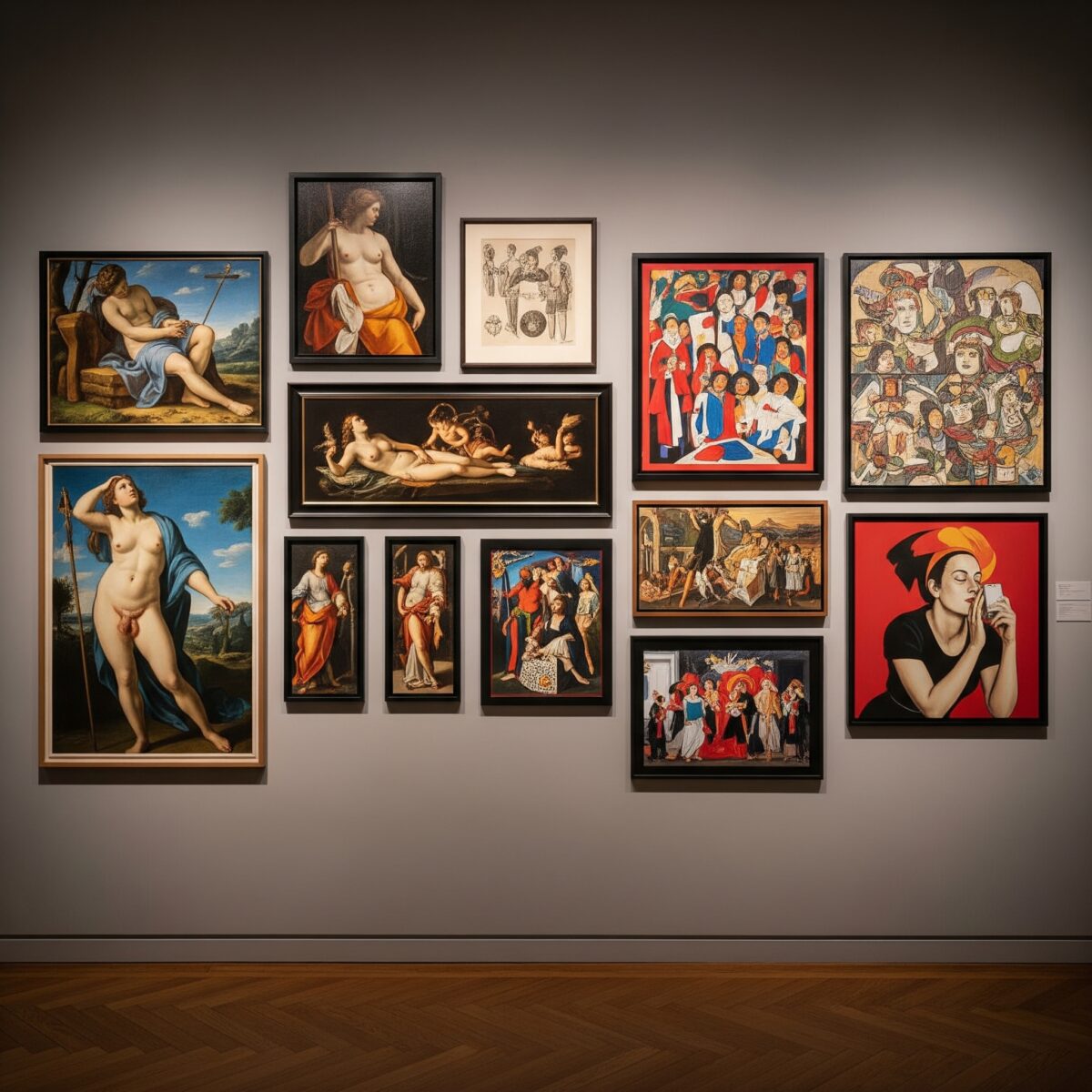
When we discuss “controversial art,” we often focus on the visceral reaction—the gasp of a gallery-goer or the headlines of a tabloid. However, the true significance of a masterpiece like Picasso’s Guernica or Serrano’s Piss Christ lies not in their ability to offend, but in their ability to expose the structural fragility of the institutions they inhabit. Art is rarely controversial because of its color palette; it becomes a flashpoint when it crosses an “invisible line” of social or political architecture—challenging who holds power, who is allowed to speak, and what symbols are considered “untouchable.” This isn’t just a list of shocking images; it is a timeline of moments where art and politics collided so violently that the laws of the land had to change in the aftermath.
1. “Piss Christ” (1987) – Andres Serrano
- The Technical Subversion: Serrano utilized a sophisticated color theory approach, using a yellow-gold hue and soft-focus photography to give the piece a “divine,” ethereal glow. The controversy arises from the juxtaposition of this traditional sacred aesthetic with the biological reality of the medium: human urine.
- The Public Backlash & Legal Consequences: This piece became the centerpiece of the 1990s “Culture Wars” in the United States. It led to a permanent structural shift in how the National Endowment for the Arts (NEA) grants are distributed, with the U.S. Senate eventually voting to slash the NEA’s budget and impose “decency” standards on federally funded art.
2. “The Last Judgment” (1536) – Michelangelo
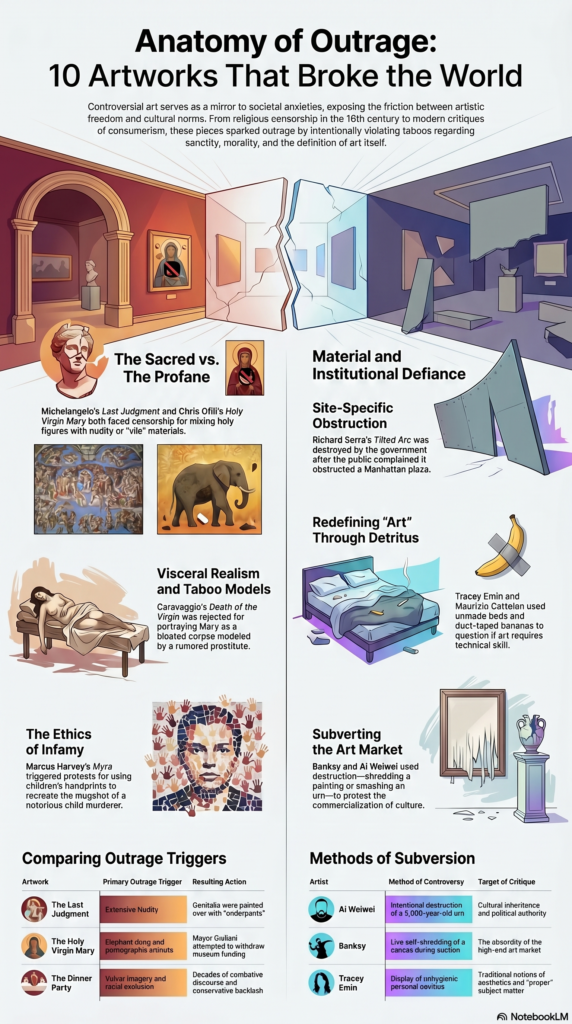
- The Technical Subversion: In a stunning move of anatomical defiance, Michelangelo painted nearly 300 figures—including Christ and the Virgin Mary—completely nude inside the heart of the Vatican. This was a direct subversion of the Church’s controlled aesthetic.
- The Public Backlash & Legal Consequences: This led to the infamous “Fig Leaf Campaign.” Shortly after the artist’s death, the Council of Trent decreed that the genitals must be covered. The artist Daniele da Volterra was hired to paint “breeches” over the figures, a permanent physical censorship that remained for centuries until a partial restoration in the 1990s.
3. “Guernica” (1937) – Pablo Picasso
- The Technical Subversion: Picasso abandoned his vibrant palette for a monochromatic, newsprint-gray scheme. This structural choice mimicked the black-and-white photography used in war reporting, giving the surrealist chaos a sense of “breaking news” urgency.
- The Public Backlash & Legal Consequences: Beyond its initial reception, the painting’s power was so potent that in 2003, a tapestry replica at the United Nations was covered with a blue cloth during Colin Powell’s speech regarding the Iraq War. The structural censorship proved that, even decades later, the piece remained a dangerous political obstacle to the rhetoric of war.
4. “Dropping a Han Dynasty Urn” (1995) – Ai Weiwei
- The Technical Subversion: The medium here isn’t the urn; it is the act of destruction. By shattering a 2,000-year-old artifact, Weiwei forced a conversation on how we value “culture” versus “capital.”
- The Public Backlash & Legal Consequences: This piece, among others, made Weiwei a permanent target of the Chinese State. It led to his 81-day detention in 2011 and the demolition of his studio, showcasing how conceptual art can trigger a physical, systemic crackdown by an authoritarian regime.
5. “The Origin of the World” (1866) – Gustave Courbet
- The Technical Subversion: Courbet used radical cropping to remove the subject’s face and limbs, focusing solely on the genitalia. This removed the “personhood” often found in classical nudes, turning the gaze into something clinical and confrontational.
- The Public Backlash & Legal Consequences: The painting was hidden in private collections and behind curtains for over a century. Today, its “legal” battle persists in the digital realm; Facebook’s censorship algorithms have famously deactivated accounts for posting the image, leading to a decade-long French court battle over distinguishing “art” from “pornography” in the age of Big Tech.
6. “The Holy Virgin Mary” (1996) – Chris Ofili
- The Technical Subversion: Ofili challenged the Western “white-washing” of religious iconography by depicting a Black Madonna. Mechanically, he used mixed media including elephant dung (treated with polyester resin) and tiny, shimmering cutouts of buttocks from pornographic magazines to represent “cherubs.”
- The Public Backlash & Legal Consequences: This piece sparked a high-profile legal battle between the Brooklyn Museum and the City of New York. Then-Mayor Rudy Giuliani called the work “sick” and “anti-Catholic,” subsequently withholding the museum’s $7 million monthly subsidy. The resulting court case, Brooklyn Institute of Arts and Sciences v. City of New York, became a landmark Second Circuit ruling that protected First Amendment rights for arts organizations receiving public funds.
7. “Open Casket” (2016) – Dana Schutz
- The Technical Subversion: A gestural, abstract painting of Emmett Till—the 14-year-old Black boy lynched in 1955. The controversy was not in the imagery itself, but in the structural identity of the artist. Schutz, a white woman, was accused of “aestheticizing” Black trauma for a predominantly white gallery audience.
- The Public Backlash & Legal Consequences: During the Whitney Biennial, protesters stood in front of the painting to block it from view. The debate led to a tectonic shift in institutional curation. Museums worldwide revised their protocols for “community consultation,” sparking a global conversation about who has the “right” to represent historical trauma and the ethics of cultural appropriation in the fine art market.
8. “The Death of Marat” (1793) – Jacques-Louis David
- The Technical Subversion: David used a technique called chiaroscuro (extreme light and dark) to mimic the lighting of a cathedral. By posing the murdered revolutionary leader Jean-Paul Marat in a position identical to the Pieta (down to the hanging arm of Christ), David structurally elevated a controversial political journalist to the level of a secular saint.
- The Public Backlash & Legal Consequences: Following the fall of Robespierre and the Jacobins, the painting was deemed “too dangerous” to be seen. The state ordered its removal, and it was hidden for decades to prevent it from acting as a visual catalyst for further uprisings. It remains the definitive example of how visual propaganda can be as threatening to a regime as an armed militia.
9. “Self” (1991) – Marc Quinn
- The Technical Subversion: This is a cast of the artist’s head made entirely from 10 pints of his own frozen, original blood. The piece is “alive” in a sense; it requires a permanent electrical source to power the refrigeration unit. If the power fails, the artwork melts—meaning the museum must provide “life support” for the piece.
- The Public Backlash & Legal Consequences: The work raised profound bioethical questions regarding the transport and display of human fluids. It forced insurance companies and international customs agencies to redraw the lines between “medical waste” and “cultural property,” creating a new legal category for bio-art.
10. “Everydays: The First 5000 Days” (2021) – Beeple
- The Technical Subversion: This piece exists as a single JPEG file associated with a Non-Fungible Token (NFT). It subverts the 500-year-old tradition of the “original masterpiece” being a physical object that can be touched. The “structure” here is the Ethereum blockchain, making the art purely a function of scarcity and digital ledger entry.
- Modern Digital Controversy & Legal Consequences: The sale of this piece for $69 million sent the art world into a tailspin. It triggered a global debate on the environmental footprint of art-making (due to minting energy consumption) and forced the SEC (Securities and Exchange Commission) to investigate whether certain digital art assets should be regulated as “securities” (investments) rather than “collectibles.”
Modern Digital Art Controversy
Artistic controversy has evolved from visual shock to structural subversion. Historically, masterpieces triggered religious and state censorship by defying moral “architecture.” Today, the friction is technological: digital art sparks outrage over environmental impact, algorithmic bias, and AI data theft. Whether it’s Michelangelo’s nudity or Beeple’s NFTs, the most controversial works are “stress tests” for society, forcing landmark legal shifts that redefine free speech, institutional power, and the very definition of human creativity.
The Verdict: Art as a “Stress Test” for Society
As we have seen, the most controversial art pieces do more than just hang on a wall; they act as a stress test for the First Amendment, religious tolerance, and the limits of modern technology. Whether it is Michelangelo’s paint or Beeple’s pixels, the backlash usually begins when the artist refuses to follow the “rules” of the system they are operating within.
Key Takeaways
- Controversy is Calculated: Most artists on this list were aware they were poking a “systemic nerve.”
- Structural Legacy: The importance of these pieces is often found in the court rulings and museum policy changes they left behind.
- The Digital Shift: We are currently in a new era where “outrage” is driven by algorithms. Understanding the history of physical censorship helps us navigate the new landscape of digital deplatforming.
Next Steps for the Curious Reader
Join the Conversation: Which of these pieces do you think remains the most dangerous today? Drop a comment below.
Visit a “Provocative” Exhibit: Look for your local contemporary art museum’s “uncomfortable” wing.
Read the Court Cases: If you’re a law or history buff, look up Brooklyn Institute of Arts and Sciences v. City of New York. It is a fascinating read on why public tax dollars must support even “offensive” art.
Updated June 26 GEM