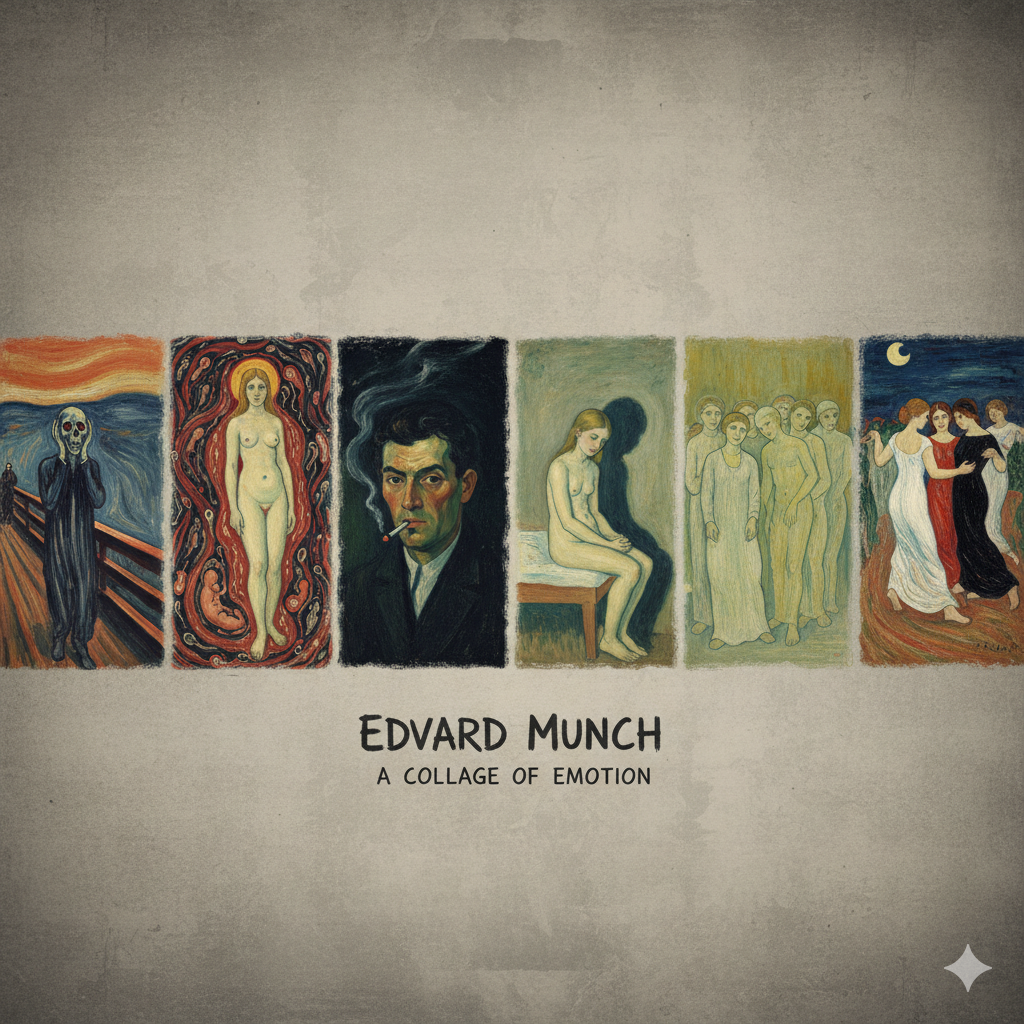

Have you ever felt an emotion so strong you wished you could just splash it onto a canvas? That’s exactly what Norwegian artist Edvard Munch did. His work serves as a raw, visual diary, capturing the intensity of love, anxiety, jealousy, and loss. To truly understand the depth of his expression, we’ve curated a list of the top 10 famous Edvard Munch paintings that define his emotional landscape.
The collection of Edvard Munch paintings is a journey into the human soul, making him a pioneer of a style called Expressionism, where feelings are more important than realistic details. He famously said, ‘I do not paint what I see, but what I saw.’ This approach changed art forever. Let’s dive into the powerful and sometimes spooky world of his most famous artworks.
The Scream (1893)
Description: This isn’t just a painting; it’s a global icon of anxiety. A ghostly figure stands on a bridge under a blood-red sky, letting out a silent shriek. Munch wasn’t painting a real scene, but rather the feeling of a panic attack he experienced while on a walk. The swirling colors and distorted landscape pull you into a moment of pure, overwhelming emotion. Munch wrote a poem in his diary describing the experience that inspired the painting, stating he felt a ‘great, infinite scream pass through nature.’
Painting Techniques: Munch used a mix of oil, tempera, and pastel on cardboard, which allowed him to create vibrant, jarring colors and raw, expressive lines that seem to vibrate with energy.
Location: National Gallery, Oslo, Norway
Estimated Value: Priceless
Madonna (1894)

A captivating look at Madonna by Edvard Munch, a painting exploring themes of life and love.
Description: This is not your typical religious painting. Munch’s ‘Madonna’ shows a sensual, entranced woman with a halo-like red aura. It’s a controversial and complex piece that explores the connection between love, life, and death. The original frame even had tiny sperm and a fetus painted on it, highlighting the cycle of life. The painting was stolen in a dramatic armed robbery in 2004 along with ‘The Scream’, but was recovered two years later.
Painting Techniques: Using oil on canvas, Munch created a soft, yet unsettling, texture. The flowing lines of the woman’s body and hair contrast with the dark, ambiguous background.
Location: Munch Museum, Oslo, Norway
Estimated Value: Priceless
Vampire (1893)

The mysterious Vampire by Edvard Munch, a masterpiece of Symbolist art exploring love and pain.
Description: Originally titled ‘Love and Pain,’ this painting shows a woman with flowing red hair burying her face in a man’s neck. Is she comforting him or draining his life force like a vampire? Munch leaves it up to us to decide, capturing the painful and sometimes destructive side of love and passion. Munch insisted the painting simply depicted a woman kissing a man’s neck, but a critic’s ‘vampire’ label stuck and became its popular title.
Painting Techniques: Munch’s use of dark, enveloping colors and stark contrasts in this oil painting creates a claustrophobic and intensely intimate atmosphere.
Location: Gothenburg Museum of Art, Gothenburg, Sweden
Estimated Value: A version sold for $38.2 million in 2008.
The Sick Child (1886)

The deeply personal painting, The Sick Child, by Edvard Munch, expressing profound grief and loss.
Description: This is one of Munch’s most personal and heartbreaking works. It depicts his older sister, Sophie, on her deathbed from tuberculosis, an event that deeply scarred the artist as a teenager. You can feel the grief in the room, from the hunched figure of the mother to the pale, fragile face of the girl. Munch was so obsessed with this memory that he created six different painted versions of ‘The Sick Child’ over 40 years.
Painting Techniques: Munch scraped and scratched at the paint, thinning it with turpentine to create a ghostly, transparent effect, as if the memory itself is fading and raw.
Location: National Gallery, Oslo, Norway
Estimated Value: Priceless
Puberty (1894)

Edvard Munch’s Puberty, a haunting depiction of adolescent anxiety and a key work in his Frieze of Life series.
Description: A young, vulnerable girl sits on the edge of her bed, attempting to cover herself. Behind her, a large, dark shadow looms like a monster. The painting powerfully captures the fear, confusion, and anxiety of growing up and facing the unknown changes of adolescence. A fire in Munch’s studio destroyed the first version of this painting, but he felt the theme was so important that he recreated it.
Painting Techniques: Munch’s brushwork is direct and somewhat coarse, emphasizing the raw emotion of the subject. The stark contrast between the pale figure and the dark shadow creates a powerful psychological tension.
Location: National Gallery, Oslo, Norway
Estimated Value: Priceless
Anxiety (1894)

Anxiety by Edvard Munch, a powerful painting that captures the feeling of collective despair.
Description: Look familiar? ‘Anxiety’ feels like the sequel to ‘The Scream.’ It features the same blood-red sky and unsettling landscape, but this time, a crowd of ghostly, well-dressed figures marches toward the viewer with blank, despairing faces. It’s a portrait of collective dread, as if the whole world is sharing in the panic. The setting is the same fjord overlooking Oslo that is featured in ‘The Scream’ and ‘Melancholy,’ a place of deep personal significance for Munch.
Painting Techniques: Using bold, swirling lines and non-naturalistic colors in oil on canvas, Munch creates a sense of unease and movement, making the crowd feel like an unstoppable, grim parade.
Location: Munch Museum, Oslo, Norway
Estimated Value: Priceless
The Dance of Life (1900)
.jpg "Scream and Beyond: The Top 10 Famous Edvard Munch Paintings 9")
The Dance of Life by Edvard Munch, a symbolic masterpiece depicting the stages of life.
Description: This large painting shows three women on a summer night by the sea. On the left, a young woman in white reaches for a flower, symbolizing innocence. In the center, a woman in red dances with a man, representing passion and experience. On the right, a woman in black looks on with folded hands, representing loneliness and the end of life. It’s a symbolic story of the stages of a woman’s life. The central figures are believed to represent Munch and Tulla Larsen, a woman with whom he had a tumultuous and ultimately disastrous love affair.
Painting Techniques: Munch uses a simplified, flowing style with broad areas of flat color, a technique influenced by the Symbolist movement, to convey the dreamlike, allegorical nature of the scene.
Location: National Gallery, Oslo, Norway
Estimated Value: Priceless
Melancholy (1892)

Melancholy by Edvard Munch, a profound exploration of sadness and jealousy through color and line.
Description: A man sits alone on a rocky shoreline, his head resting in his hand, lost in thought. The winding, dark coastline seems to mirror his gloomy state of mind. The painting is a powerful depiction of jealousy and sadness, inspired by his friend’s unhappy romance. This is one of the first paintings where Munch used the landscape to reflect a character’s internal emotional state, a technique that would become his signature.
Painting Techniques: The use of long, sinuous lines and somber, synthetic colors is characteristic of the Synthetist style Munch was experimenting with at the time, focusing on emotional truth over visual accuracy.
Location: National Gallery, Oslo, Norway
Estimated Value: Priceless
Death in the Sickroom (1893)

Death in the Sickroom by Edvard Munch, a powerful and theatrical depiction of a family’s shared grief.
Description: Another painting inspired by the death of his sister Sophie, this scene feels like a stage play frozen in a moment of silent grief. Each family member is isolated in their own sorrow, facing different directions. Munch himself is the figure facing away from the viewer near the door, unable to look. Unlike ‘The Sick Child’, this painting doesn’t show the dying sister but instead focuses on the family’s reaction to the unseen death, making the grief itself the central subject.
Painting Techniques: Painted with thinned oil on canvas, the work has a stark, graphic quality. The figures are simplified, and the claustrophobic space is defined by rigid, geometric lines, enhancing the feeling of being trapped by grief.
Location: Munch Museum, Oslo, Norway
Estimated Value: Priceless
Ashes (1894)

Ashes by Edvard Munch, an emotionally charged painting about the painful end of a love affair.
Description: This painting captures the devastating aftermath of a love affair. A woman in a white dress stands with her hands on her head, her expression wild and distressed, while a man slumps in shame and despair in the corner. The smoldering log in the foreground symbolizes their burnt-out passion. The official title of this work is ‘Aske,’ which is the Norwegian word for ‘ashes,’ directly referencing the end of a relationship.
Painting Techniques: Munch’s use of dramatic color contrast, with the woman’s white dress against the dark forest and the vibrant red of her hair, creates a powerful visual metaphor for the emotional turmoil of the scene.
Location: National Gallery, Oslo, Norway
Estimated Value: Priceless
Inspiration and Legacy
Munch didn’t create in a vacuum. He was inspired by the emotional intensity of Post-Impressionists like Vincent van Gogh and the symbolic, dream-like qualities of Paul Gauguin. However, Munch took these ideas and made them his own, creating a unique psychological style. His raw, honest art then blazed a trail for a whole new generation. The German Expressionist groups, Die Brücke (The Bridge) and Der Blaue Reiter (The Blue Rider), saw Munch as a spiritual father. Artists like Ernst Ludwig Kirchner and Wassily Kandinsky were heavily influenced by his bold colors and emotionally charged figures, proving that Munch’s legacy was in teaching others how to paint not just what they see, but what they feel.
Final Thoughts on Top 10 Famous Edvard Munch Paintings
Edvard Munch’s contribution to art is immeasurable. He was a master of turning internal turmoil into unforgettable images, proving that a painting could be a window into the soul. His work reminds us that art can be more than just pretty pictures; it can be a powerful way to explore the complex, messy, and beautiful experience of being human. The legacy of Edvard Munch paintings is their timeless ability to connect with our deepest emotions, ensuring his art will continue to haunt and inspire audiences for generations to come.
FAQs about Edvard Munch
Why is The Scream so famous?
‘The Scream’ is famous because it perfectly captures a universal feeling of anxiety in a simple, powerful image. Its distorted figure and blood-red sky are instantly recognizable and have become a pop culture symbol for stress and existential dread.
What art movement is Edvard Munch associated with?
Edvard Munch is a key figure in Symbolism and a major pioneer of the Expressionist movement. Expressionism focuses on portraying internal emotions and psychological states rather than objective reality.
Did Munch only paint sad or scary things?
While he is famous for his intense and often dark themes, Munch also painted beautiful landscapes, portraits, and scenes of everyday life. However, his most influential works are those that explore complex emotions like love, anxiety, and grief.
Where can I see most of Edvard Munch’s paintings?
The largest collection of his work is in his home country of Norway. The Munch Museum and the National Gallery, both in Oslo, hold the most significant collections of his paintings, drawings, and prints.