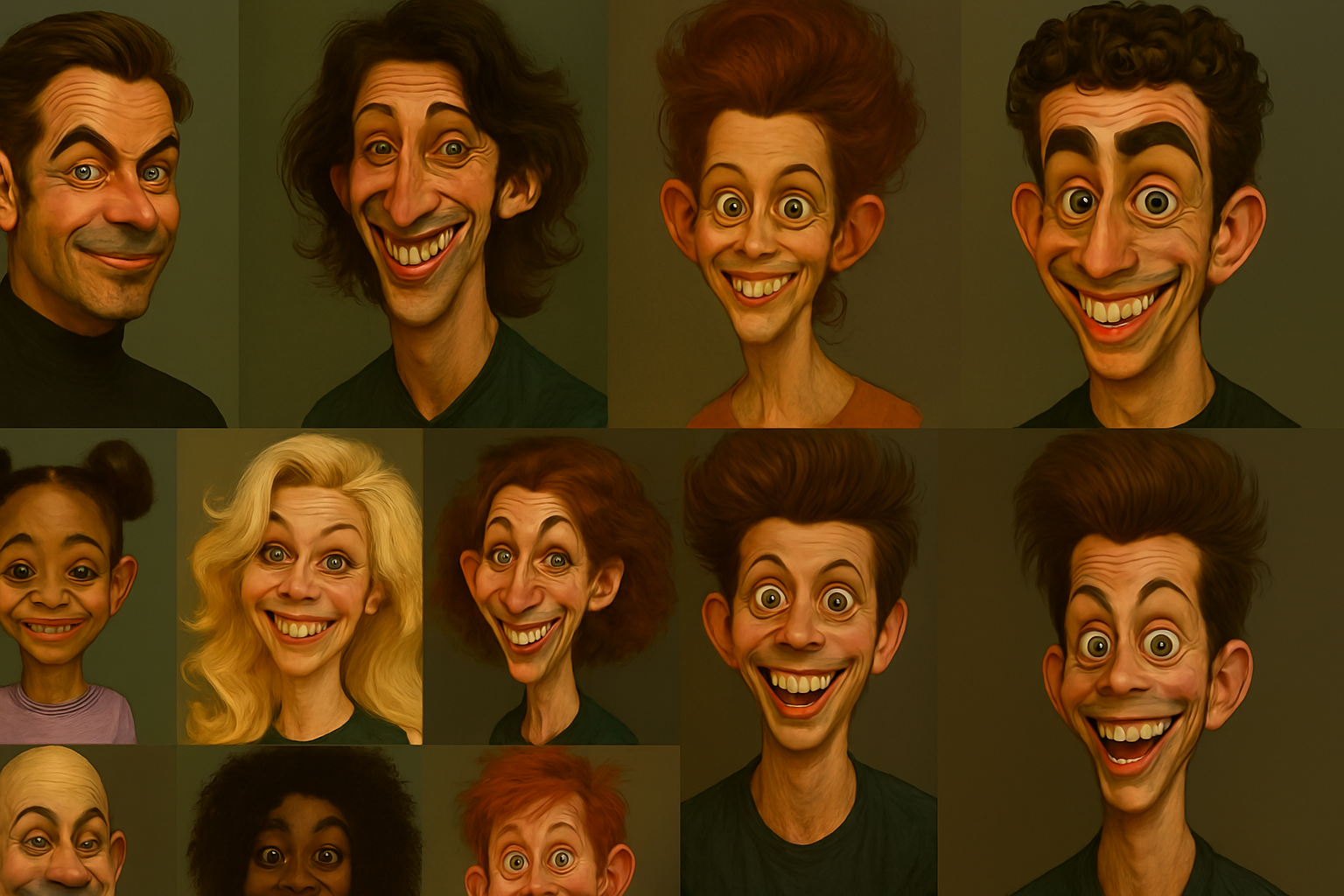
Ever looked at a funny cartoon version of a celebrity and wondered how artists make those hilarious exaggerated drawings? That’s the magic of caricature art! Drawing caricatures from photos is an exciting skill that anyone can learn, whether you’re doodling in your sketchbook or creating digital art on a tablet. This art form combines observation, creativity, and a dash of humor to transform ordinary photographs into entertaining, recognizable portraits that capture someone’s personality in a playful way.
Key Points Summary:
- Caricatures exaggerate distinctive features while maintaining likeness
- High-quality reference photos are essential for success
- The process involves observation, sketching, and thoughtful exaggeration
- Practice and experimentation lead to improvement
- Both traditional and digital tools work perfectly for beginners
What Makes a Caricature Special?
A caricature is more than just a silly drawing—it’s a unique form of portrait art that emphasizes a person’s most memorable features. Think of it as a visual joke that’s also a compliment. The best caricatures make you laugh while immediately recognizing who they represent.
The history of caricature art goes back centuries, with artists using this technique to comment on society, politics, and everyday life. Today, you’ll find famous caricature artists at theme parks, street fairs, and working digitally for magazines and websites.
The Three Essential Elements
Every successful caricature balances three critical components:
| Element | Description | Why It Matters |
|---|---|---|
| Likeness | The drawing must be recognizable as the subject | Without likeness, it’s just a random cartoon |
| Exaggeration | Distinctive features are amplified or minimized | This creates the humor and visual impact |
| Personality | Capturing the subject’s character and spirit | Makes the artwork feel alive and authentic |
Why Learn Drawing Caricatures from Photos?
Using photographs as references offers tremendous advantages for aspiring caricature artists. Photos don’t move, get tired, or need breaks! You can study facial features at your own pace, comparing different angles and expressions. Plus, you can practice with images of anyone—family members, friends, or even celebrities—without needing them to pose for hours.
Photos also help you build confidence before attempting live caricature drawing, which requires working quickly while someone watches. Starting with photo references lets you experiment freely and develop your unique artistic style. If you’re just getting started with drawing basics, using photos makes learning fundamentals much easier.
Selecting Your Reference Photo


The quality of your reference photo directly impacts your final caricature. Look for images with these characteristics:
- Sharp focus and good resolution
- Even lighting that reveals facial contours
- Clear facial features without shadows obscuring details
- Natural expressions that show personality
- Straight-on or three-quarter views work best for beginners
Avoid blurry selfies, heavily filtered images, or photos where the face is too small. If you’re looking for quality reference images, check out free stock photos for artists where you can find multiple photos of the same person from different angles—this helps you understand their three-dimensional features better.
Understanding Faces: Your Foundation for Caricature Drawing
Before you start exaggerating features, you need to understand normal facial proportions. This might seem contradictory, but knowing the rules helps you break them effectively! Learning how to draw faces for beginners provides essential knowledge about facial anatomy.
Basic Facial Anatomy
The human face follows general proportion guidelines:
- Eyes sit roughly halfway down the head
- The distance between eyes equals one eye-width
- The nose tip aligns with the bottom of the ears
- The mouth sits about halfway between nose and chin
Once you recognize these standard proportions in your reference photo, you can identify which features deviate from the norm—those are your opportunities for exaggeration!
Identifying Dominant Characteristics
Every face has unique features that make it memorable. Maybe it’s bushy eyebrows, a prominent nose, a wide smile, or a distinctive chin. Study your reference photo and ask yourself:
- What do I notice first about this face?
- Which feature is largest or most unusual?
- What creates this person’s expression or mood?
- If I could change only one or two things, what would make this face most recognizable?
Mastering Exaggeration Techniques
“Exaggeration is the essence of caricature. It’s not about making fun of people—it’s about celebrating what makes them unique and interesting.”
Professional Caricature Artist
The art of exaggeration requires a delicate balance. Push features too far, and you lose likeness. Don’t push enough, and it’s just a regular portrait sketch.
Head Shape and Structure
Start with the overall head shape. Is it round, oval, square, or heart-shaped? Exaggerate the dominant geometry. Someone with a round face gets an even rounder head in your caricature. A long face becomes longer and more oval.
The Eyes: Windows to Personality
Eyes convey enormous personality. Consider:
- Size: Small eyes can become tiny dots; large eyes grow even bigger
- Shape: Round, almond, or droopy—amplify the existing shape
- Distance: Close-set or wide-set eyes can be pushed further
- Expression: Playful, serious, or mischievous—capture and enhance it
Learning to draw realistic eyes first helps you understand what to exaggerate later.
The Nose: Your Playground
According to experienced caricature artists, the nose offers the most opportunities for creative exaggeration. Whether it’s long, button-shaped, hooked, or wide, the nose can handle significant modification while maintaining recognition.
Mouth, Lips, and Expressions
The mouth region communicates emotion and personality. A big smile becomes enormous, thin lips get thinner, and a crooked grin gets delightfully lopsided. Pay attention to teeth, lip fullness, and how the mouth sits in relation to the nose and chin.
Don’t Forget Supporting Features
- Ears: Often overlooked but great for subtle humor
- Chin and jawline: Strong jaws get stronger; weak chins recede further
- Hair: Hairstyles offer excellent exaggeration potential
- Accessories: Glasses, hats, or jewelry can be amplified for effect
Step-by-Step: Drawing Caricatures from Photos

Step 1: Observation and Analysis (5-10 minutes)
Don’t immediately start drawing! Spend time really looking at your reference photo. Squint at it to see major shapes. Cover parts of the face to isolate features. Make mental notes about what stands out.
Step 2: Thumbnail Sketches (10-15 minutes)
Create several small, quick sketches—no bigger than a few inches. These “thumbnails” let you experiment with different levels of exaggeration without committing to a finished drawing. Try making the nose huge in one sketch, the forehead massive in another. This exploration is crucial!
Step 3: Basic Head Shape and Proportions
Once you’ve decided on your approach, lightly sketch your exaggerated head shape. Draw a center line down the face and horizontal guidelines for eyes, nose, and mouth. Remember—these guidelines should follow your exaggerated proportions, not standard ones.
Step 4: Sketching Exaggerated Features
Now add your features, focusing on your chosen dominant characteristics first. Work loosely and don’t worry about perfection. You can always refine later. Keep referring to your photo, but trust your creative instincts about how much to push each feature.
Step 5: Refining the Likeness
Step back (literally!) and compare your drawing to the photo. Does it capture the person’s essence? If not, identify what’s missing. Often, it’s a subtle detail like eyebrow angle or mouth position that makes the difference.
Step 6: Adding Details and Expression
Now’s the time for personality! Add wrinkles, freckles, hair texture, or clothing details. These elements bring your caricature to life and make it feel complete. Don’t overdo it—strategic details work better than cluttering every inch.
Step 7: Inking and Finishing (Optional)
If you want a polished look, trace your final lines with a pen or marker, then erase your pencil guidelines. You can also add shading, color, or leave it as a clean line drawing. Digital artists might use layers in software like Adobe Photoshop or the more drawing-focused Adobe Fresco. Check out our guide on creating your first digital artwork if you’re interested in digital techniques.
Video: Professional caricature artist demonstrates techniques for beginners
Tools and Materials You’ll Need
Traditional Drawing Tools
Starting with traditional tools is affordable and accessible. Our guide to the best paint brushes for beginners covers some fundamental art supplies, though for caricature drawing you’ll focus on:
- Pencils: Get a range from hard (H) to soft (B). A 2B pencil works great for sketching
- Erasers: Both kneaded erasers and regular ones are useful
- Paper: Any smooth drawing paper works; sketch pads are convenient
- Optional: Fine-tip pens for inking, colored pencils or markers for finishing
Digital Drawing Options
If you prefer digital art, check out top free digital art software options:
- Drawing tablet: Entry-level options like Wacom Intuos are budget-friendly
- Stylus: For iPad users, the Apple Pencil offers excellent control
- Software: Free options like Krita or affordable ones like Procreate for iPad
- Learning resources: Platforms like Skillshare offer numerous caricature courses
Essential Tips for Beginners

Start Simple: Don’t attempt to draw celebrities with complex features right away. Begin with friends or family members whose faces you know well. Familiarity helps you identify their unique characteristics more easily.
Practice Regularly: Like any artistic skill, caricature drawing improves with consistent practice. Try drawing one caricature weekly, or even daily quick sketches. Check out our creative art prompts and creative doodling ideas for inspiration. The more faces you study, the better you’ll understand facial diversity.
Embrace Mistakes: Your first caricatures probably won’t be masterpieces—and that’s perfectly okay! Each “failed” attempt teaches you something valuable. Keep your early work to track your progress over time. Our article on common painting mistakes beginners make offers valuable lessons.
Focus on Personality: The best caricatures capture something deeper than physical appearance. Try to convey whether someone is serious, playful, sophisticated, or goofy. This intangible quality separates good caricatures from great ones.
Respect Your Subject: While exaggeration is essential, avoid being mean-spirited or disrespectful. The goal is playful humor, not mockery. This is especially important when drawing real people who might see your artwork.
Common Mistakes to Avoid
- Over-exaggerating everything: Choose one or two features to emphasize dramatically rather than pushing every feature to extremes
- Losing the likeness: If you exaggerate so much that the person becomes unrecognizable, you’ve created a random cartoon, not a caricature
- Ignoring the head and body relationship: Remember to show at least a hint of neck and shoulders for context
- Forgetting about hair: Hair is often a key identifying feature—don’t neglect it
- Working too small: Give yourself space to work; tiny drawings make it harder to capture details
If you’re struggling, our guide on how to overcome creative blocks for painters offers helpful strategies.
Taking Your Skills Further
Once you’ve mastered basic techniques for drawing caricatures from photos, you can expand your practice in exciting ways. Try different art styles—some caricature artists use bold, angular lines while others prefer soft, rounded shapes. Experiment with color theory and understanding color theory in art to add depth to your work.
Consider studying famous caricature artists to see their approaches. Organizations like the National Caricaturist Network showcase professional work and offer resources for improving your craft. You might even attend caricature conventions or workshops to learn directly from experienced artists.
Digital artists can explore animation, turning static caricatures into moving characters. Traditional artists might experiment with various media like watercolor or ink wash for different effects. Check out our guides on different painting techniques for more ideas.
Frequently Asked Questions
How do you draw a caricature from a photo? Start by studying your reference photo to identify distinctive features. Create thumbnail sketches exploring different exaggerations, then draw an exaggerated head shape. Add your emphasized features while maintaining recognizability, and finish with details that capture personality.
What are the 3 elements of a caricature? The three essential elements are likeness (recognizability), exaggeration (amplified distinctive features), and personality (capturing the subject’s character and spirit). Balancing these three aspects creates successful caricatures.
What features do you exaggerate in a caricature? Focus on the most prominent or unusual features—commonly the nose, eyes, chin, forehead, or ears. Also consider head shape, hair, facial expressions, and the relationship between features. Choose one or two dominant features to exaggerate dramatically rather than pushing everything equally.
Can you draw caricatures from a photo? Absolutely! Drawing caricatures from photos is an excellent way to practice and develop your skills. Photos provide stable references you can study at your own pace, making them ideal for beginners learning exaggeration techniques and facial proportions.
What is the first step in drawing a caricature? The first step is careful observation and analysis. Study your reference photo for 5-10 minutes before drawing anything. Identify which features are most distinctive, consider the overall head shape, and determine which characteristics best capture the person’s personality.
Your Caricature Journey Starts Now
Learning the art of drawing caricatures from photos opens up a world of creative expression and entertainment. Whether you’re creating personalized gifts, developing a unique artistic skill, or just having fun with pencil and paper, caricature drawing offers endless possibilities for creativity and humor.
Remember that every professional caricature artist started exactly where you are now—with a pencil, a photo, and curiosity. The difference between them and beginners isn’t talent; it’s practice, patience, and persistence. Each face you draw teaches you something new about proportion, exaggeration, and personality. For more inspiration, explore our collection of easy things to draw to keep your creativity flowing.
So grab a photo, your drawing supplies, and start experimenting! Don’t worry about perfection—focus on capturing what makes each face special and interesting. Before you know it, you’ll be creating caricatures that make people smile and say, “That’s exactly them!”

Additional Resources
Learning Platforms:
- Proko – Figure Drawing Fundamentals – Excellent resource for understanding facial anatomy
- Skillshare Caricature Classes – Various courses from beginner to advanced
- Ctrl+Paint – Free digital painting and drawing lessons
Professional Organizations:
- National Caricaturist Network – Community and resources for caricature artists
- International Society of Caricature Artists – Professional organization with competitions and events
Digital Tools:
- Adobe Creative Cloud – Professional-grade software including Photoshop and Fresco
- Procreate – Popular iPad app for digital illustration
- Krita – Free, open-source digital painting program
Inspiration and Reference:
- The Caricaturist Blog – Industry news and artist features
- Pinterest Caricature Boards – Thousands of examples for style inspiration