
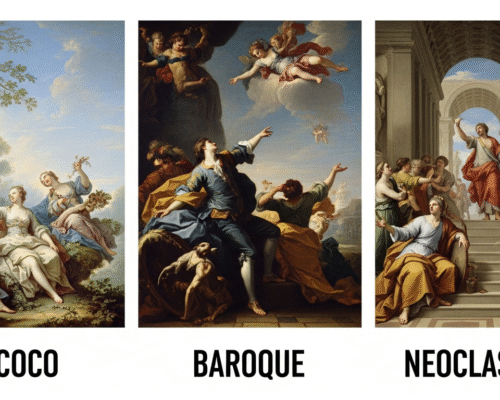
Have you ever walked through a museum and wondered why some paintings look so calm and serious, with people dressed in togas standing in perfectly balanced poses? You might have been looking at Neoclassical art – a fascinating style that brought ancient Greek and Roman ideas back to life during the 1700s and 1800s. Learning how to identify Neoclassical art doesn’t require a fancy art degree; with a few simple clues, you’ll be spotting these masterpieces like a pro in no time!
Key Points Summary
- Neoclassical art emerged in the mid-18th century as a revival of ancient Greek and Roman styles
- Look for balanced compositions, idealized figures, and serious themes about heroes and virtue
- The movement was a reaction against the fancy, decorative Rococo style
- Famous artists include Jacques-Louis David, Jean-Auguste-Dominique Ingres, and Antonio Canova
- Key features: smooth surfaces, no visible brushstrokes, sober colors, and classical subjects
- Influenced by the Enlightenment, archaeological discoveries, and revolutionary ideals
What Exactly Is Neoclassical Art?
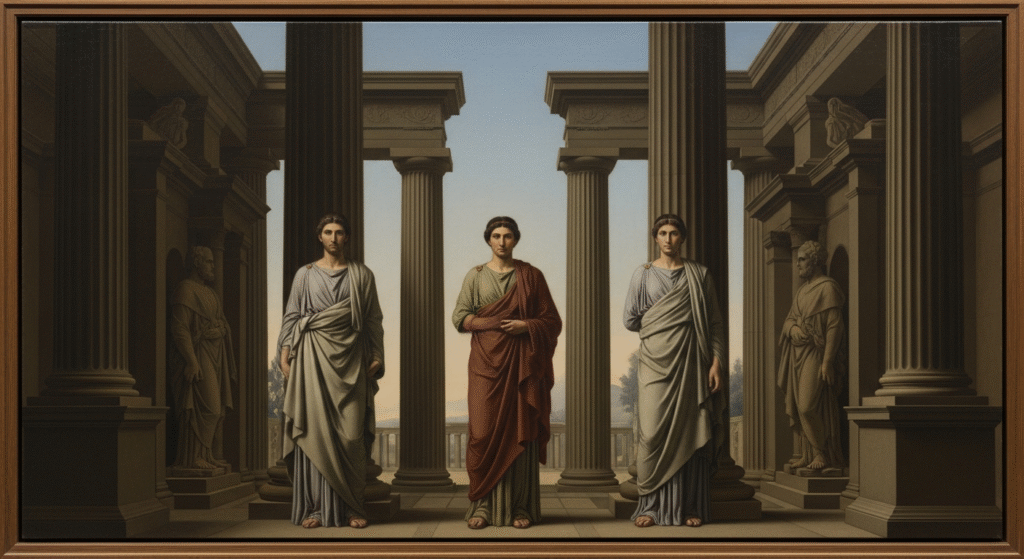
Let’s start with the basics. The word “Neoclassical” literally means “new classical” – think of it as a reboot of ancient art. Between the mid-1750s and early 1800s, artists became obsessed with recreating the beauty and values of ancient Greece and Rome.
Imagine if today’s artists suddenly decided that art from the 1960s was the absolute best, and everyone started painting like Andy Warhol again. That’s basically what happened during the Neoclassical period, except they were looking back about 2,000 years instead of 60!
This wasn’t just about copying old statues and buildings. Neoclassical art represented a complete shift in thinking about what art should be and do. Artists wanted to create works that taught moral lessons, celebrated heroes, and made people think about duty, honor, and virtue.
The Historical Ingredients That Cooked Up Neoclassicism
The Age of Enlightenment: When Reason Ruled
During the 1700s, Europe went through a major intellectual makeover called the Enlightenment. Philosophers and thinkers started questioning everything—religion, government, even art. They believed that reason, logic, and order should guide human life.
This affected art in a big way. Instead of the swirly, emotional, over-the-top styles that came before, artists started craving simplicity and clarity. They wanted art that made sense, followed rules, and taught important lessons about being a good person and citizen.
Digging Up the Past: Pompeii and Herculaneum
In 1738 and 1748, archaeologists made some mind-blowing discoveries: they found the ancient Roman cities of Herculaneum and Pompeii, perfectly preserved under volcanic ash from Mount Vesuvius.
Suddenly, people could see exactly how ancient Romans lived, what their houses looked like, and what kind of art they made. It was like finding a time capsule! Artists rushed to study these discoveries, sketching every statue, wall painting, and mosaic they could find.
The Grand Tour: Study Abroad for Rich Kids
Wealthy young European men (and occasionally women) took something called the “Grand Tour” – basically a gap year traveling around Europe, with a major focus on Italy. They’d visit Rome, Florence, and Venice, studying ancient ruins and Renaissance masterpieces.
These travelers came home full of ideas about classical art and architecture, which influenced artists, architects, and designers back home. The Grand Tour helped spread Neoclassical ideas across Europe and eventually to America.
Revolution in the Air
The late 1700s saw two massive revolutions: the American Revolution (1776) and the French Revolution (1789). Both revolutions looked back to ancient Greek and Roman republics as models for government.
Ancient Rome and Greece became symbols of democracy, civic virtue, and liberty. Artists connected these classical ideals with modern revolutionary values, creating paintings that celebrated both ancient heroes and contemporary revolutionary figures.
Core Principles: What Neoclassical Artists Believed
Before we jump into identifying specific artworks, let’s understand what Neoclassical artists actually valued:
| Principle | What It Means |
|---|---|
| Harmony | Everything in the artwork should work together perfectly, like a well-organized team |
| Clarity | The message and composition should be crystal clear—no confusion allowed |
| Restraint | Less is more; avoid excessive decoration or emotion |
| Universality | Artworks should speak to timeless human experiences, not just passing trends |
| Idealism | Show the perfect version of reality, not reality’s messy truth |
| Order | Logical arrangement and structure are essential |
| Virtue | Art should teach moral lessons and celebrate good behavior |
Think of Neoclassical art as the serious, studious kid in class who always follows the rules and gets their homework done perfectly. Meanwhile, the Baroque and Rococo styles that came before were more like the loud, dramatic kids who loved showing off.
How to Identify Neoclassical Painting: Your Detective Guide
Now for the fun part—let’s learn how to spot Neoclassical paintings! Think of yourself as an art detective, looking for specific clues.
Clue #1: Subject Matter – What’s the Story?
Neoclassical paintings almost always show:
- Ancient Greek and Roman stories: Heroes, gods, famous battles, and mythological tales
- Moral lessons: Stories that teach you to be brave, honorable, and virtuous
- Heroic deeds and civic duty: People sacrificing for their country or family
- Contemporary events dressed up as ancient ones: Modern people posed like ancient Romans
If you see people in togas doing something serious and noble, you’re probably looking at Neoclassical art!

Example: Jacques-Louis David’s famous painting Oath of the Horatii (1784) shows three Roman brothers swearing to fight for Rome, even though it might mean fighting their own relatives. It’s dramatic, but in a controlled, serious way – not wild and emotional.
Clue #2: Composition and Form—How Is It Arranged?
Neoclassical paintings look like they were designed with a ruler and compass:
- Clear, linear design: Strong, clean lines everywhere
- Horizontal and vertical emphasis: Lots of straight lines going across and up-down
- Shallow space: The scene doesn’t go super deep into the background
- Balanced arrangement: If you drew a line down the middle, both sides would feel equally weighted
- Geometric organization: Everything fits into invisible squares, triangles, and rectangles
Unlike Romantic art, which could be wild and unpredictable, Neoclassical compositions feel stable and carefully planned.
Clue #3: Color and Light – What’s the Palette?
Neoclassical artists weren’t big fans of bright, cheerful colors:
- Sober, serious colors: Think browns, grays, dark blues, and muted reds
- Non-decorative: Colors serve the composition, not decoration
- Single light source: Light comes from one direction, creating clear shadows
- Strong contrasts: Bold differences between light and dark areas (called chiaroscuro)
The colors in Neoclassical paintings often look like what you’d see in an old photograph—dignified and restrained, not flashy.
Clue #4: The Figures – How Do People Look?
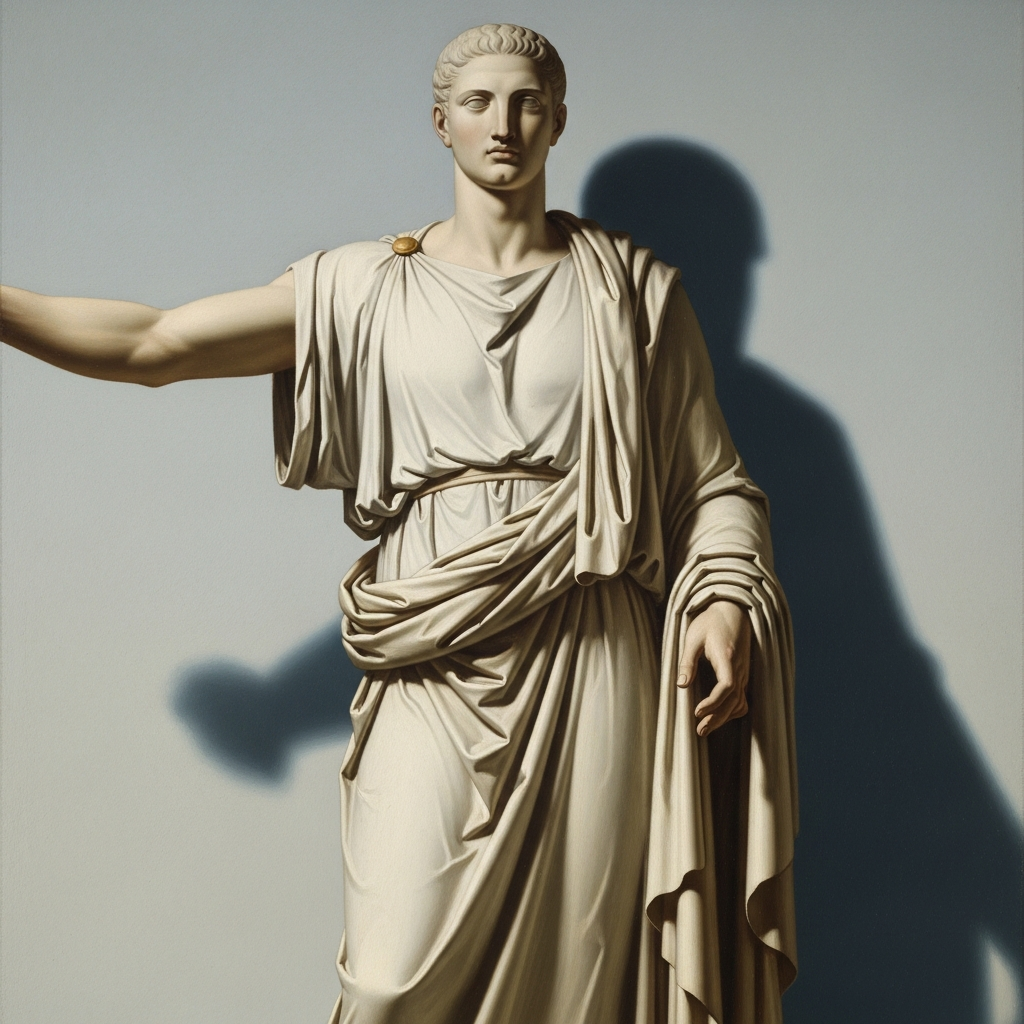
The people in Neoclassical art have a very specific vibe:
- Idealized bodies: Perfect proportions based on ancient Greek statues, not real people
- Stoic expressions: Serious, calm faces – nobody’s having a giggling fit
- Lack of obvious emotion: Even in dramatic moments, figures stay composed
- Rigid, geometric poses: People stand or sit in carefully arranged positions
- Classical clothing: Togas, robes, and ancient-style outfits
Think of Neoclassical figures as ancient Greek statues that came to life – they’re beautiful but emotionally distant.
Clue #5: Surface Quality – The Paint Itself
Here’s a super easy way to identify Neoclassical painting:
- Smooth, polished surface: The paint looks almost like porcelain
- No visible brushstrokes: You shouldn’t be able to see how the artist applied the paint
- Finished, refined appearance: Everything looks perfectly complete
Compare this to Impressionist paintings, where you can see every brushstroke! Neoclassical artists wanted their work to look effortless and perfect.
Famous Neoclassical Painters You Should Know
Jacques-Louis David (1748-1825): The King of Neoclassicism
David was basically the superstar of Neoclassical painting. He lived through the French Revolution and even served in the revolutionary government!
Famous works:
- Oath of the Horatii (1784): Three brothers swearing loyalty to Rome
- Death of Marat (1793): A revolutionary hero assassinated in his bathtub
- Napoleon Crossing the Alps (1801): The emperor looking heroic on horseback
David’s paintings are like textbooks on Neoclassicism—clear composition, moral themes, and perfectly painted surfaces.
Jean-Auguste-Dominique Ingres (1780-1867): The Perfectionist
Ingres studied under David and took the Neoclassical style even further. He was obsessed with perfect drawing and smooth surfaces.
Famous works:
- The Valpinçon Bather (1808): A woman’s back painted with incredible smoothness
- La Grande Odalisque (1814): An exotic figure that blends Neoclassicism with Romanticism
- Portrait of Monsieur Bertin (1832): A realistic portrait with Neoclassical clarity
Angelica Kauffman (1741-1807): Breaking Barriers

Kauffman was one of the few successful female artists of her time and a founding member of the British Royal Academy of Arts.
Famous works:
- Ariadne Abandoned by Theseus (1774): A mythological scene with emotional restraint
- Cornelia, Mother of the Gracchi (1785): A moral tale about virtue and motherhood
Spotting Neoclassical Sculpture: Marble Perfection
Neoclassical sculpture is easier to identify than painting because the style is so distinctive!
What to Look For:
Subject Matter:
- Gods and goddesses from Greek and Roman mythology
- Heroic figures and virtuous themes
- Contemporary people posed like ancient statues
Form and Style:
- Perfectly proportioned bodies based on ancient Greek ideals
- Smooth, idealized surfaces
- Monumental scale (many sculptures are life-size or larger)
- Anatomical accuracy mixed with idealization
Emotion:
- Calm, serene expressions
- Cool, controlled feeling even in dramatic scenes
- Grace and dignity over raw emotion
Materials:
- Usually pristine white marble
- Polished to a smooth finish
“The imitation of the Greeks in painting and sculpture is the only way for us to become great, perhaps inimitable.”
Johann Joachim Winckelmann, influential art historian and father of Neoclassicism
Antonio Canova (1757-1822): The Marble Magician

Canova was the most famous Neoclassical sculptor. He could make marble look as soft as skin!
Famous works:
- Psyche Revived by Cupid’s Kiss (1787-1793): A tender mythological scene
- Napoleon as Mars the Peacemaker (1806): The emperor portrayed as a Roman god
- The Three Graces (1814-1817): Three goddesses in perfect harmony
Hiram Powers (1805-1873): America’s Neoclassical Star
Powers brought Neoclassicism to America and became internationally famous.
Many American museums and government buildings use Neoclassical architecture because the founding fathers wanted to connect America with ancient democratic ideals.
Famous work:
- The Greek Slave (1843): A controversial sculpture of a nude woman in chains that became a sensation across America and Europe
Neoclassical Architecture: Building Like the Ancients
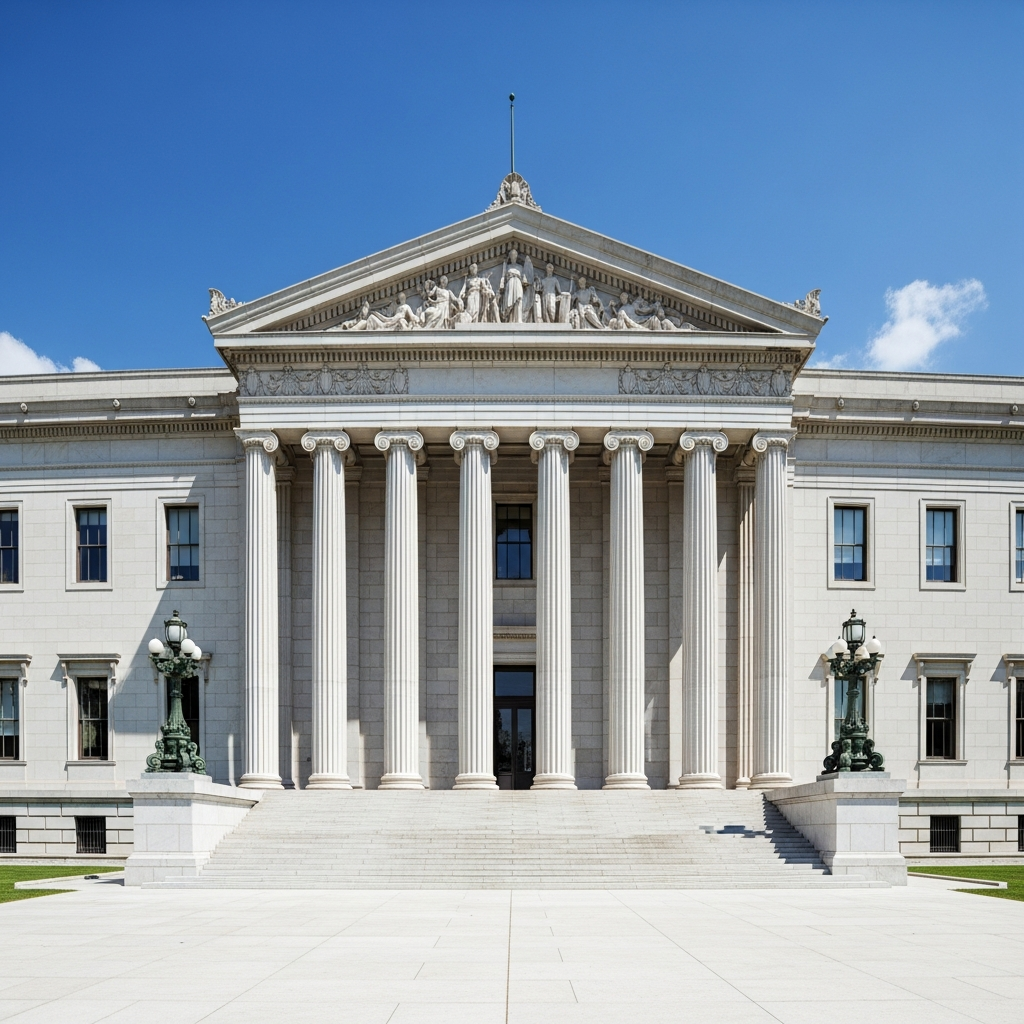
Neoclassical architecture is probably the easiest style to spot because it’s still everywhere today – courthouses, museums, banks, and government buildings often use this style!
Identifying Features:
| Element | Description |
|---|---|
| Columns | Classical Greek orders (Doric, Ionic, or Corinthian) |
| Pediments | Triangular sections above entrances, like Greek temples |
| Symmetry | Perfectly balanced design |
| Domes | Large, rounded roofs inspired by the Roman Pantheon |
| Grand Scale | Impressive, monumental size |
| Geometric Forms | Clear circles, squares, and rectangles |
| Simplicity | Minimal decoration compared to Baroque or Rococo |
Famous Examples:
- The United States Capitol Building in Washington, D.C.
- The Panthéon in Paris
- The Brandenburg Gate in Berlin
- The British Museum in London
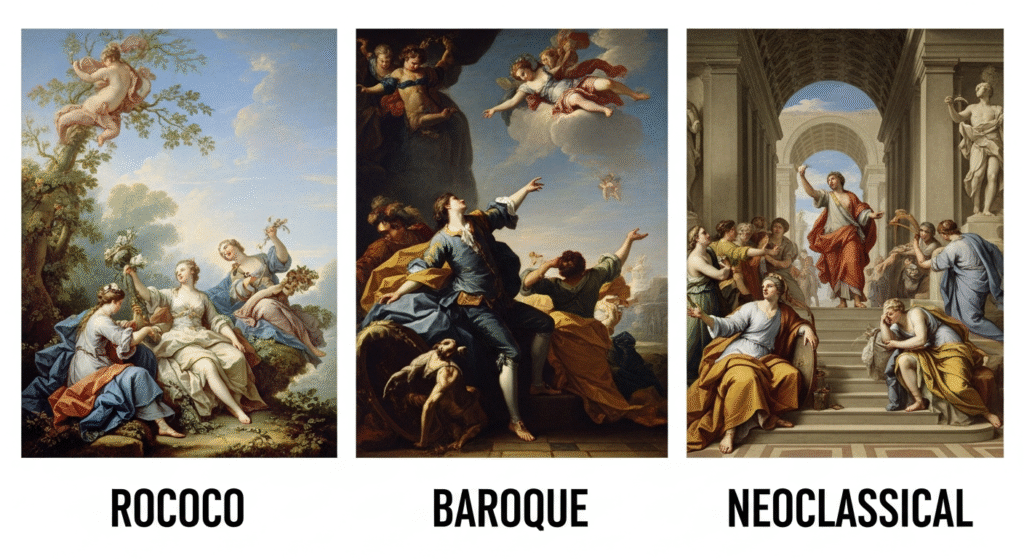
Neoclassicism vs. Rococo vs. Baroque: What’s the Difference?
This is where many people get confused! Let’s break down the differences:
Neoclassical vs. Rococo
Rococo (early-mid 1700s) was all about luxury, playfulness, and decoration:
| Feature | Rococo | Neoclassical |
|---|---|---|
| Mood | Frivolous, lighthearted, playful | Serious, moral, educational |
| Colors | Pastel pinks, blues, golds | Sober browns, grays, muted tones |
| Subject | Love, mythology (sexy versions), aristocratic leisure | Heroes, virtue, civic duty |
| Composition | Asymmetrical, flowing, decorative | Symmetrical, balanced, austere |
| Ornamentation | Elaborate, excessive decoration | Minimal, restrained decoration |
| Emotion | Light, romantic, sensual | Controlled, stoic, dignified |
Think of Rococo as a fancy birthday party with cake and decorations everywhere, while Neoclassicism is like a serious graduation ceremony.
Neoclassical vs. Baroque
Baroque (1600s-early 1700s) was dramatic and emotional:
| Feature | Baroque | Neoclassical |
|---|---|---|
| Emotion | Intense, dramatic, passionate | Restrained, controlled, calm |
| Movement | Swirling, dynamic, energetic | Static, stable, balanced |
| Light | Dramatic contrasts, theatrical lighting | Clear, rational lighting |
| Decoration | Rich, ornate, abundant | Simple, minimal, classical |
| Theme | Religious intensity, drama | Moral virtue, civic duty |
| Composition | Diagonal movement, complex | Horizontal/vertical, clear |
Baroque is like an action movie with explosions and drama, while Neoclassicism is like a documentary that teaches you important lessons.
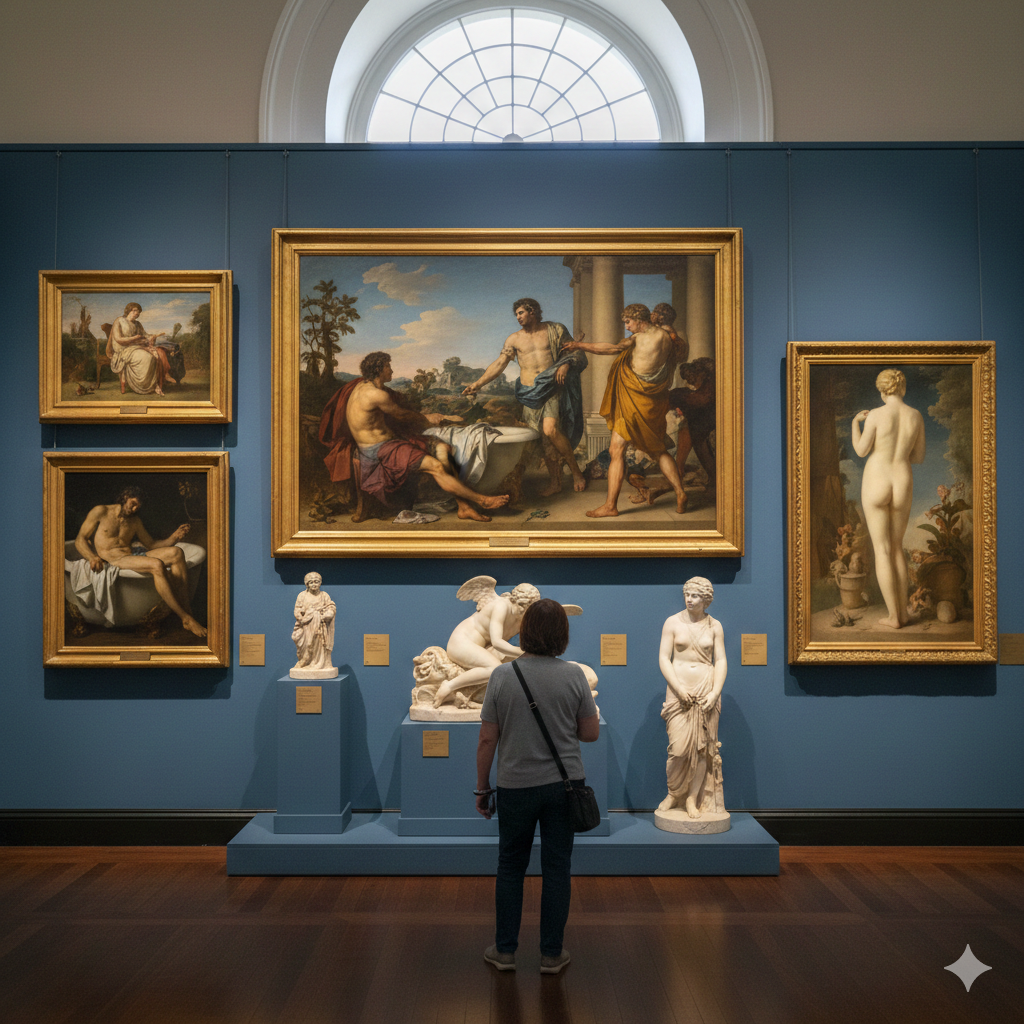
Quick Tips for Identifying Neoclassical Art in Museums
When you’re standing in front of a painting and wondering if it’s Neoclassical, ask yourself these questions:
- Does it show ancient Greeks or Romans, or people dressed like them? ✓
- Is the composition super balanced and organized? ✓
- Are the colors serious and muted rather than bright and cheerful? ✓
- Do the people have calm, emotionless expressions? ✓
- Is the surface smooth with no visible brushstrokes? ✓
- Does it seem to teach a moral lesson about virtue or duty? ✓
If you answered “yes” to most of these questions, you’re probably looking at Neoclassical art!
Here’s a simple memory trick: Think “New Classical = Rules, Reason, Rome!“
The Legacy: Why Neoclassicism Still Matters
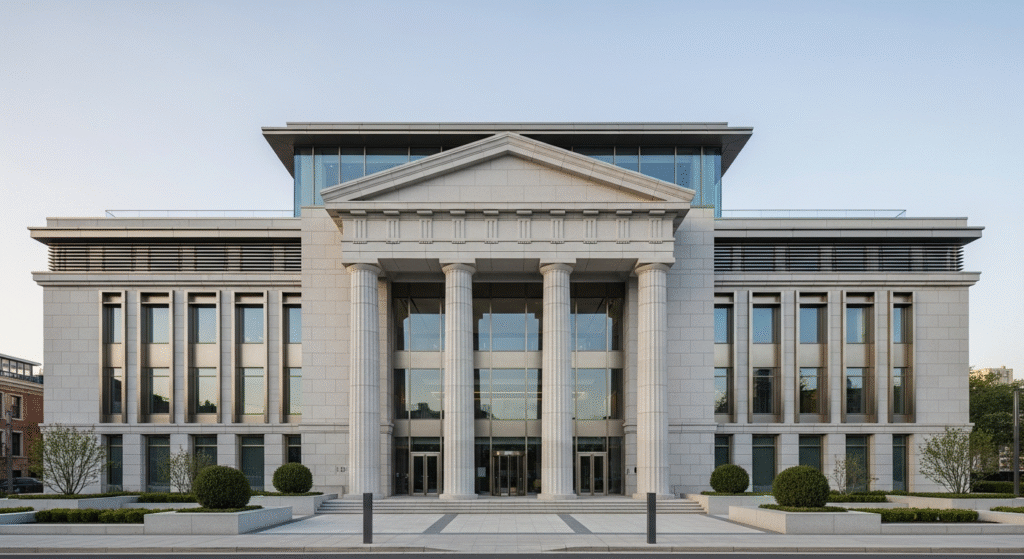
Neoclassical art might seem old-fashioned, but its influence is everywhere! Every time you see:
- A government building with columns
- A museum with a grand entrance
- A statue in a public park
- Classical references in movies or TV shows
…you’re seeing Neoclassicism’s lasting impact.
The movement also established important ideas about art that influenced later styles. Even though Romantic artists rebelled against Neoclassical rules, and Impressionists threw out the smooth surfaces, they were all responding to Neoclassical ideas.
Understanding Neoclassical art helps you appreciate not just these specific works, but how art movements react to and build on each other. It’s like understanding one chapter in a long, fascinating story that continues today.
Your Turn to Be an Art Detective!
Now that you know how to identify Neoclassical art, you’re ready to put your skills to the test! Next time you visit a museum or browse art online, look for those telltale signs: balanced compositions, idealized figures, moral themes, and smooth surfaces.
Remember, the beauty of Neoclassical art lies in its clarity, restraint, and connection to timeless ideals of virtue and beauty. While it might not be as flashy as other styles, there’s something powerful about art that speaks to universal human values and presents them with such technical perfection.
So grab a friend, head to your nearest art museum, and see how many Neoclassical artworks you can identify. You might be surprised at how much you’ve learned—and how much more interesting art becomes when you understand what you’re looking at!
Frequently Asked Questions
What are the main characteristics of Neoclassical art?
The main characteristics of Neoclassical art include idealized human figures, balanced and symmetrical compositions, smooth paint surfaces without visible brushstrokes, sober color palettes, subjects drawn from Greek and Roman history or mythology, moral and virtuous themes, clear linear design, and restrained emotion. The style emphasizes reason, order, and classical ideals over decoration and drama.
How does Neoclassical art differ from the preceding Rococo style?
Neoclassical art differs dramatically from Rococo in mood, subject matter, and technique. While Rococo art was playful, decorative, asymmetrical, and featured pastel colors with lighthearted themes of love and aristocratic leisure, Neoclassical art was serious, moral, symmetrical, and used sober colors to depict heroic deeds and civic virtue. Neoclassicism rejected Rococo’s frivolous sensuality in favor of restrained dignity and educational content.
Which artists are well-known for their Neoclassical style?
The most famous Neoclassical artists include Jacques-Louis David (known for Oath of the Horatii and Death of Marat), Jean-Auguste-Dominique Ingres (famous for The Valpinçon Bather), Angelica Kauffman (celebrated for Ariadne Abandoned by Theseus), sculptor Antonio Canova (creator of Psyche Revived by Cupid’s Kiss), and American sculptor Hiram Powers (known for The Greek Slave). David is often considered the leading figure of the movement.
What historical events influenced the Neoclassical art movement?
The Neoclassical art movement was influenced by several major historical events: the Age of Enlightenment’s emphasis on reason and order, the archaeological discoveries of Pompeii and Herculaneum in 1738 and 1748, the Grand Tour tradition that exposed wealthy Europeans to classical art and architecture, and the revolutionary ideals of both the American Revolution (1776) and French Revolution (1789), which looked back to ancient Greek and Roman republics as models for democratic government.
When did the Neoclassical art movement take place?
The Neoclassical art movement flourished from the mid-18th century (approximately 1750s) through the early 19th century (around 1830). It emerged as a reaction against the Rococo style and eventually gave way to Romanticism. The movement’s peak coincided with the Age of Enlightenment and the revolutionary period in Europe and America.
Why did Neoclassical artists idealize human figures?
Neoclassical artists idealized human figures because they wanted to represent universal, timeless beauty based on ancient Greek and Roman standards of perfection. Rather than depicting real people with individual imperfections, they aimed to show humanity at its best – both physically and morally. This idealization reflected Enlightenment values of reason and the belief that art should elevate viewers by showing perfect examples of virtue and beauty.
What is the difference between Neoclassical and Baroque art?
Neoclassical art emphasizes restraint, clarity, balance, and moral themes, while Baroque art features dramatic emotion, dynamic movement, intense contrasts, and theatrical compositions. Baroque artworks often have swirling diagonal compositions and rich ornamentation, whereas Neoclassical works use horizontal and vertical structures with minimal decoration. Baroque tends toward religious intensity and drama, while Neoclassicism focuses on civic virtue and rational order.
Citations:
- Neoclassical Art: History, Characteristics & Artists – Explores emphasis on linear design over color and light effects.
- The Long Influence of Classicism – Details the rejection of Rococo for symmetry and geometric clarity.
- Neoclassicism: An Introduction – Discusses rational drawing, smooth surfaces, and shallow pictorial space.
- What Is Neoclassicism? – Defines the movement by its pursuit of harmony and rigor.
- Neoclassical Art Overview – Highlights the influence of archaeology on 18th-century artistic taste.
- Neoclassicism Movement Summary – Covers the movement’s moralizing messages and Greco-Roman ideal virtues.