The art world runs on blood.
Not metaphorically. Actual rivalry. Actual hatred. These weren’t polite disagreements over coffee – they were territorial wars fought with pigment and ego. When two titans collide, the friction doesn’t produce gentle sparks. Great rivalries in the art world produce fire that burns through decades.
Forget the myth of the serene artist contemplating beauty in quiet solitude. That’s marketing. The real story? Artists are vicious. Competitive. Driven by something subcutaneous and raw – a need not just to create, but to dominate. To be seen. To obliterate the competition.
These rivalries weren’t sidebar drama. They were the engine. Picasso didn’t revolutionize form because he felt like it one morning. He did it because Matisse existed. Bacon painted meat because Freud painted flesh. The tension between opposing forces – different philosophies, clashing temperaments, incompatible visions – created a pressure so intense it fractured the entire trajectory of art history.
This is what they won’t tell you in museum wall texts: genius needs an enemy. It needs someone to destroy, someone to prove wrong, someone whose success feels like a personal insult. Without rivalry, art gets comfortable. Soft. Safe.
And safe art is dead art.
The greatest work emerges from conflict. From artists who looked at their contemporaries’ canvases and thought, “I can obliterate that.” Who stayed up nights fueled by rage and inadequacy and the burning need to be better. Who let that competitive fire push them past technical mastery into something visceral and unprecedented.
That’s the real inheritance these feuds left us. Not just paintings. Not just sculptures. But proof that art advances through combat.
What Makes an Artistic Rivalry Great?
The Psychology Behind Creative Competition
Artistic rivalries aren’t born from simple jealousy or ego—they stem from deeper psychological and creative forces. When two brilliant minds work in similar spheres, their proximity creates a natural tension that can either destroy or elevate their work. The best rivalries combine mutual respect with fierce competition, pushing both artists beyond their comfort zones.
Elements of Legendary Art Feuds
Great artistic rivalries share certain characteristics:
- Contrasting Styles: The most memorable rivalries pit artists with fundamentally different approaches against each other
- Public Recognition: These battles often played out in the public eye, with audiences choosing sides
- Mutual Influence: Despite their competition, rival artists almost always influenced each other’s work
- Historical Impact: The greatest rivalries changed the course of art history itself
The Renaissance Titans
The Renaissance Showdown: Leonardo vs. Michelangelo
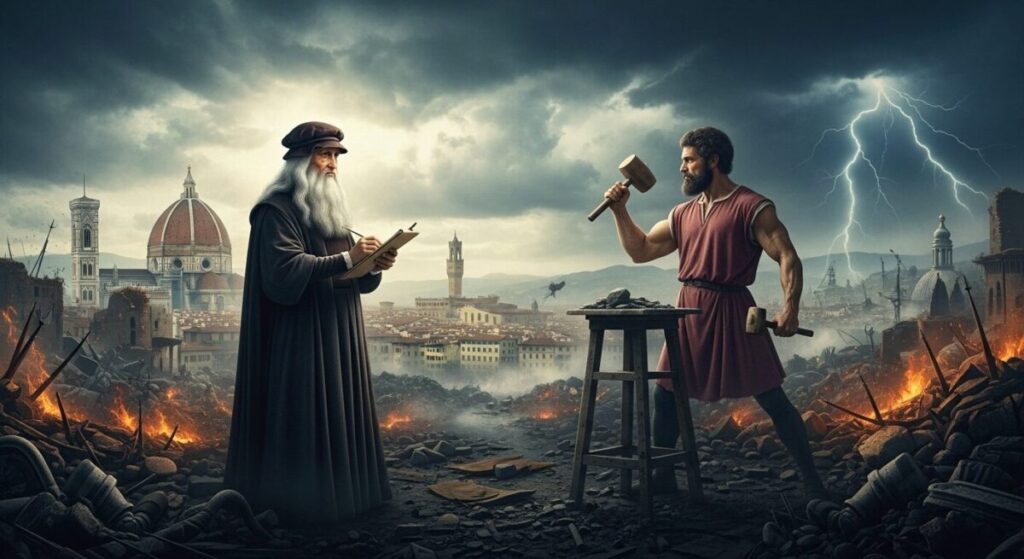
Let’s start with the OG of artistic rivalries: Leonardo da Vinci and Michelangelo. These two were total opposites. Leonardo, the older of the two, was a true Renaissance man. He wasn’t just a painter; he was a scientist, an inventor, and a thinker who was fascinated by everything from human anatomy to flying machines. His art, like the Mona Lisa or The Last Supper, is known for its incredible detail and soft, misty feel, a technique called sfumato. He was always trying to get things just right, sometimes so much that he’d leave a project unfinished.
Then you have Michelangelo, a younger, fiery, and a bit grumpy artist who saw himself as a sculptor first. He believed that the true power of art came from freeing the form hidden within a block of stone. He was known for his intense and dramatic works, like the sculpture of David or the magnificent ceiling of the Sistine Chapel. He thought Leonardo’s scientific approach was a waste of time and famously mocked him for not finishing his horse sculpture.
The Battle of the Frescoes

Their rivalry came to a head in Florence in 1504 when they were both commissioned to paint massive battle scenes on opposite walls of the Palazzo Vecchio. This was a direct, head-to-head competition for the public’s attention. Leonardo was working on The Battle of Anghiari, and Michelangelo was creating The Battle of Cascina. Although neither artist completed their fresco, the sketches and preparations for these works became legendary. The clash of their styles—Leonardo’s fluid motion versus Michelangelo’s muscular, powerful figures—defined the artistic landscape of their time.

Different Approaches, Lasting Impact
Leonardo approached art as a scientist, studying anatomy, light, and movement with mathematical precision. Michelangelo saw art as a spiritual calling, believing that sculpture revealed divine truth hidden in stone. This fundamental difference in philosophy created a rivalry that went beyond technique to the very purpose of art itself. You can learn more about the works of these incredible artists on our page about prominent Renaissance artists. For more information on the beautiful sculptures created by Michelangelo, visit our site about famous Renaissance sculptures.
The Impressionist Era Conflicts
Impressionism’s Odd Couple: Manet vs. Monet
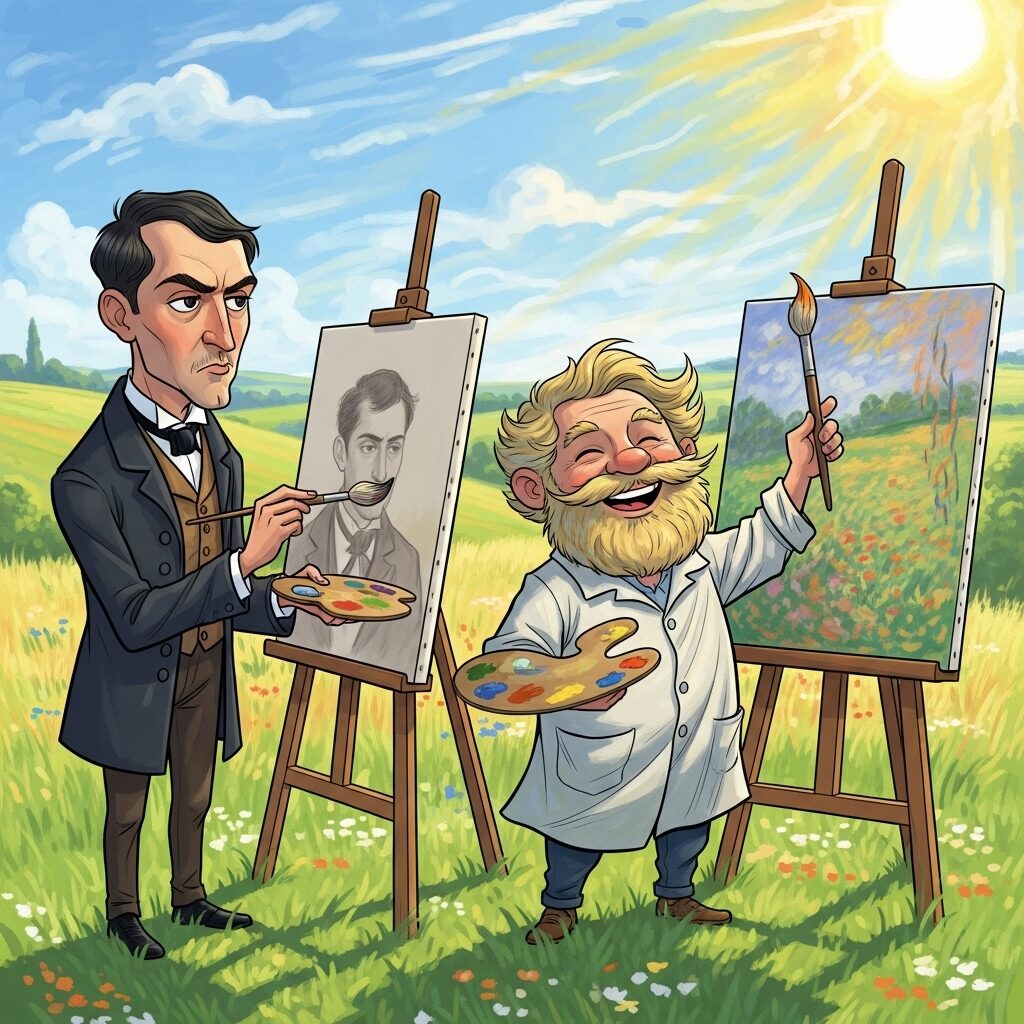
Don’t get them confused! Édouard Manet and Claude Monet, despite their similar names, had a fascinating relationship. Manet was the older, established artist who bridged the gap between Realism and Impressionism. He was a bit of a rebel, creating shocking and scandalous paintings like Le Déjeuner sur l’herbe (The Luncheon on the Grass). He famously refused to join the Impressionists’ independent exhibitions, even though they looked up to him as a leader.
The Great Name Mix-Up
The similar names weren’t just confusing for art historians—they were a source of constant frustration for both artists. Manet often received mail intended for Monet, and vice versa. This mix-up became symbolic of their intertwined yet distinct artistic paths.
Outdoor Painting Revolution
Monet, a younger artist, was the ultimate Impressionist. He was obsessed with capturing the fleeting effects of light and atmosphere in his landscapes. He’d paint the same scene over and over again—like his famous Water Lilies series or the Rouen Cathedral—just to show how light changed throughout the day.
While they weren’t direct rivals in the same way as Picasso and Matisse, their relationship was a mix of friendship and professional competition. Manet painted a famous portrait of Monet and his wife in their garden, and the two often worked side-by-side. Monet’s dedication to painting outdoors and capturing light influenced Manet to experiment with brighter colors and looser brushstrokes. You can read more about how this period of art came to be in our article on the origins of the Impressionist movement.
Modern Art Masters
The Modern Art Melee: Picasso vs. Matisse
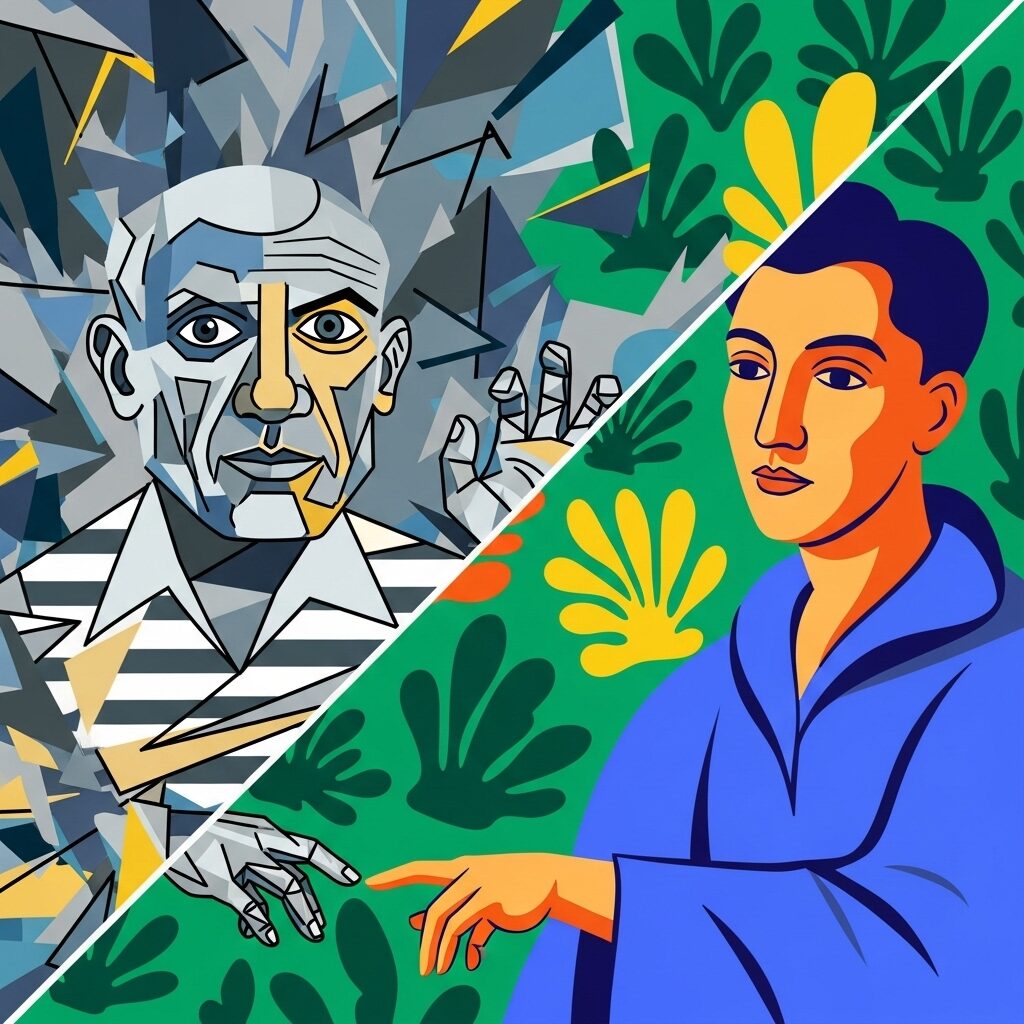
Fast forward to the early 20th century in Paris, where another great rivalry was brewing. This time, the contenders were Pablo Picasso and Henri Matisse. Just like Leonardo and Michelangelo, these two couldn’t have been more different. Matisse was the elder statesman, a master of vibrant color and expressive brushstrokes. His art was all about creating harmony and a sense of calm, famously saying he wanted his art to be like a “good armchair” for the viewer. His work, like The Dance or Woman with a Hat, is pure joy and color.
The Cubist Revolution vs. Fauvist Expression
Picasso, on the other hand, was the young, rebellious genius who wanted to break all the rules. He co-created Cubism, a style that shattered traditional perspective and showed objects from multiple angles at once. His paintings, like Les Demoiselles d’Avignon or Guernica, can be jarring, challenging, and even a little scary.
A Friendship Built on Competition
The competition between them was a friendly but intense game of one-upmanship. They would visit each other’s studios, buy each other’s work (and sometimes even try to steal it!), and constantly push the other to innovate.
“We’ve got to see each other often, because when one of us goes, there are things the other will no longer be able to say to anyone.”
Matisse
Mutual Artistic Evolution
This friendly but competitive relationship was a huge deal for modern art. Matisse’s focus on color pushed Picasso to use brighter, more emotional palettes. In turn, Picasso’s revolutionary ideas about form and space challenged Matisse to find new ways to express himself, leading to his famous “cut-outs” later in life. Their mutual admiration and rivalry shaped the entire course of modern art. To see more about the development of different art styles you can check our post on the history of modern art.
Personal and Professional Entanglements
The Artistic Power Couple: Kahlo and Rivera
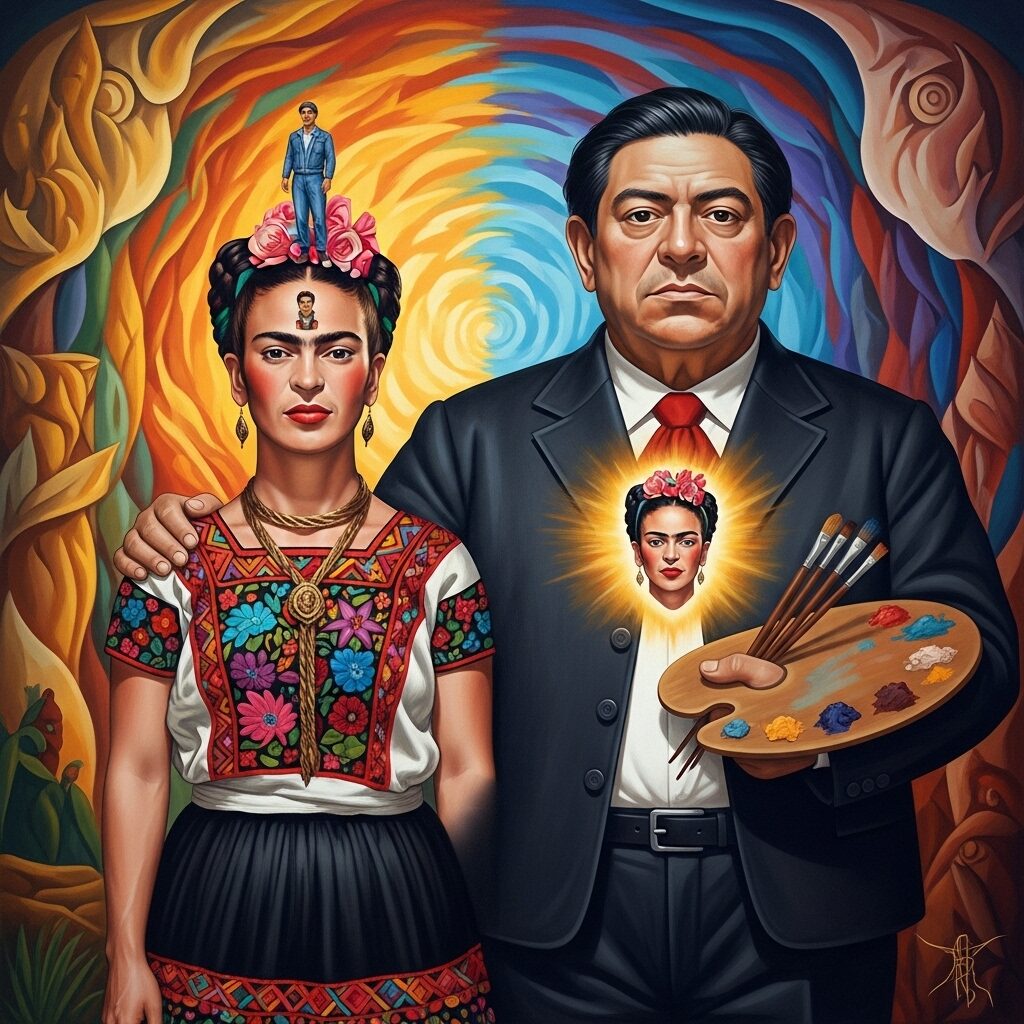
Not all rivalries are about competition; some are about collaboration and a push-and-pull dynamic within a relationship. The passionate and often turbulent marriage of Frida Kahlo and Diego Rivera is a perfect example. Rivera was a famous and larger-than-life muralist, celebrated for his large-scale political works that told the story of Mexico’s history. Kahlo, on the other hand, was best known for her deeply personal and symbolic self-portraits that explored themes of pain, identity, and Mexican culture.
Love, Art, and Politics
Their relationship was filled with passion, infidelity, and an intense connection. They were each other’s biggest fans and harshest critics. Rivera admired Kahlo’s raw honesty and unique style, while Kahlo looked up to Rivera’s mastery of scale and political expression.
Shared Cultural Identity
Their creative dialogue and shared love for their country, a concept called Mexicanidad, fueled their art. Though their relationship was tumultuous, their mutual influence and support were undeniable, making them one of the most iconic artistic duos of all time.
The Vienna Secession Conflict
The Master and the Protégé: Klimt and Schiele
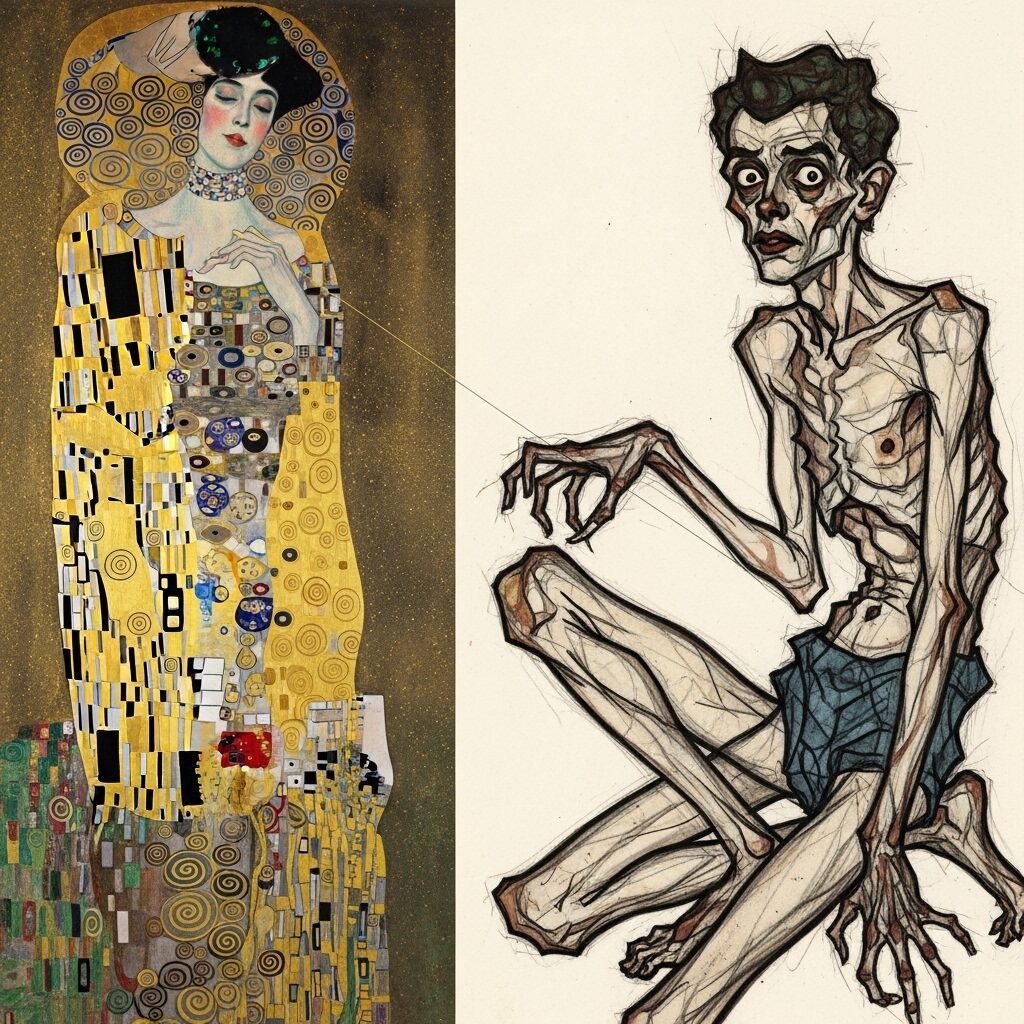
Our final major pairing is a master and his apprentice, Gustav Klimt and Egon Schiele, whose intense relationship defined the Vienna Secession movement. Klimt was the founder of the movement, known for his beautiful, decorative, and symbolic paintings, often featuring gold leaf and intricate patterns, like his famous The Kiss. He was a mentor and a father figure to the younger Schiele.
Breaking Away from Beauty
Schiele, however, was a rebel in his own right. His work was much darker, more raw, and often shocking. He used twisted, elongated figures and unsettling lines to express the inner turmoil and emotions of his subjects. While Klimt’s work was about beauty and decoration, Schiele’s was about raw, sometimes uncomfortable, truth.
From Mentorship to Rivalry
Klimt admired Schiele’s talent and supported him, introducing him to patrons and buying his work. Schiele, in turn, idolized Klimt, and his early work shows a clear influence from his mentor. However, as Schiele’s style matured, his art became a bold, personal statement that pushed far beyond Klimt’s more decorative style.
The Evolution of Expression
This rivalry wasn’t about public feuding, but an intense artistic push-and-pull. Schiele was driven to find his own voice, and Klimt watched with a mixture of pride and perhaps a little jealousy as his protégé surpassed him in a different kind of artistic expression. You can discover more about this fascinating period on our page about famous Austrian artists. The use of line and form to convey emotion is a core element in many of their works, as seen in our article on figurative art.
Comparative Analysis of Major Rivalries
| Artist | Style & Focus | Rival’s Influence | Period |
|---|---|---|---|
| Leonardo da Vinci | Scientific, detailed, sfumato, human anatomy | Competed with Michelangelo’s sculptural, dramatic style | Renaissance |
| Michelangelo | Sculptural, dramatic, muscular figures | Rivalry with Leonardo pushed him to innovate | Renaissance |
| Pablo Picasso | Cubism, fragmented forms, social commentary | Matisse’s use of color and harmony influenced him | Modern |
| Henri Matisse | Fauvism, vibrant color, simplified forms | Picasso’s revolutionary ideas pushed him to new levels of abstraction | Modern |
| Frida Kahlo | Surrealist-inspired, personal self-portraits | Diego’s large-scale political murals and shared Mexican identity shaped her work | Modern |
Lesser-Known But Equally Fierce Rivalries
Beyond the Famous Five
While the major rivalries get most of the attention, the art world has been filled with countless other competitive relationships that shaped artistic movements and individual careers.
American Art Battles
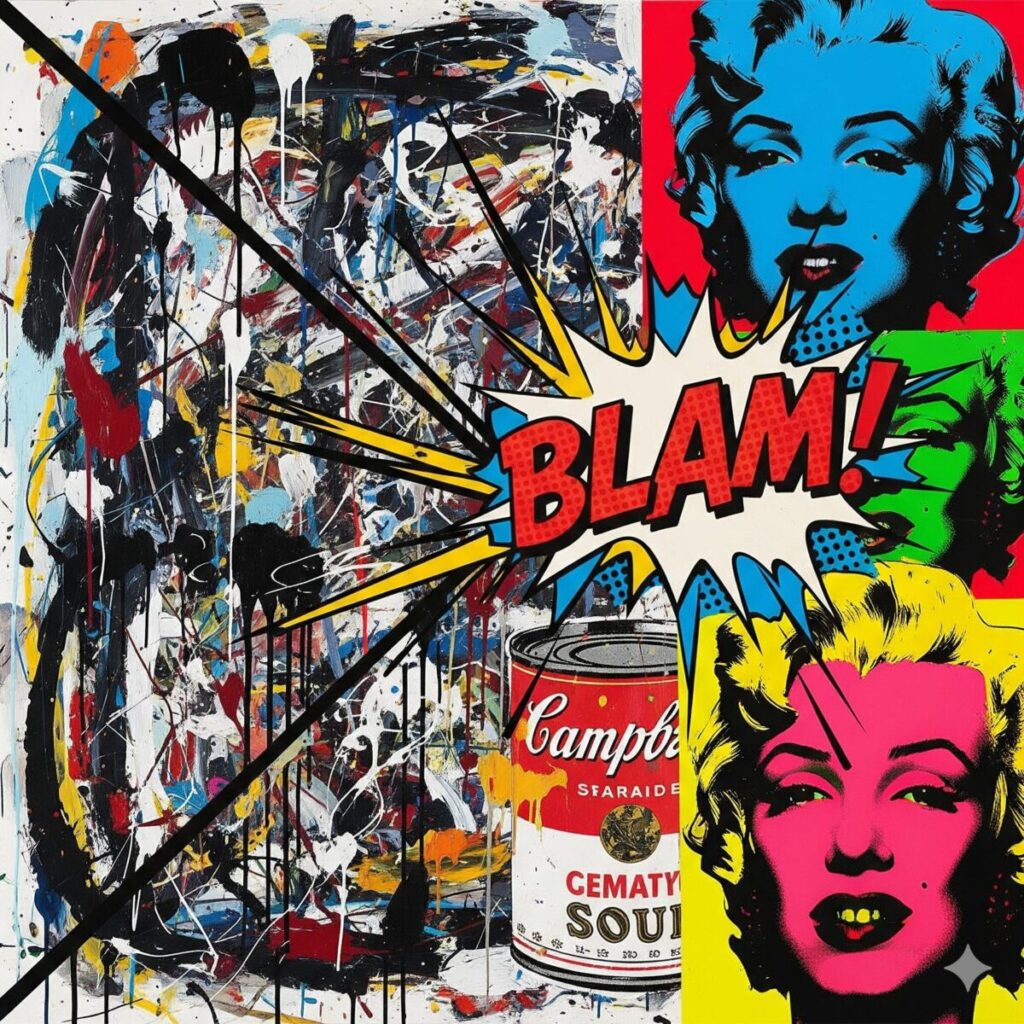
The American art scene has produced its own legendary rivalries, from the Abstract Expressionists’ internal competitions to the Pop Art movement’s clash of personalities.
Contemporary Conflicts
Even today’s art world continues the tradition of creative rivalry, with contemporary artists pushing each other to new heights through competition and collaboration.
Additional Notable Art World Rivalries
| Rival Artists | Movement/Period | Nature of Rivalry | Impact |
|---|---|---|---|
| Caravaggio vs. Annibale Carracci | Italian Baroque | Naturalism vs. Classical Idealism | Shaped Baroque painting direction |
| Ingres vs. Delacroix | 19th Century French | Linear Classicism vs. Romantic Color | Defined French academic vs. romantic art |
| Whistler vs. Ruskin | Victorian Era | Modern Art vs. Traditional Criticism | Famous libel trial changed art criticism |
| Pollock vs. de Kooning | Abstract Expressionism | Gestural vs. Figurative Abstraction | Defined American avant-garde |
| Warhol vs. Lichtenstein | Pop Art | Commercial vs. Comic Book Aesthetics | Established Pop Art movement |
| Basquiat vs. Haring | 1980s Street Art | Raw Expression vs. Accessible Icons | Bridged street art and gallery world |
The Psychology of Artistic Competition
Why Rivalries Drive Innovation
Artistic rivalries serve as catalysts for innovation because they create specific psychological conditions that foster creativity:
The Pressure to Differentiate
When two artists work in similar styles or movements, the pressure to stand out forces each to develop unique approaches and push boundaries.
Motivation Through Recognition
The desire for critical acclaim and historical significance drives artists to exceed not just their own previous work, but their rival’s achievements.
Technical Advancement
Competition often leads to technical innovations as artists seek new methods to distinguish their work and gain advantage over their rivals.
The Role of Public Perception
Audiences as Judges
Many great artistic rivalries were amplified by public interest and media coverage, turning private competition into public spectacle.
Critics and Commentators
Art critics often fueled rivalries by comparing artists directly, creating narratives of competition that influenced public perception and market value.
Legacy and Historical Narrative
How we understand these rivalries today is shaped by decades of art historical interpretation, sometimes exaggerating or minimizing the actual relationship between the artists.
Lessons from Legendary Feuds
What Modern Artists Can Learn
The great rivalries of art history offer valuable lessons for contemporary artists:
Healthy Competition
The best rivalries were built on mutual respect and genuine admiration for each other’s work, even amid fierce competition.
Innovation Through Opposition
Contrasting approaches and philosophies can create productive tension that benefits both artists and the broader art world.
The Power of Dialogue
Even adversarial relationships can foster important artistic dialogue that advances entire movements and genres.
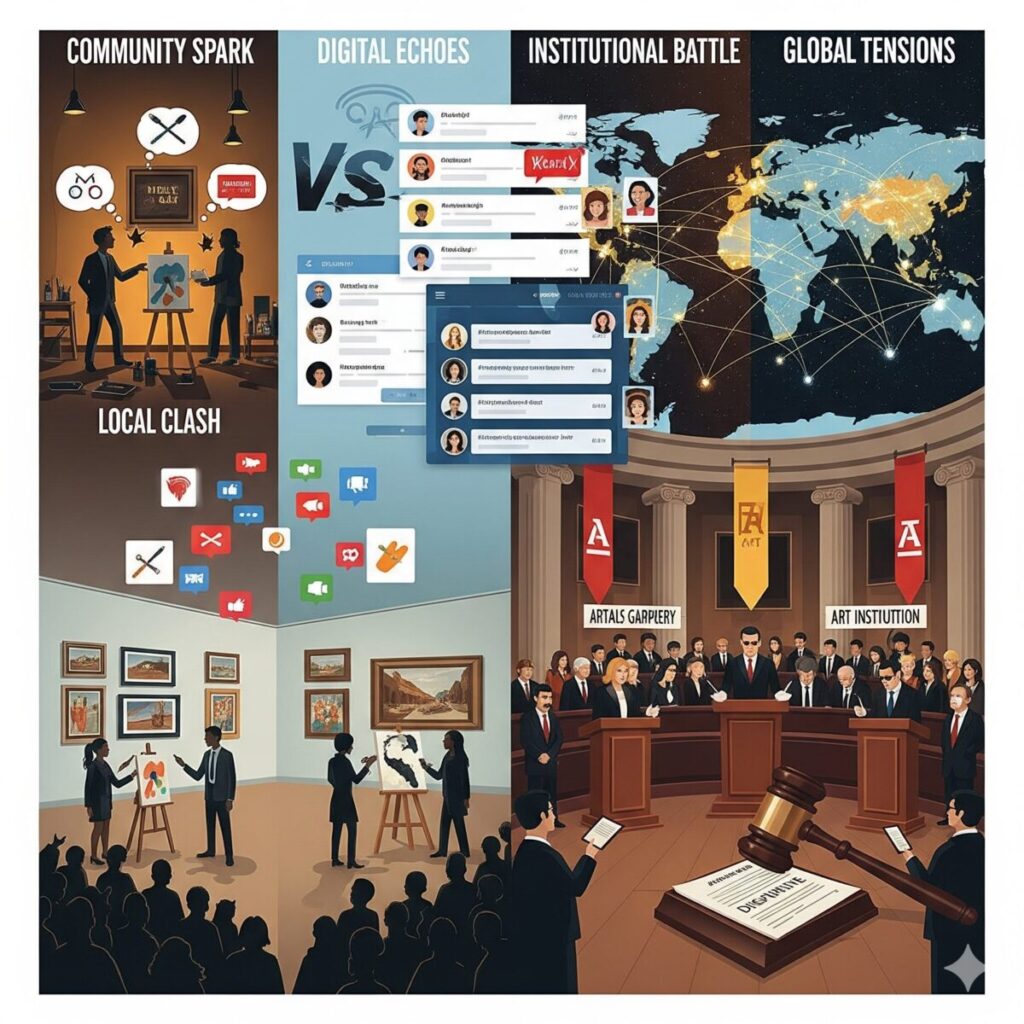
The Evolution of Artistic Rivalry
From Personal to Institutional
Modern art world rivalries often occur between institutions, galleries, or art movements rather than individual artists.
Digital Age Competition
Social media and online platforms have created new forms of artistic rivalry and competition for attention and recognition.
Global vs. Local Tensions
Contemporary art rivalries often reflect broader cultural and economic tensions between different regions and art markets.
Final Thoughts: The Eternal Dance of Competition
Competition isn’t inspiration. It’s survival. These rivalries produced masterpieces because losing meant erasure. Leonardo didn’t admire Michelangelo – he resented him. Picasso didn’t respect Matisse – he wanted to destroy him. That visceral hatred, that subcutaneous rage of being second-best, forced them past limitation into genuine innovation.
We romanticize it now as “creative dialogue.” Sanitize it. But standing before these paintings, you feel the violence. The territorial aggression. These weren’t love letters. They were declarations of war.
That’s what made them matter. Art born from comfort produces nothing. Growth comes from competition so brutal it fractures you open.
That’s the fire that forged everything.
FAQs About Great Rivalries in the Art World
General Questions
1. Who was the biggest rival of Leonardo da Vinci? Leonardo da Vinci’s biggest rival was Michelangelo. Their rivalry was famous in Florence during the Renaissance. It was a clash of two very different personalities and artistic approaches—Leonardo’s scientific, intellectual style versus Michelangelo’s fiery, emotional, and sculptural approach.
2. Did Picasso and Matisse hate each other? No, Picasso and Matisse did not hate each other. Their relationship was a complex mix of friendship, mutual respect, and intense rivalry. They were each other’s biggest artistic rivals, but they also admired and learned from one another, which pushed them both to new levels of creativity.
3. What was the relationship between Frida Kahlo and Diego Rivera? The relationship between Frida Kahlo and Diego Rivera was a passionate and tumultuous marriage. It was characterized by deep love, mutual admiration, and frequent infidelities. They were each other’s greatest artistic influences and supporters, and their shared passion for art and politics shaped their lives and work.
Historical Context
4. Why did Manet and Monet have a rivalry? The “rivalry” between Édouard Manet and Claude Monet was less of a direct feud and more of a friendly professional competition. They were friends and mentors to each other. Manet, the more established artist, influenced Monet’s early work, and in turn, Monet’s focus on painting outdoors and capturing light pushed Manet to adopt a brighter, more Impressionist style.
5. How did Klimt and Schiele’s rivalry influence their art? Gustav Klimt was a mentor to the younger Egon Schiele. While Klimt’s work was more decorative and symbolic, Schiele’s was raw and expressive. This relationship pushed Schiele to find his own unique style, while his boldness may have encouraged Klimt to continue his own artistic experimentation. The intense push and pull between master and protégé helped define the Vienna Secession movement.
Contemporary Questions
6. Were there any female rivalries in the art world? Yes, there were! While many of the most famous rivalries were between men, female artists also had complicated and competitive relationships. For example, the relationship between Georgia O’Keeffe and her husband Alfred Stieglitz was a constant artistic dialogue, and their careers often felt like a push-and-pull for artistic dominance. The art world has seen many female artists whose competitive relationships were crucial to their artistic development.
7. Do artistic rivalries still exist today? Absolutely! While they may be less dramatic or public than historical rivalries, contemporary artists still compete for gallery representation, critical attention, and market success. Social media has created new forms of artistic rivalry, and competition between different art movements and styles continues to drive innovation in the art world.
8. How do art market forces affect modern rivalries? Today’s art rivalries are often influenced by market forces, with auction prices and gallery representation playing roles that didn’t exist in earlier periods. This can create different types of competitive pressure than the purely artistic or philosophical rivalries of the past.
Citations Section
- “Art History Feuds: Michelangelo and Leonardo Da Vinci” by ArtRKL. This article explores the competitive jealousy and dramatic redefinition of artistic rebirth between these Renaissance masters. https://artrkl.com/blogs/news/art-history-feuds-michelangelo-and-leonardo-da-vinci
- “Why Did Leonardo and Michelangelo Have Beef?” by Artnet News. Details the contrasting visions and dramatic differences in their approaches to the famous battle scene commissions. https://news.artnet.com/art-world/why-did-leonardo-and-michelangelo-have-beef-2620049
- “Henri Matisse and Pablo Picasso: 6 Notes on Friendship and Rivalry” by TheCollector. This piece offers a detailed look at the complex relationship between two modern art giants and their mutual artistic influences. https://www.thecollector.com/henri-matisse-pablo-picasso-friendship-rivalry/
- “Two masters, one friendship: the story of Matisse and Picasso” by Tate. Explores the honest friendship and open rivalry between these masters of modern art. https://www.tate.org.uk/art/artists/henri-matisse-1593/two-masters-one-friendship-story-matisse-and-picasso
- “Matisse & Picasso” by Smithsonian Magazine. Chronicles how their respect and friendship deepened during World War II and their mutual defense of each other’s work. https://www.smithsonianmag.com/arts-culture/matisse-picasso-75440861/
- “The Passionate (& Controversial) Relationship of Frida Kahlo and Diego Rivera” by TheCollector. Delves into the artistic and personal dynamic of this iconic couple, exploring their mutual influence and shared Marxist beliefs. https://www.thecollector.com/frida-kahlo-diego-rivera-relationship/
- “Leonardo and Michelangelo: An Ideological Rivalry” by In Arte Matt. Examines how their relationship came to an abrupt end after a public quarrel in Florence over Dante’s Divine Comedy. https://inartematt.wordpress.com/2020/11/01/leonardo-and-michelangelo-an-ideological-rivalry/
- “Pablo Picasso” by Google Arts & Culture. Details how Matisse’s Fauvist work motivated Picasso to explore more radical styles, beginning their fruitful rivalry. https://artsandculture.google.com/entity/m060_7