Let’s be honest: staring at a blank canvas is terrifying.
You want to create something beautiful, but you don’t know where to start. You worry about proportions, color mixing, and making “mistakes.”
Here’s the good news: you don’t have to start from scratch.
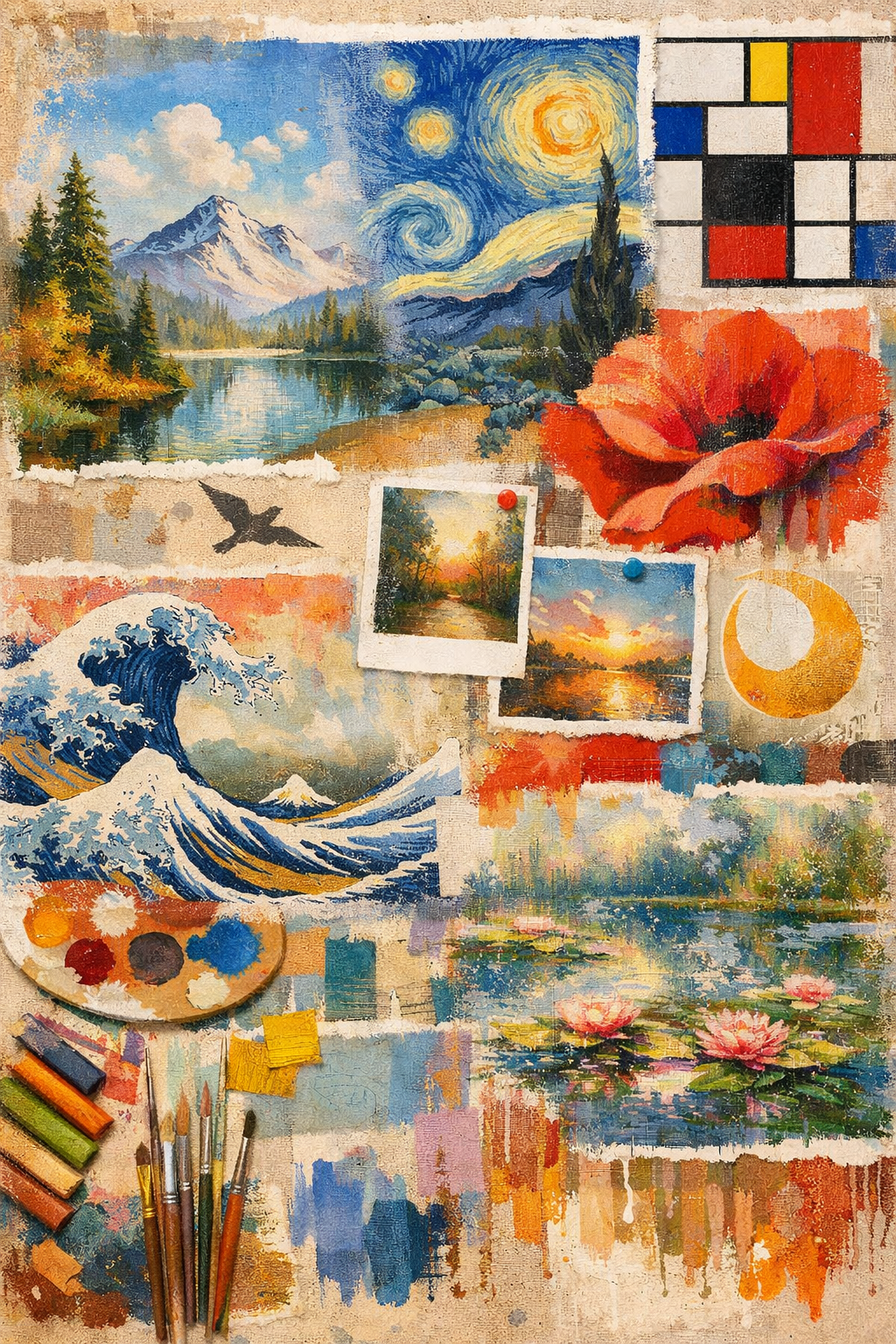
Some of the world’s greatest artists learned by copying the work of those who came before them. It’s not cheating; it’s called a “master study,” and it’s one of the fastest ways to improve your skills. By recreating easy famous paintings, you learn:
- How to mix colors like a pro.
- How to handle your brush with confidence.
- How to simplify complex shapes.
At Prominent Painting, we believe art should be joyful, not intimidating. That’s why we’ve rounded up 5 iconic artworks that are surprisingly simple to recreate—even if you’ve never held a brush before.
“Learn the rules like a pro, so you can break them like an artist.” — Pablo Picasso
Ready to pick up your brush? Let’s dive in.
1. The “Happy Little Tree” (Inspired by Bob Ross)
Difficulty: ⭐ (Easiest)
Time: 20 Minutes
Best Medium: Acrylics or Oils
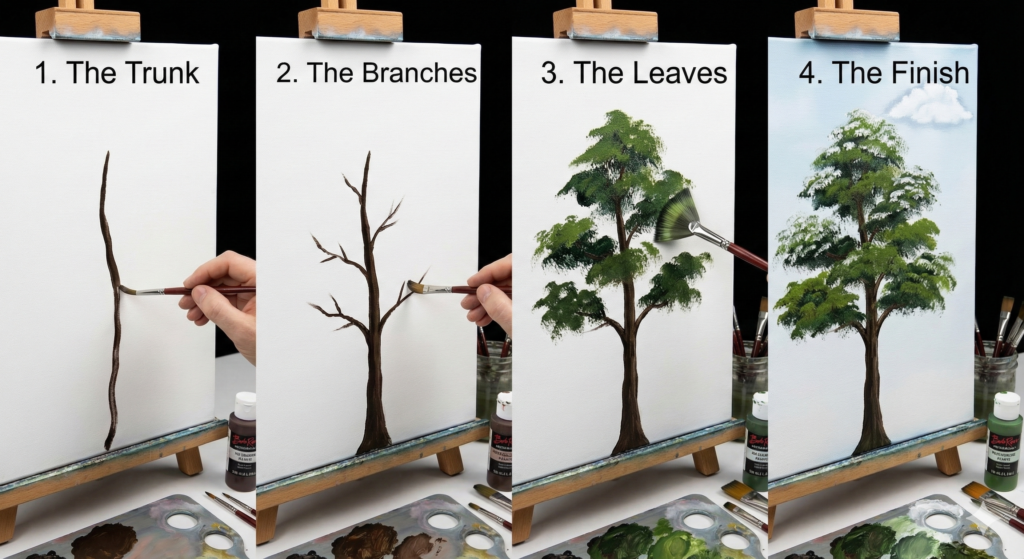
Bob Ross taught the world that there are “no mistakes, only happy accidents.” His signature pine trees are perfect for beginners because they rely on a simple tapping motion rather than detailed drawing.
🎨 How to Paint It:
- The Trunk: Load a small round brush with dark brown paint. Drag it straight down the canvas, wiggling slightly for a natural look.
- The Branches: Use the corner of the brush to tap small lines outward from the trunk.
- The Leaves: This is the fun part! Take a fan brush, load it with dark green, and gently tap it against the branches. Layer lighter greens on top for highlights.
- The Finish: Add a touch of white to the very top tips for sunlight.
Why it works: It teaches you texture and layering without needing perfect lines.
Need gear? Check our essential painting supplies guide.
2. The Minimalist Grid (Inspired by Piet Mondrian)
Difficulty: ⭐⭐
Time: 30 Minutes (+ drying time)
Best Medium: Acrylics
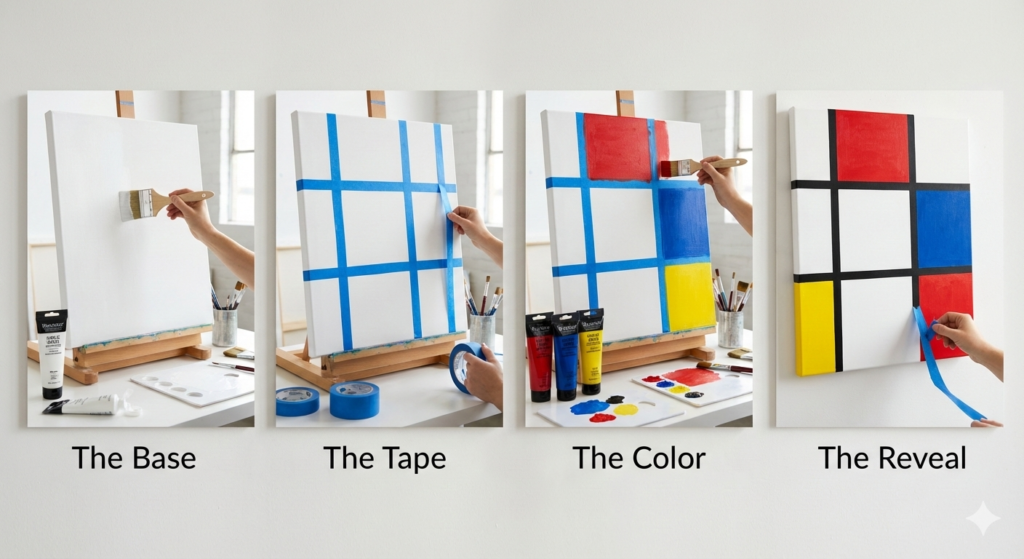
If you’re afraid of freehand drawing, this one is for you. Mondrian’s style is all about clean lines and primary colors. It looks modern, chic, and is incredibly forgiving.
🎨 How to Paint It:
- The Base: Paint your entire canvas white. Let it dry completely.
- The Tape: Use painter’s tape to create a grid of vertical and horizontal lines. Don’t overthink the spacing—imperfection adds character!
- The Color: Pick 2 or 3 blocks within your grid. Paint them solid Red, Blue, or Yellow. Leave the rest white.
- The Reveal: Carefully peel off the tape while the paint is still slightly wet to reveal crisp black (or white) lines. Note: You can paint black lines over the tape edges if needed.
Why it works: It teaches you composition and the power of negative space.
Love geometry? Try our guide to mandala art next.
3. The Simple Water Lily (Inspired by Claude Monet)
Difficulty: ⭐⭐
Time: 45 Minutes
Best Medium: Watercolors or Soft Acrylics
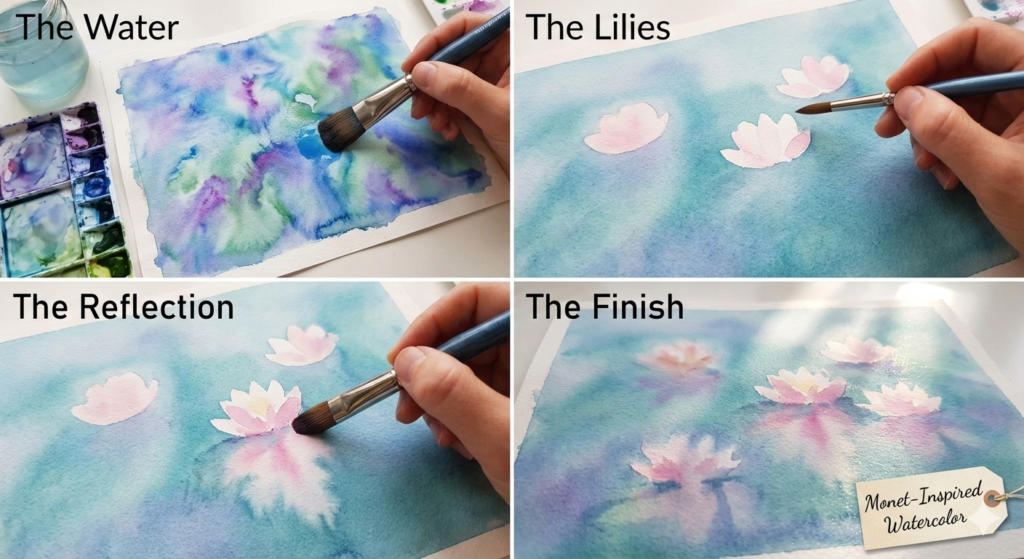
Monet didn’t paint every single leaf; he painted the feeling of light on water. This makes his work perfect for beginners who want to practice blending.
🎨 How to Paint It:
- The Water: Wet your paper/canvas with clean water. Drop in diluted blues, purples, and greens. Let them bleed together naturally.
- The Lilies: Once dry, use a medium round brush to paint simple oval shapes in soft pinks and whites. Don’t outline them! Just let the color sit on the background.
- The Reflection: Dip a clean, damp brush into the lily colors and drag them downward slightly to create a watery reflection.
Why it works: It teaches you “wet-on-wet” blending and lets go of the need for control.
More water tips in our seascape painting 101 guide.
4. The Bold Sunflower (Inspired by Vincent van Gogh)
Difficulty: ⭐⭐⭐
Time: 1 Hour
Best Medium: Heavy Body Acrylics or Oils
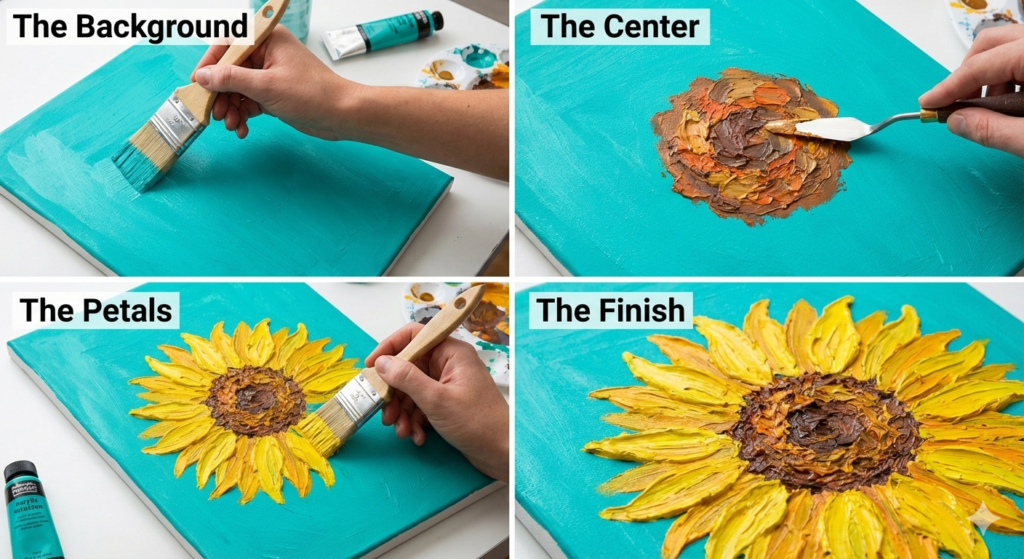
Van Gogh’s sunflowers are famous for their thick paint (impasto) and vibrant yellows. You don’t need to be realistic; just be bold!
🎨 How to Paint It:
- The Background: Paint the background a solid, contrasting color like bright blue or teal.
- The Center: Mix brown, orange, and yellow. Use a palette knife or stiff brush to dab a rough circle in the middle.
- The Petals: Load your brush with thick yellow paint. Use short, confident strokes radiating outward from the center. Vary your yellows (lemon, ochre, gold).
- The Texture: Don’t smooth it out! Let the brushstrokes stay visible. That’s the Van Gogh style.
Why it works: It builds confidence in using thick paint and expressive brushwork.
Want more expression? Read our abstract painting guide.
5. The Giant Flower Petal (Inspired by Georgia O’Keeffe)
Difficulty: ⭐⭐⭐
Time: 1 Hour
Best Medium: Acrylics
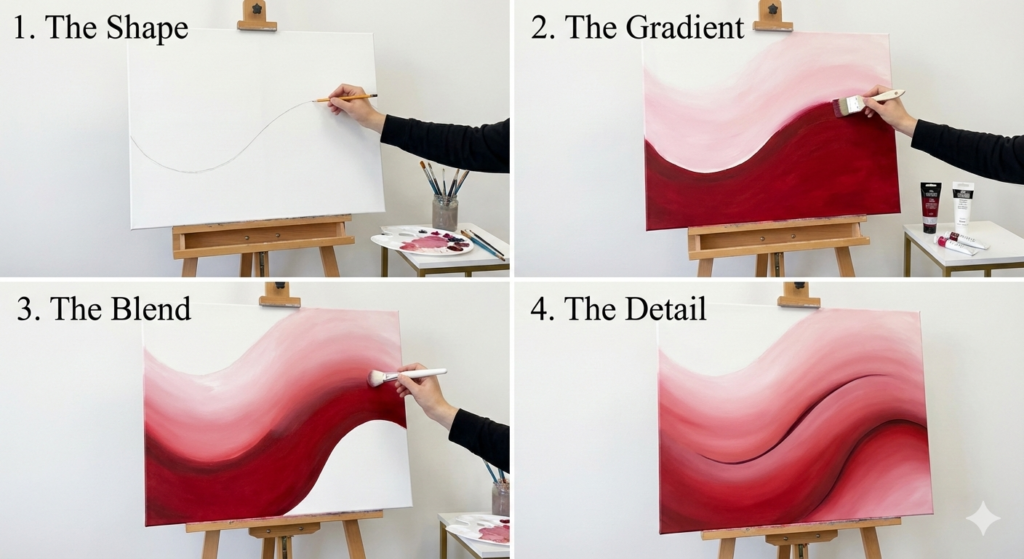
O’Keeffe magnified nature until it became abstract. Painting just one part of a flower removes the pressure of getting the whole thing right.
🎨 How to Paint It:
- The Shape: Sketch a large, simple curve that fills most of the canvas (like a hill or a wave).
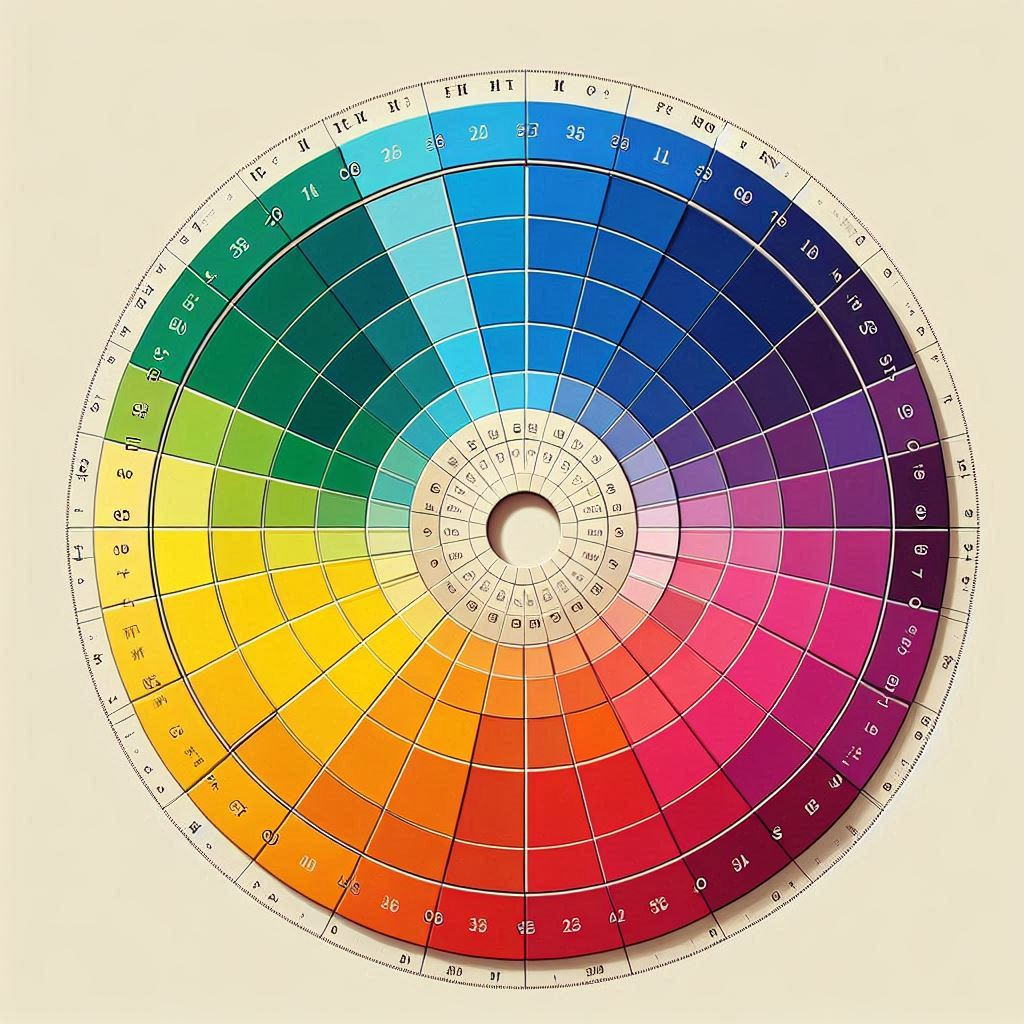
- The Gradient: Mix your darkest color (e.g., deep red) and lightest color (soft pink/white).
- The Blend: Paint the dark color at the bottom of the shape and the light color at the top. While wet, use a clean dry brush to gently blend where they meet.
- The Detail: Add a single curved line to suggest the fold of the petal. Keep it simple!
Why it works: It teaches you gradient blending and focusing on form over detail.
Floral fan? See our how to paint flowers tutorial.
🛠️ What You Need to Get Started
You don’t need a studio full of supplies. Here is the bare minimum to try these 5 paintings:
- Paints: A basic set of Acrylics (Red, Blue, Yellow, White, Black).
- Brushes: One Flat, One Round, One Fan brush.
- Surface: Canvas boards or heavy watercolor paper.
- Extras: A palette (or a paper plate), a cup of water, and painter’s tape (for the Mondrian!).
Unsure what to buy? We break it all down in our essential painting supplies guide.
💡 3 Tips for Your First Master Study
- Don’t Aim for Perfection: Your goal isn’t to forge a masterpiece; it’s to learn a technique. If your tree looks wonky, call it “stylized.”
- Limit Your Palette: Try using only 3 colors + white. It forces you to learn mixing and keeps your painting cohesive.
- Set a Timer: Give yourself 45 minutes. Working against the clock stops you from overthinking and over-working the piece.
❓ Frequently Asked Questions
Q: Is it okay to sell paintings that copy famous artists?
A: Generally, no. You cannot sell exact copies of copyrighted or trademarked works. However, using a style (like “painting like Monet”) for your own original subjects is perfectly fine and a great way to learn!
Q: Which of these is the absolute easiest?
A: The Bob Ross “Happy Tree” or the Mondrian Grid. Both rely on simple tools (fan brush or tape) rather than complex drawing skills.
Q: I made a mistake! Can I fix it?
A: Yes! If using acrylics, let it dry and paint over it. If using oils, just scrape it off with a palette knife. Remember Bob Ross: it’s just a “happy accident.”
Q: Do I need to prime my canvas?
A: Most store-bought canvases come pre-primed. If yours looks like raw fabric, apply a layer of Gesso first.
🌟 Your Turn to Create
Art isn’t about talent; it’s about showing up and trying. These 5 easy famous paintings to copy are your gateway to finding your own style.
So, grab a brush, pick your favorite master, and make your mark. And when you’re done? Share it with us! We’d love to see your master studies.
“Every artist was first an amateur.” — Ralph Waldo Emerson
Next Steps:
- Tried one of these? Tag us @ProminentPainting with #MasterStudyMadeEasy.
- Ready for more? Explore our full library of beginner painting tutorials.