The art world is often seen as a mysterious place, filled with high-society auctions and quiet galleries. But in 2025, the curtain has been pulled back. Thanks to the explosion of online marketplaces and social media, we know exactly what people are hanging on their walls. Whether you are an artist trying to figure out what type of art sells best on Etsy, a homeowner looking for modern art styles for home decor, or an investor scouting the most popular art genres, understanding the numbers is key.
Gone are the days when popularity was dictated solely by a few critics in New York or London. Today, popularity is driven by data, durability, and digital discovery. From the resurgence of tactile textures to the stabilizing market of digital assets, 2025 is shaping up to be a year of diverse tastes.
Below, we dive deep into the art market trends of 2025, backed by real statistics from industry leaders like the Hiscox Report and Art Basel. We will explore not just what looks good, but what holds its value, what lasts the longest on your wall, and who exactly is buying it.
Key Takeaways:
- Abstract Art remains the volume leader, accounting for nearly 20% of global sales.
- Biophilic Design is driving a massive spike in landscape and botanical art sales.
- Gen Z is reshaping the market, with 89% using Instagram for discovery.
- Durability Matters: Collectors are becoming more educated on the longevity differences between oil and acrylic paints.
- Affordability: The sweet spot for volume sales is now between $100 and $2,000.

State of the Art Market 2024-2025
To understand the most popular art genre, we first have to look at the money. The art market has bifurcated (split in two). On one side, you have the “Blue-Chip” market—famous names selling for millions. On the other, you have the rapidly growing “Affordable Art” market, which is where most of us live.
Key Market Statistics (Sales Volume vs. Value)
The following table breaks down the current state of the art market based on data from the Hiscox Online Art Trade Report and Art Basel 2024 findings. This data highlights the difference between what sells the most (Volume) and what sells for the most money (Value).
| Metric | Statistic / Trend | Insight |
|---|---|---|
| Global Online Sales | $11.8 Billion (approx.) | Online sales now capture ~18% of the total market, up from previous years. |
| Top Genre by Volume | Abstract Art (20%) | Abstract remains the safest bet for home decor and office spaces. |
| Fastest Growing Segment | Nature/Landscape (+15%) | Driven by “Biophilic” interior design trends post-pandemic. |
| Gen Z Spending | $100 – $1,000 | 40% of Gen Z collectors prefer this entry-level price point for digital and physical art. |
| Color Trends | Bold/Vibrant (+18%) | Neutral tones are fading; buyers want statement pieces with high saturation. |
| Print Durability | Giclée vs. Standard | Archival pigment inks (Giclée) are becoming a standard requirement for buyers concerned with value. |
The Shift to Online: How Digital Platforms Are Changing Popularity
The biggest driver of change in 2025 is access. In the past, you had to walk into a gallery to buy art. Now, online art market growth is exploding. Platforms like Saatchi Art, Etsy, and Artfinder have democratized the process.
This shift affects what becomes popular. Art that looks good on a smartphone screen—bold colors, high contrast, and graphic shapes—tends to sell better than subtle, dark, or highly detailed works that require in-person viewing. If you are an artist wondering how to sell art online in 2025, optimizing your work for the “scrolling” generation is essential.
Affordable Art (<$5,000) vs. Blue-Chip Investment
While news headlines focus on $100 million Picassos, the real volume is in the under $5,000 bracket. The “democratization” of art means that limited edition prints value has skyrocketed. Buyers realize they can own a signed, limited piece by a reputable artist for $500 rather than an original for $10,000. This has led to a boom in Giclée printing and high-quality reproductions.
Top 5 Most Popular Art Genres (Ranked by Sales)
Based on sales volume across major online platforms and mid-market galleries, these are the heavy hitters of 2025.
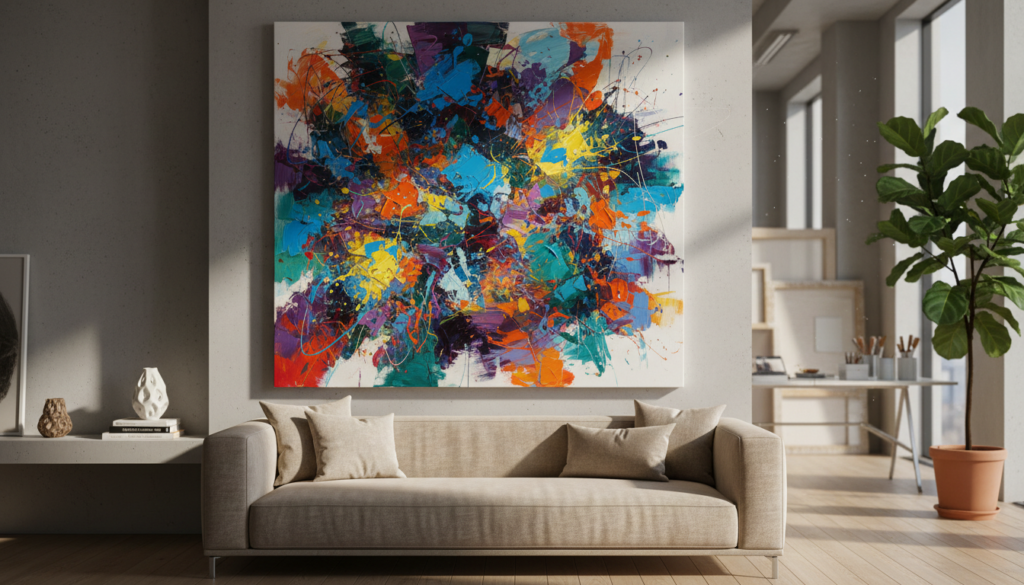
1. Abstract Art: The Undisputed King of Home Decor
Why it sells: Versatility.
Market Share: ~20% of global sales.
Abstract art continues to dominate the market because it is “subject-neutral.” In interior design, a realistic painting of a dog or a boat dictates the theme of a room. An abstract piece, however, focuses on color and emotion. It can fit into a minimalist apartment in Tokyo or a farmhouse in Texas.
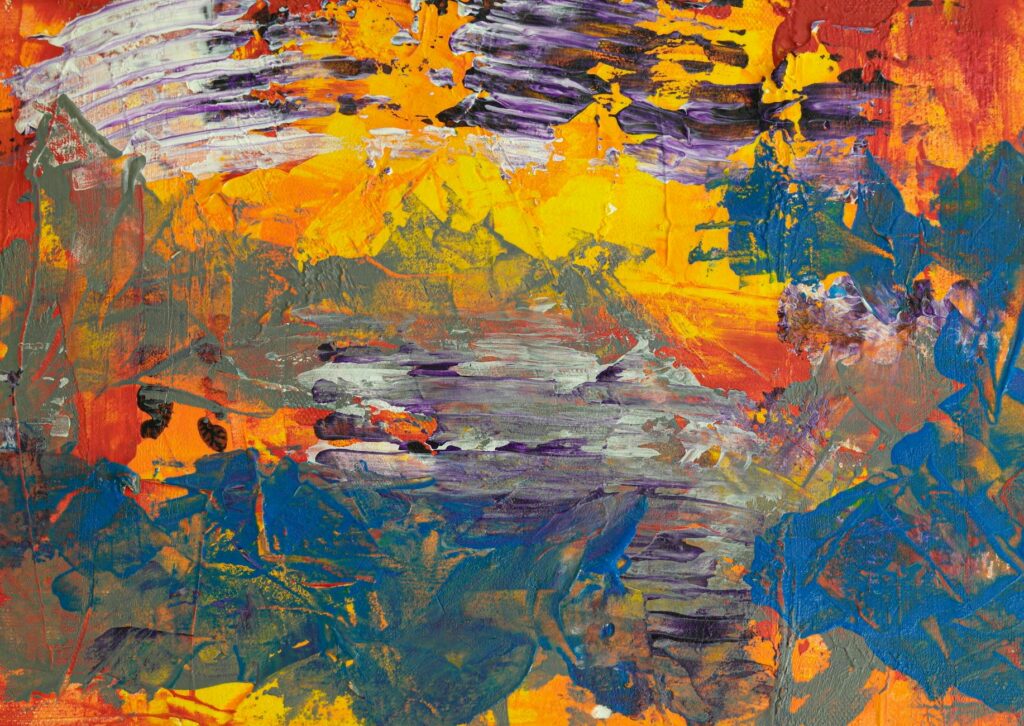
Specifically, Abstract Expressionism is seeing a revival. Buyers are looking for energetic brushwork and evidence of the human hand—something AI cannot easily replicate with soul. If you are questioning is abstract art a good investment in 2025, the data suggests that while blue-chip abstract names (like Rothko) remain high, emerging abstract artists have the highest liquidity (ease of selling) in the affordable market.
2. Contemporary Landscapes & Nature
The “Biophilic” Trend: Bringing the outdoors in.
Bestselling Sub-genres: Coastal, Botanical, Semi-Abstract Landscapes.
With the rise of remote work, people are spending more time at home. This has triggered the “Biophilic” design trend—a desire to connect with nature within our built environments. Sales of landscape paintings have risen by 15%.
However, the style has shifted. We aren’t seeing as many traditional, photorealistic landscapes. Instead, impressionism and semi-abstract landscapes are thriving. Buyers want the feeling of a forest or an ocean, rather than a literal map of it. Seascapes remains a perennial bestseller, particularly in the US and UK markets.
3. Pop Art & Street Art
Demographic: High appeal among Millennials and Gen Z.
Growth: Driven by limited edition prints and cultural icons.
Fueled by the legacy of artists like Banksy and KAWS, Street Art has moved from the alleyway to the auction house. This genre appeals heavily to younger collectors (Millennials and Gen Z) who view it as the art of their generation.
This genre is also the leader in investment art genres for entry-level collectors. A limited-edition screen print by a rising street artist often appreciates in value faster than traditional oil paintings. The aesthetic is bold, graphic, and often political, making it perfect for social media sharing.
4. Minimalism
Design Fit: Scandi/Japandi interior trends.
Market Data: High volume in open-edition prints.
Closely linked to the wellness movement, Minimalism offers a visual break from the chaos of the digital world. The “Japandi” style (a blend of Japanese rustic minimalism and Scandinavian functionality) is a massive interior design trend in 2025.
Art buyers are seeking works with plenty of negative space, monochromatic palettes (black, white, beige), and simple geometric forms. While these pieces may sell for lower individual prices than complex oil paintings, the volume of sales is incredibly high, especially in the print market.
5. Portraiture & Figurative Art
Resurgence: Focus on identity, diversity, and human connection.
After years of abstract dominance, the face is back. Portraiture and figurative art have seen a resurgence, driven largely by a desire for representation. Collectors are actively seeking works that depict diverse cultures, bodies, and stories.
This isn’t the stiff portraiture of the 1800s. It is messy, emotional, and often combines realistic faces with abstract backgrounds. This style, sometimes called “disrupted realism,” connects deeply with buyers looking for art that tells a human story.
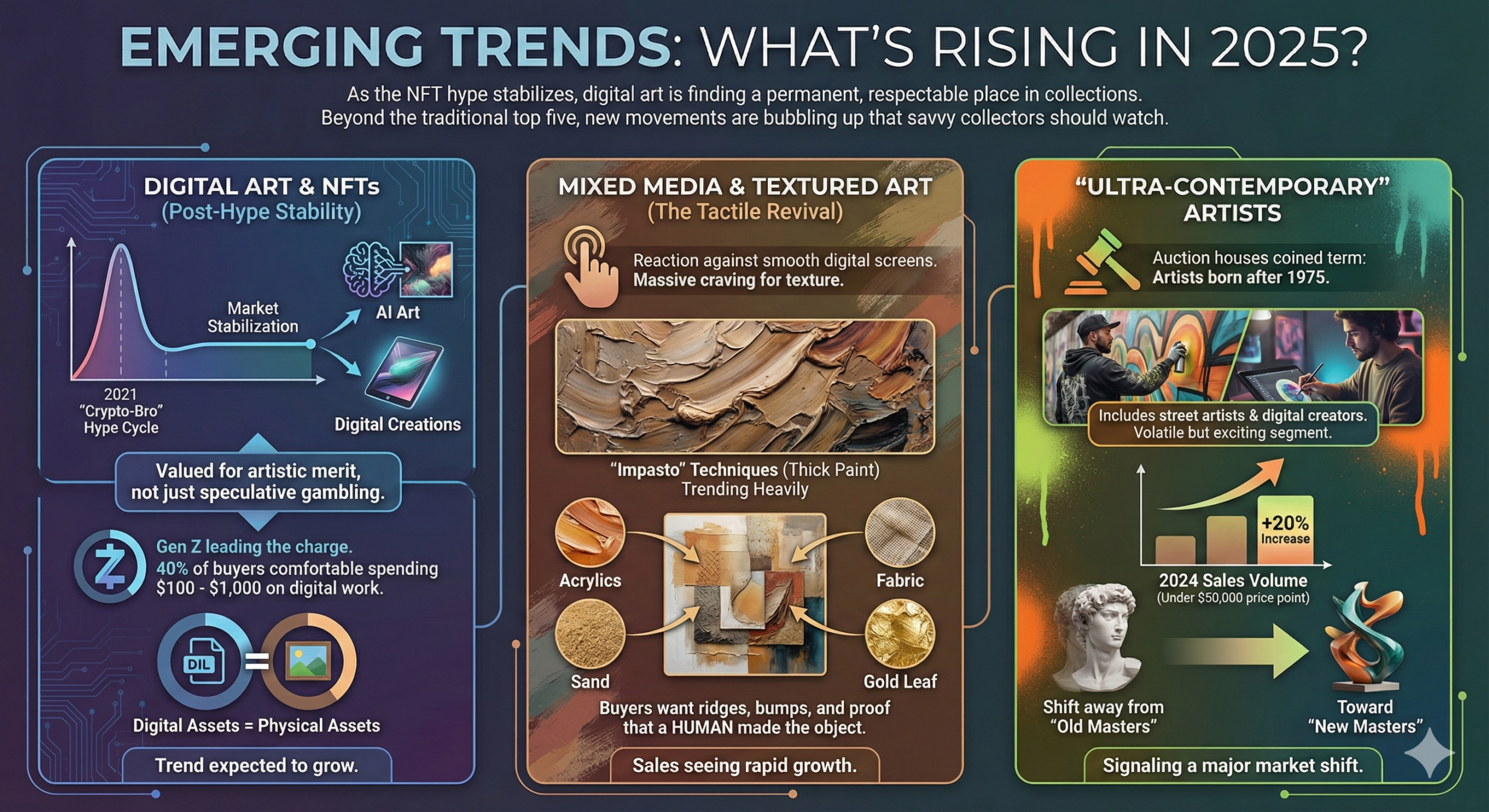
Emerging Trends: What’s Rising in 2025?
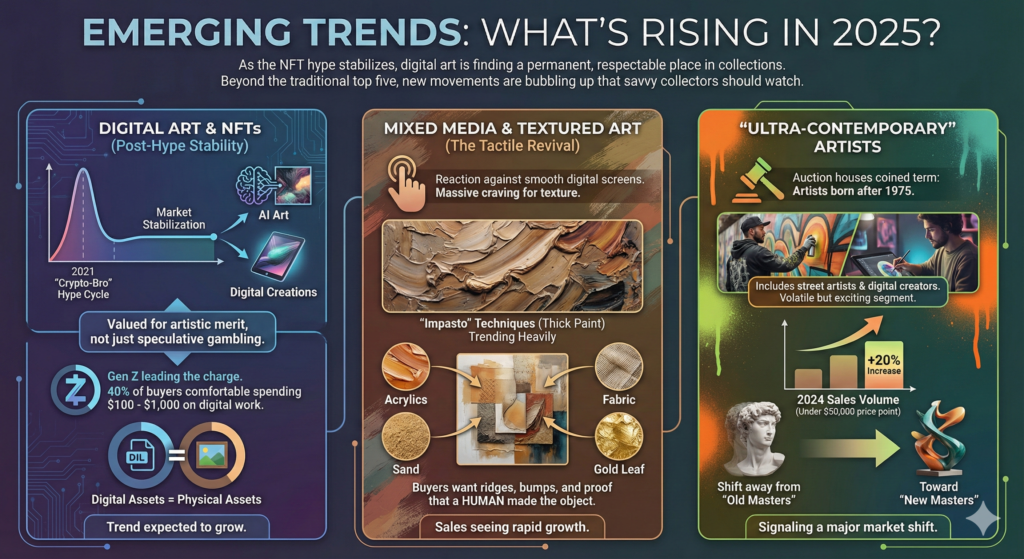
Beyond the traditional top five, new movements are bubbling up that savvy collectors should watch.
Digital Art & NFTs (Post-Hype Stability)
The “crypto-bro” hype cycle of 2021 has cooled, which is actually good news for the art. The market has stabilized. We are now seeing AI Art and digital creations being valued for their artistic merit rather than just speculative gambling.
Gen Z is leading this charge. Statistics show that 40% of Gen Z buyers are comfortable spending between $100 and $1,000 on a digital work. They view digital assets as equal to physical ones—a trend that will only grow.
Mixed Media & Textured Art (The Tactile Revival)
As a reaction against smooth digital screens, there is a massive craving for texture. “Impasto” techniques (thick paint application) are trending heavily. Artists using mixed media—combining acrylics, sand, fabric, and gold leaf—are seeing rapid sales. Buyers want to see the ridges and bumps; they want proof that a human made the object.
“Ultra-Contemporary” Artists
Auction houses have coined the term “Ultra-Contemporary” for artists born after 1975. This segment of the market is volatile but exciting. It includes many of the street artists and digital creators mentioned above. In 2024, sales volume for this group under the $50,000 price point increased by 20%, signaling a shift away from “Old Masters” toward “New Masters.”
Technical Breakdown: Durability & Value by Medium
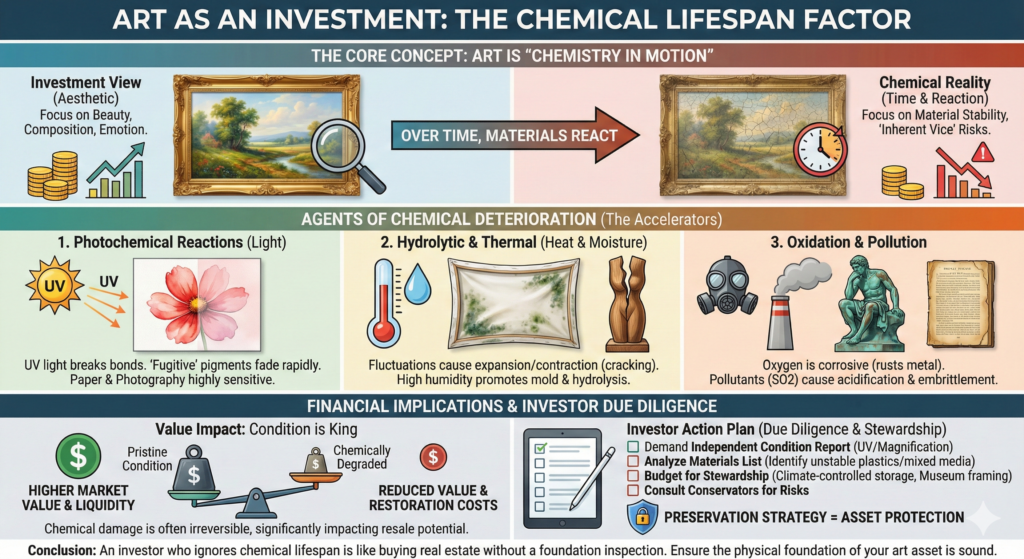
One of the most overlooked aspects of the most popular art genre discussion is durability. A painting might be popular now, but will it survive 50 years? Smart collectors in 2025 are asking technical questions.
Oil vs. Acrylic: A Collector’s Longevity Guide
The debate of Oil vs. Acrylic is critical for investment.
- Oil Paint:
- Pros: The gold standard for centuries. Deep color luminosity. Proven to last 500+ years if cared for.
- Cons: It becomes brittle over time. If painted on a flexible surface (like a loose canvas), it will crack eventually. It also has a tendency to yellow without light.
- Acrylic Paint:
- Pros: It is essentially liquid plastic. It remains flexible forever. It will not yellow. It is incredibly durable against temperature changes.
- Cons: It hasn’t been around for 500 years, so our “100+ year” estimates are scientific projections.
- Verdict: For modern homes with fluctuating temperatures, acrylic is often the safer, lower-maintenance choice for types of painting.
Prints vs. Originals: Understanding Value
Buyers often ask about the difference between giclee and art print.
- Art Print (Poster): Usually printed with dye-based inks. These look great on day one but will fade significantly within 10-25 years if exposed to sunlight.
- Giclée Print: Printed with archival pigment inks. These are rated to last 80+ years in light and 200+ years in dark storage.
Investment Tip: Always check if a print is “Open Edition” (unlimited copies) or “Limited Edition” (e.g., 1 of 50). Limited editions hold value; open editions generally do not.
Buyer Demographics: Who is Buying What?

Understanding the art market trends 2025 requires looking at who is swiping the credit card.
Millennials vs. Gen Z Buying Habits
- Millennials: They are currently the highest volume buyers. They are reaching their peak earning years and buying homes. They prefer finding art inspiration via Pinterest and Instagram but often finalize the purchase on established gallery websites. They lean towards Abstract and Mid-Century Modern styles.
- Gen Z: This generation is disrupting the model. They value ethics and identity. They are more likely to buy directly from an artist via DM (Direct Message) or TikTok than through a gallery. They are the primary consumers of Pop Art and Digital Art.
Regional Preferences
- US Market: Prefers larger scale works. Abstract Expressionism and Coastal themes dominate.
- UK/Europe: Tends toward slightly smaller, more collectible formats. Strong market for figurativism and political street art.
- Asia: A massive growth engine for “Ultra-Contemporary” art and characters (Pop Art styles).
Best Selling Sizes & Formats
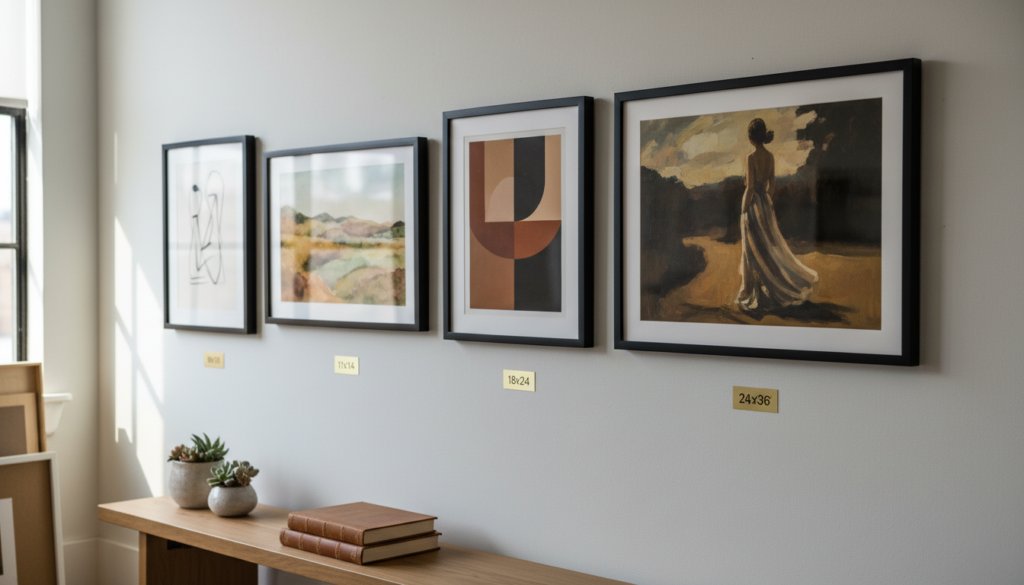
If you are looking for popular art sizes, the data is clear. The “Golden Sizes” for home decor follow the standard sizes of ready-made frames (because custom framing is expensive!).
The “Golden Sizes” for Home Decor
- Volume Sellers (The Gift Market): 8×10 inches and 11×14 inches. These are affordable, easy to ship, and fit on bookshelves.
- Statement Sellers (The “Over the Couch” Market): 24×36 inches and 30×40 inches. These command higher prices and are essential for living room decor.
Paper vs. Canvas Preference
There is a distinct psychological difference in value perception.
- Canvas: Buyers generally perceive canvas art as “higher value” and closer to an original painting. It doesn’t require glass, which eliminates glare.
- Paper: Preferred for photography, complex illustrations, and watercolors. However, the cost of framing paper (matting + glass) often makes the final cost higher than canvas.
Frequently Asked Questions (FAQ)
Here are the answers to the most searching questions regarding the 2025 art market.
What type of art sells best on Etsy?
On Etsy, the best-selling categories are generally botanical prints, abstract minimalism, and customizable portraits (of people or pets). Because Etsy shoppers are often looking for affordable decor, downloadable digital prints (print-at-home) are the highest volume category, though they have the lowest profit margin per unit.
Is abstract art a good investment in 2025?
Yes, but with caveats. Abstract art is the safest genre for resale because it appeals to the widest range of interior design tastes. However, “investment” implies financial return. To see a return, you typically need to buy original works from emerging artists with a growing exhibition history, or limited edition prints from established blue-chip artists.
What is the best art style for a small living room?
For small spaces, Minimalism or Impressionist Landscapes are recommended. Large-scale Minimalism (lots of white space) can make a room feel bigger and less cluttered. Avoid dark, chaotic, or heavily detailed Baroque-style paintings, as they can visually shrink a small room.
Does frame quality affect art value?
Absolutely. A poor frame can devalue a painting, while a high-quality frame can increase its perceived value by 30-50%. For framing and varnishing, using UV-protective glass and acid-free mats is essential for conservation, which savvy buyers look for.
Why is abstract art so popular?
Psychologically, abstract art allows the viewer to project their own emotions onto the canvas. It doesn’t demand a specific narrative. From a design perspective, it adds color and energy without clashing with furniture themes. This “chameleon” quality makes it the most popular art genre for decorators.
Conclusion: Predicting the Next Big Genre
As we move through 2025, the line between the physical and digital art worlds will continue to blur. While Abstract Art holds the crown for volume and safety, the energy in the market is shifting toward Textured Mixed Media and Neo-Pop Art.
Whether you are an artist wielding a brush or a collector wielding a credit card, the trends point toward authenticity. In a world increasingly generated by AI, the “human touch”—be it a visible brushstroke, a textured surface, or a raw, emotional portrait—is the ultimate luxury.
If you are ready to start your own collection or pick up a brush, check out our guides on getting started with painting to join the movement.