

Of course, this is not the view of Olly and Opal our resident writers who appreciate and regularly visit Art Museums and Galleries for inspiration! Lemmy our guest writer is a Jeremy Clarkson acolyte so expect some controversial views. Comments welcome for debate. Take it away Lemmy …
Right. So apparently we need to have a conversation about whether art museums are dinosaurs. And I have to tell you, having spent an afternoon wading through research papers full of phrases like “participatory engagement” and “decolonization discourse,” I’ve come to a startling conclusion: yes, they absolutely are dinosaurs. But not in the way you think.
See, when people call museums dinosaurs, they mean lumbering, obsolete relics about to go extinct. Big, slow things that can’t adapt to the modern world. Things that belong in the past, like cassette tapes, phone boxes, and people who think modern art is clever.
But here’s the thing – and I can’t believe I’m about to defend museums – dinosaurs were actually brilliant. They ruled the planet for 165 million years. That’s not a failure. That’s a greater success story than the Porsche 911. And the really clever ones? They didn’t go extinct. They evolved into birds.
Which is precisely what’s happening to art museums right now, whether you’ve noticed or not.
The Numbers Are Absolutely Catastrophic (Sort Of)
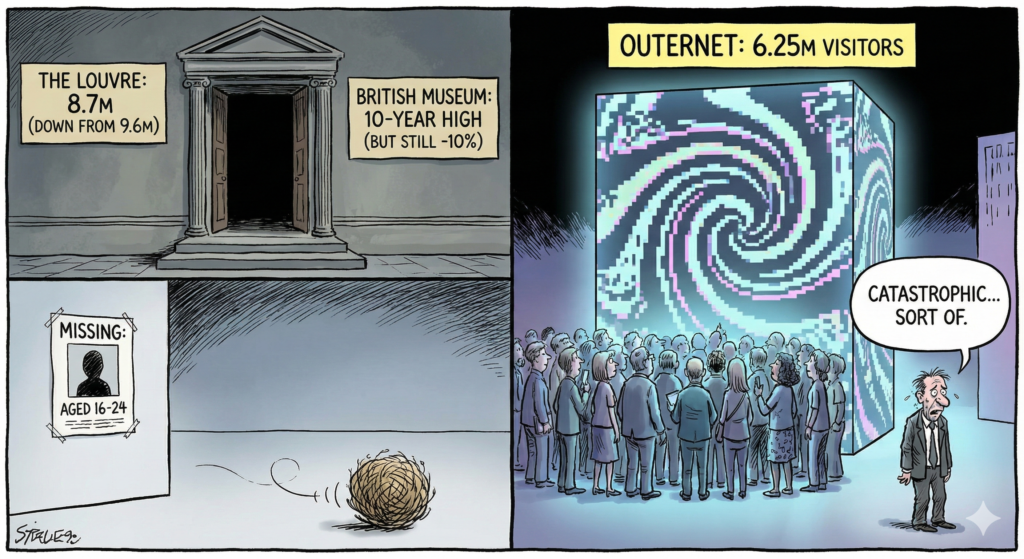
Let’s start with the bad news, shall we? The Louvre – that giant glass pyramid thing in Paris where tourists go to take selfies with the Mona Lisa – had 8.7 million visitors in 2024. Which sounds impressive until you realize that’s down from 9.6 million in 2019. The British Museum hit a ten-year high, which is lovely, except overall UK museum visits are still 10% lower than pre-pandemic.
But here’s where it gets properly worrying: young people have stopped showing up. And I don’t mean slightly fewer. I mean catastrophically fewer. Tate Modern had 609,000 visitors aged 16-24 in 2019. By 2024? Just 357,000. That’s nearly half. Gone. Vanished. Like my enthusiasm for electric cars.
The National Gallery? Down 47% from 2019. The Royal Academy? Down 50%. These aren’t speed bumps. These are walls.
Meanwhile – and this is the bit that should terrify every museum director in the land – some immersive digital art thing called Outernet reported 6.25 million visitors in London. That’s MORE than the British Museum. For what’s essentially a very large telly showing swirly colors.
The Kids Want to Touch Everything (And Who Can Blame Them?)
Here’s the problem: Generation Z grew up with the internet. They’ve been swiping, tapping, and interacting with screens since they were in nappies. And now you want them to stand in a silent room, looking at a painting of a bowl of fruit while some bloke in a turtleneck whispers about “composition” and “the artist’s relationship with mortality”?
No. They want to DO something. They want participatory engagement. Which, once you strip away the ghastly academic jargon, means they want to touch things, make things, and – God help us – take Instagram photos where they’re part of the experience.
This is why TeamLab in Tokyo is making an absolute fortune. It’s not a museum. It’s a playground for adults where you walk through rooms full of projected flowers and waterfalls, and every surface is “Instagrammable.” They’ve sold 4.5 million tickets at roughly $60 million in revenue. That’s more than most proper museums make while actually owning priceless art.
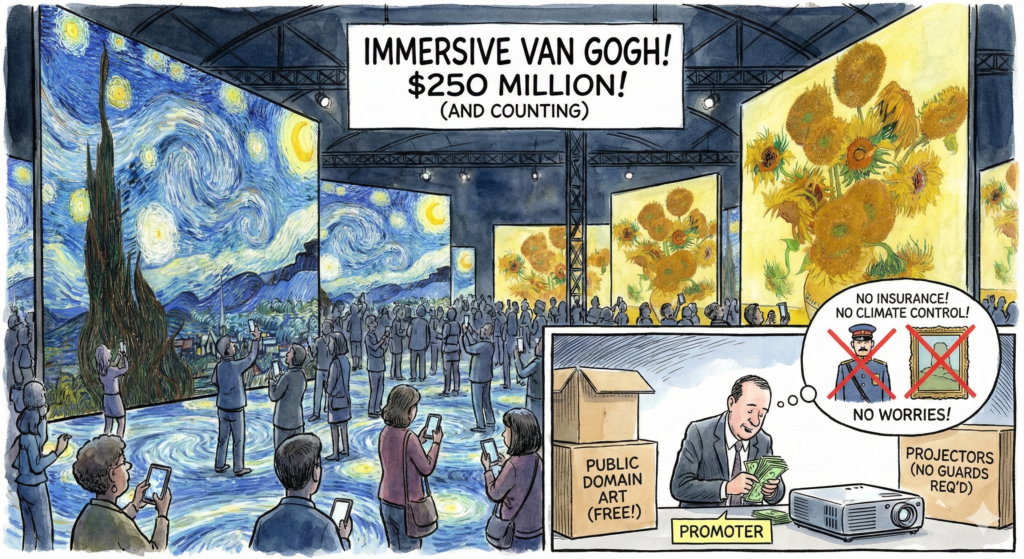
The “Immersive Van Gogh” shows – basically Van Gogh’s paintings projected really big on walls with swirly music – made $250 million. And do you know what’s brilliant about that business model? No insurance for priceless canvases. No climate control. No security guards worrying about someone nicking a Rembrandt. Just projectors and public domain art.
It’s genius. Utterly soulless, but genius.
Museums Strike Back (With Holograms and Blockchain. Obviously.)
Now, you might think museums would just roll over and die like Blockbuster Video. But no. They’re fighting back with the kind of desperate innovation you see from car manufacturers trying to make electric vehicles not utterly boring.
The V&A – which is actually rather good – created an exhibition about Alice in Wonderland where you could wear VR headsets. It worked. People showed up. The Science Museum is putting holographic artifacts in classrooms. Museums are buying NFTs. Yes, those things that absolutely everyone agrees are definitely not a massive scam.

The Musée d’Orsay even let visitors “blow into their phones” to generate digital art. I’m not making this up. You blow on your phone like it’s a Nintendo cartridge, and it makes art. And people pay for this.
But here’s what’s actually clever: museums are realizing they can’t just be temples anymore. They have to be town squares. Community spaces. Places where things happen, not just where things sit behind glass looking expensive and judgmental.
The Colonial Elephant in the Gallery
And then there’s the really uncomfortable bit. The bit where we all have to acknowledge that a lot of museum collections were acquired through what we might charitably call “aggressive collecting” and what anyone honest would call “looting during colonialism.”
The Benin Bronzes – sculptures stolen by British troops in 1897 – have become the poster child for this crisis. Germany returned theirs to Nigeria. The Smithsonian returned 29. The Museum of Fine Arts in Boston actually closed an entire gallery and sent the bronzes back.
Meanwhile, the British Museum is legally forbidden from returning anything because of a 1963 law. So they’re stuck offering “long-term loans,” which is like stealing someone’s car and then generously offering to lend it back to them at weekends.
But here’s the twist: returning artifacts isn’t killing tourism. In Benin Republic, 26 returned artifacts attracted 200,000 visitors in months. Ninety percent were locals seeing their own heritage for the first time. That’s not destruction. That’s creation.
So What’s the Verdict?
Look, museums aren’t dying. They’re molting. They’re shedding that dusty, elitist skin and growing something new. The National Portrait Gallery closed for three years, renovated, and came back with visitor numbers up 36%. The Young V&A stopped being boring and focused on children, and visits jumped 47%.
The museums that are dying are the ones doing nothing. The ones that think people will keep showing up just because they own a Monet. Those are the actual dinosaurs. The asteroid has hit, and they’re standing there wondering why it’s getting dark.
The museums that will survive – and thrive – are the ones that realize the game has changed. You can’t just own culture anymore. You have to share it, remix it, and occasionally, yes, project it really big on walls with dramatic music.
Is it as good as the real thing? No. Of course not. But standing in a silent room looking at a painting while feeling inadequate because you don’t “get it”? That wasn’t working either.
The museum of the future will be louder, messier, and probably involve more screens than seems healthy. It’ll let you touch things, make things, and blow into your phone to create digital art that makes absolutely no sense.
But it’ll be alive. And that’s better than being a perfectly preserved corpse.
Even if I still think a well-engineered V12 engine is more beautiful than anything hanging in the Tate Modern. But that’s an argument for another day.