When you see bold black lines creating rectangles filled with primary colors, you are looking at one of art history’s most recognizable styles. Mondrian grid art transformed modern painting by proving that simple geometric shapes could express deep artistic meaning. This revolutionary approach to composition continues to inspire artists, designers, and students more than a century after Piet Mondrian first developed his iconic grid-based style.
Key Points Summary
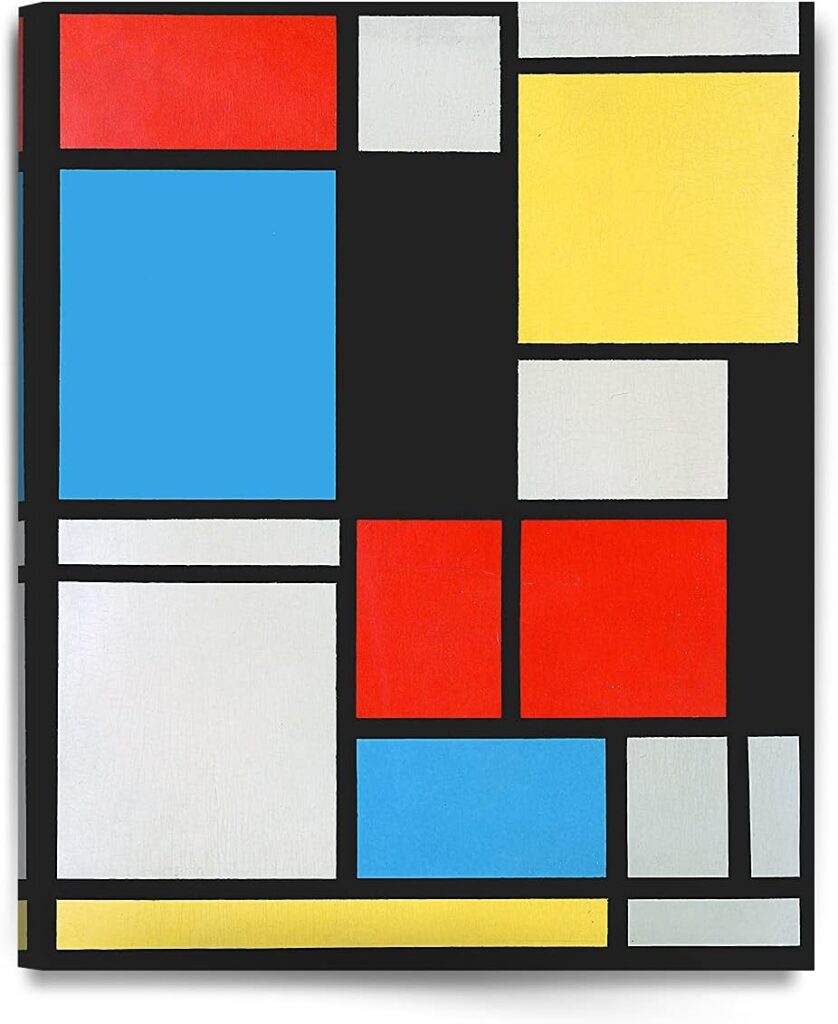
- Visual Style: Features black lines forming rectangles filled with primary colors (red, blue, yellow) and white spaces.
- Origins: Piet Mondrian developed this style as part of the De Stijl movement in the early 1920s.
- Philosophy: The grid represents a search for universal harmony, spiritual balance, and essential truth.
- Educational Value: Creating this art teaches fundamental design principles including balance, proportion, and color theory.
- Legacy: Modern applications range from high fashion and architecture to digital design and pop culture.
Understanding Piet Mondrian and His Vision
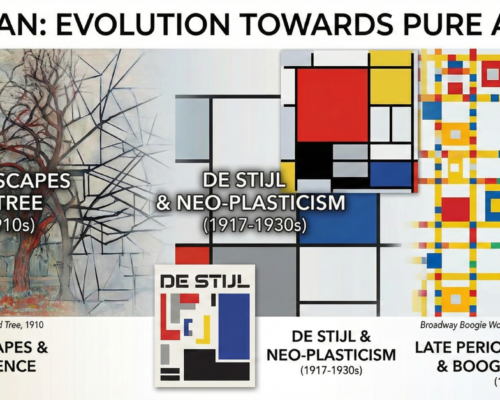
Piet Mondrian (1872-1944) was a Dutch painter who pioneered abstract art. Born in the Netherlands, he began his career painting realistic landscapes. However, his artistic philosophy evolved dramatically, leading him to reject representational art entirely in favor of pure abstraction.
Mondrian believed that art should express universal truths rather than depict specific objects. He sought a visual language that transcended individual experiences, leading him to develop “neoplasticism” or “new plastic art.”
The Journey to Geometric Abstraction
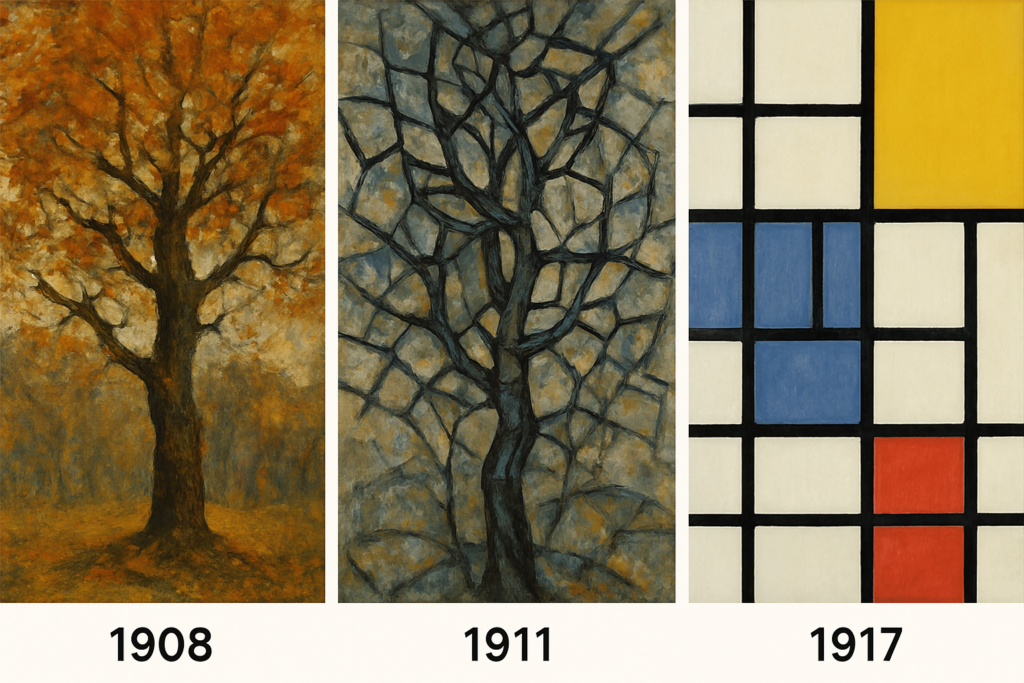
Mondrian’s path to the grid wasn’t immediate. He worked in impressionism and luminism before encountering Cubism in Paris in 1911. This profoundly influenced his thinking about breaking forms into essential components. He gradually simplified his work, moving from recognizable subjects to increasingly abstract compositions. By the early 1920s, he arrived at his mature style featuring only horizontal and vertical lines, primary colors, and non-colors.
“The emotion of beauty is always obscured by the appearance of the object. Therefore, the object must be eliminated from the picture.”
Piet Mondrian
The De Stijl Movement
Mondrian’s art became the centerpiece of De Stijl (“The Style”), a movement founded in 1917 in the Netherlands. De Stijl embraced abstraction and simplification, promoting the idea that art should achieve universal harmony by reducing form and color to their basics. This aesthetic extended beyond painting into architecture and furniture design, notably in the work of Gerrit Rietveld.
Core Principles
The movement established strict rules that defined Mondrian grid art:
- Reduction to Essentials: Only vertical and horizontal lines were permitted.
- Limited Palette: Restricted to primary colors (red, yellow, blue) plus black, white, and gray.
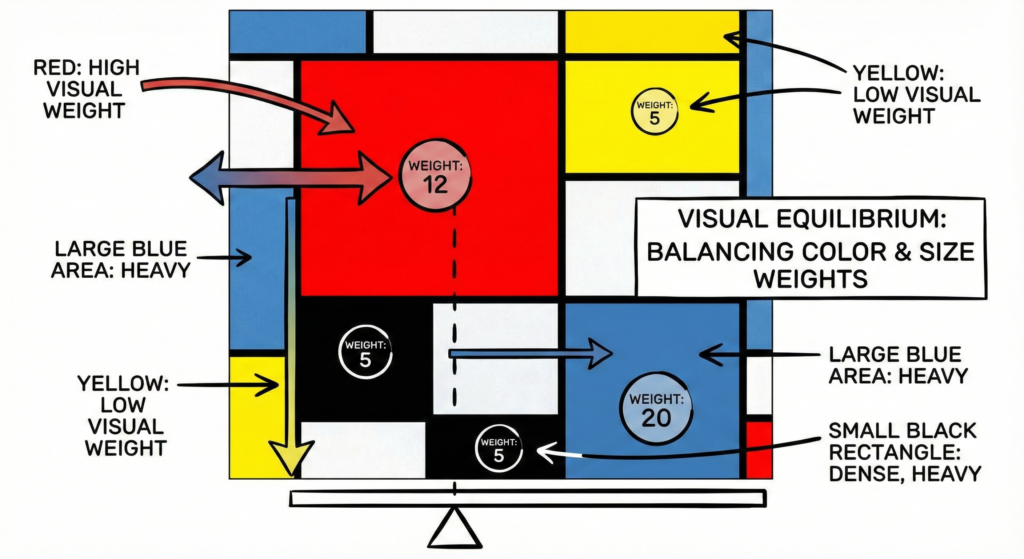
- Asymmetrical Balance: Compositions achieved balance through the distribution of weight, not symmetry.
- Universal Expression: The goal was to express objective truths rather than personal emotion.
Elements of Mondrian Grid Design
Understanding the components of Mondrian’s style is essential for appreciating his work and creating your own.
The Grid Structure
The foundation is a network of perpendicular lines dividing the canvas. These lines are always perfectly horizontal or vertical—never diagonal. The grid creates order and structure, while varying rectangle sizes introduce dynamic tension. No two rectangles in a composition are typically identical.
Color Theory
Mondrian’s use of color was philosophical. By limiting himself to primary colors, he believed he was working with the fundamental elements of reality.
- Red: Energy, dynamism, warmth.
- Yellow: Light, spirituality, intellect.
- Blue: Calm, depth, contemplation.
- White: Space, possibility, purity (dominates most compositions).
- Black: Definition, structure, grounding.
Balance and Proportion
The most sophisticated aspect of this style is achieving balance without symmetry. A large area of white might be balanced by a small block of intense red; a heavy blue rectangle might be counterweighted by several small yellow sections. This creates visual tension that keeps the eye moving.
How to Create Your Own Mondrian Grid Art
Creating Mondrian-style artwork is an excellent way to learn design principles. The apparent simplicity makes it accessible, while the challenge of balance keeps it engaging.
Materials Needed
- Traditional: Canvas/heavy paper, ruler, pencil, black marker/paint, primary color paints (acrylic), flat brushes, masking tape.
- Digital: Drawing software (Photoshop, Illustrator, Procreate) and basic shape tools.
Step-by-Step Process
- Plan Your Composition: Sketch thumbnail versions. Focus on the overall balance of rectangles rather than perfect lines.
- Create the Grid: Lightly draw grid lines with a ruler. Lines don’t need to extend across the whole canvas; stop some partway for a dynamic look.
- Apply Black Lines: Paint or draw the black lines. Use masking tape for crisp edges. Ensure consistent line width.
- Add Primary Colors: Select a few rectangles to fill. Less is more—Mondrian left most of the canvas white. Consider visual weight (red is heaviest, yellow lightest).
- Refine and Balance: Step back. Does it feel balanced? Adjust grid lines or colors if the harmony feels “off.”
Common Mistakes to Avoid
- Overusing Color: White space is as important as color.
- Symmetry: Avoid mirror images; seek asymmetrical balance.
- Inconsistent Lines: Keep line thickness uniform within the composition.
- Diagonals: Strictly avoid diagonal lines to maintain the neoplastic style.
The Philosophy Behind the Grid
Mondrian wasn’t making decorative patterns; he was visualizing reality.
Theosophical Influences
Mondrian was influenced by Theosophy, a philosophy seeking universal truths underlying all religions. The horizontal and vertical lines represented cosmic dualities: spirit/matter, male/female, positive/negative. Reducing art to these elements expressed the essential structure of the universe.
Spiritual Dimension
For Mondrian, art was a spiritual practice. The balance in his compositions represented spiritual harmony. His mature work reflects the belief that reality consists of pure relationships—connections between elements rather than the elements themselves.
Mondrian’s Influence on Modern Design
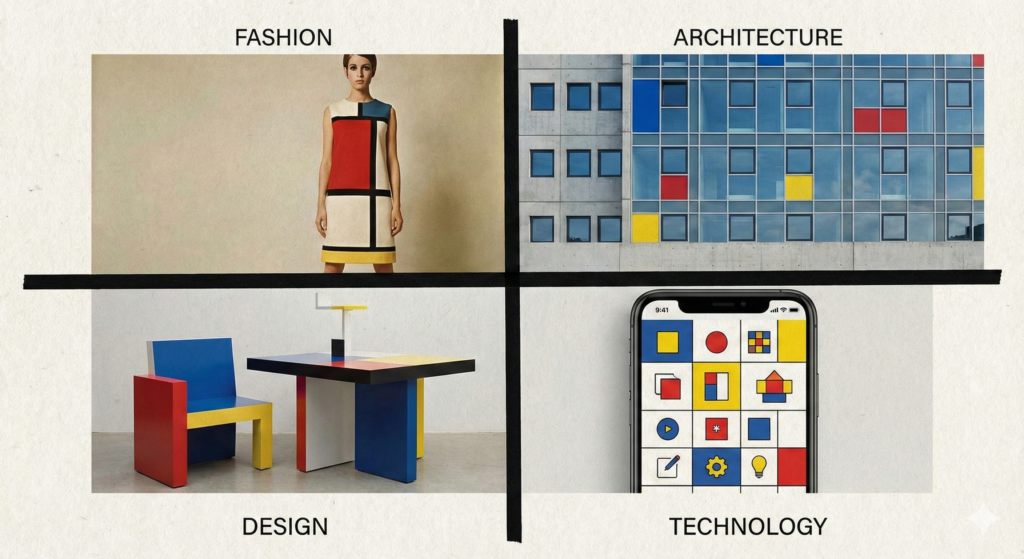
Mondrian’s aesthetic is one of the most commercially influential of the 20th century.
Fashion and Textiles
Yves Saint Laurent’s 1965 “Mondrian Collection” translated paintings into wearable art. The shift dresses featured bold blocks of primary colors and remain iconic. The aesthetic continues to appear in everything from sneakers to haute couture.
Architecture and Interiors
De Stijl principles translate naturally to three-dimensional space. Modern architecture frequently employs the grid aesthetic, using primary colors as accents against neutral backgrounds. Interior designers use the style to create spaces emphasizing openness and clean lines.
Graphic and Web Design
The grid system underlying modern graphic design owes a debt to Mondrian. His work helped establish the grid as a fundamental tool for organizing information. Today, web interfaces and data visualizations frequently use Mondrian-inspired layouts for clarity and hierarchy.
Teaching Mondrian in the Classroom
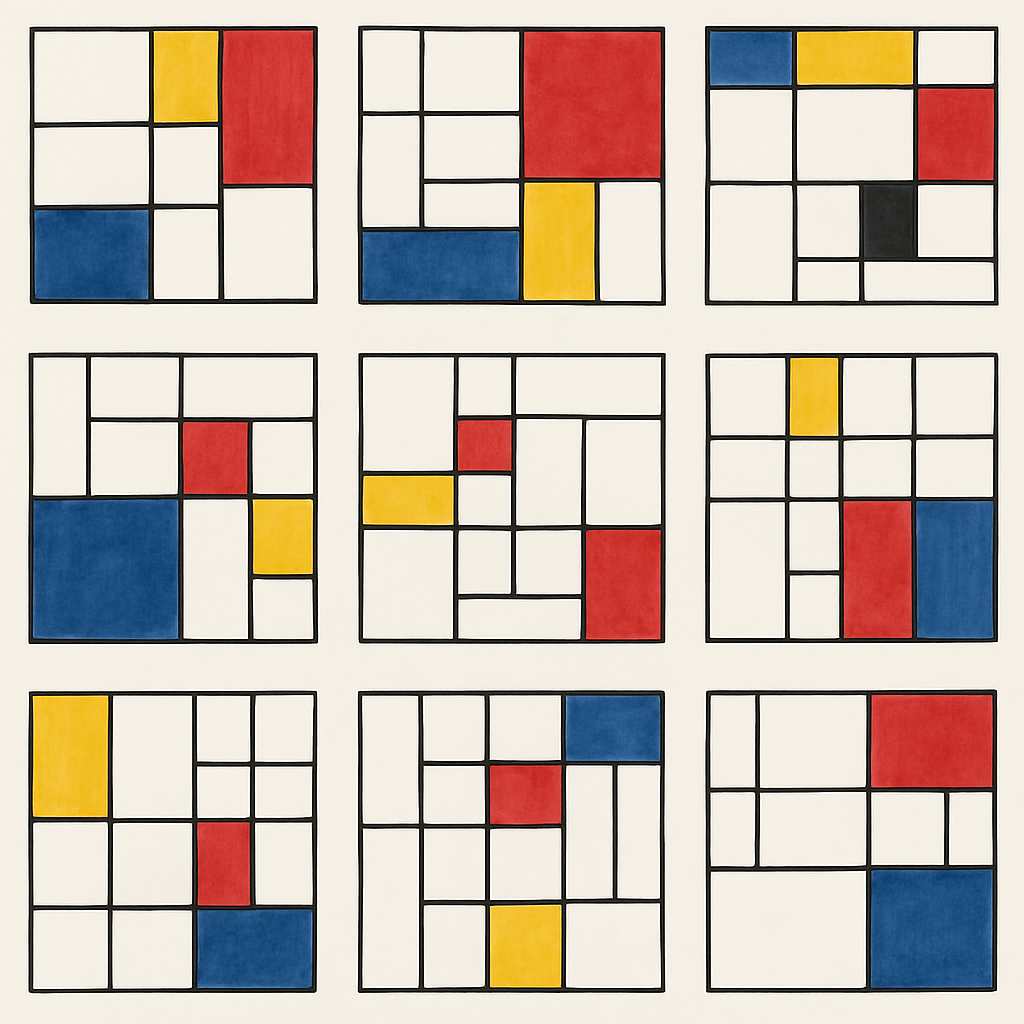
Mondrian’s work is a staple in art education because it teaches complex concepts through accessible means.
Educational Benefits
- Composition: Teaches spatial relationships and balance.
- Color Theory: demonstrably shows the power of primary colors.
- Precision: Requires planning and careful execution.
- History: Connects students to modernism and abstract art history.
Project Ideas
- Math Integration: Calculate the area of rectangles or explore the Golden Ratio.
- Collaborative Murals: Have students contribute sections to a large-scale grid.
- Digital Art: Use the style to introduce vector drawing tools.
- Music Connection: Discuss the rhythm of “Broadway Boogie Woogie” and have students paint to jazz music.
Mondrian in the Digital Age
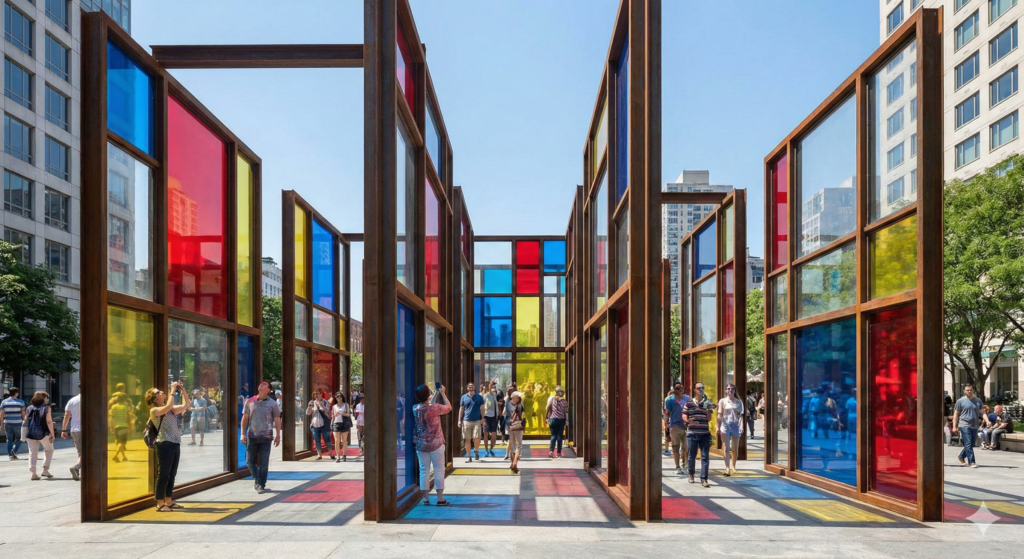
Technology has opened new frontiers for this century-old style.
Digital Creation
Software like Adobe Illustrator or Figma is perfect for the clean lines and flat colors of Neoplasticism. Digital tools allow for rapid experimentation with composition and color arrangement without the drying time of paint.
Generative Art
Artists now use algorithms to generate Mondrian-style compositions, exploring whether aesthetic principles can be quantified. These projects question what makes a composition “feel” like a Mondrian.
Interactive Installations
Museums utilize touchscreens allowing visitors to manipulate grids, making the abstract concepts of balance and tension tangible and interactive.
Famous Artworks
- Composition with Red, Blue and Yellow (1930): The quintessential Mondrian. It features his mature style at its most refined, with perfect equilibrium achieved through asymmetrical arrangement.
- Broadway Boogie Woogie (1942-43): Created in New York, this work reflects the city’s energy. Solid black lines are replaced by broken, colored lines, suggesting street grids and jazz rhythms.
- Victory Boogie Woogie (1942-44): His final, unfinished work. It uses a diamond-shaped canvas and complex, musical patterns of color.
Analyzing Technique
Mondrian’s paintings were not mechanically produced; they were labor-intensive handmade objects.
- Process: He built up black lines through multiple applications and often repainted sections to adjust weight. X-rays reveal he frequently moved lines during the painting process.
- Line Quality: Lines were refined but show subtle brushstrokes, reminding the viewer of the human hand.
- Color Application: Colors were applied in thin layers to avoid brush texture, emphasizing the hue itself rather than the paint.
Design Your Own Neoplastic Masterpiece
Explore the principles of De Stijl firsthand with this interactive digital canvas. To begin, select a “Split” mode and click anywhere on the white square to divide it into smaller rectangles, building your own unique grid structure. Once you are happy with your layout, switch to “Paint” mode to fill your geometric shapes with iconic primary colors. You can fine-tune your composition by adjusting the Line Thickness slider to add visual weight, and when your masterpiece is complete, simply click “Download Image” to save a high-quality copy of your work.
Mondrian Grid Studio
FAQs
What inspired Mondrian to create grid art?
He was inspired by a search for universal harmony and truth, influenced by Theosophy and Cubism. He believed reducing art to lines and primary colors revealed the underlying structure of reality.
Why only primary colors?
He viewed red, yellow, and blue as the most fundamental visual elements because they cannot be mixed from other colors. This aligned with his goal of reduction to essentials.
Can I create Mondrian-style art without breaking copyright?
Yes. The style (grids, primaries) is not copyrighted. However, reproducing a specific painting (like Composition II) creates a copy of a specific work. Creating original compositions using his principles is legal and encouraged.
What is Neoplasticism?
It is the term Mondrian used for his philosophy. It means “new plastic art,” referring to art that is “formed” (plastic) but abstract, reduced to essential elements to express universal beauty.
How much are his paintings worth?
They are incredibly valuable. Composition No. II sold for $51 million in 2022.
Final Thoughts
Mondrian grid art is more than just colorful rectangles; it is a sophisticated visual philosophy. Piet Mondrian’s reduction of painting to its essentials created a language that remains vital today. Whether you are a student learning composition, a designer seeking clarity, or an artist exploring balance, engaging with the grid connects you to a tradition that bridges the gap between fine art and universal design.
Citations
- Piet Mondrian: A Beginner’s Guide to His Iconic Style – ProminentPainting.com comprehensive overview of Mondrian’s artistic development and philosophy
- The Museum of Modern Art – Piet Mondrian Collection – MoMA’s extensive collection and scholarly resources on Mondrian’s work
- Tate Modern – Piet Mondrian Biography – Comprehensive biography and analysis of major works
- Guggenheim Museum – The De Stijl Movement – Historical context and documentation of the De Stijl movement
- Khan Academy – Introduction to Neo-Plasticism – Educational resource explaining Mondrian’s neoplasticism