
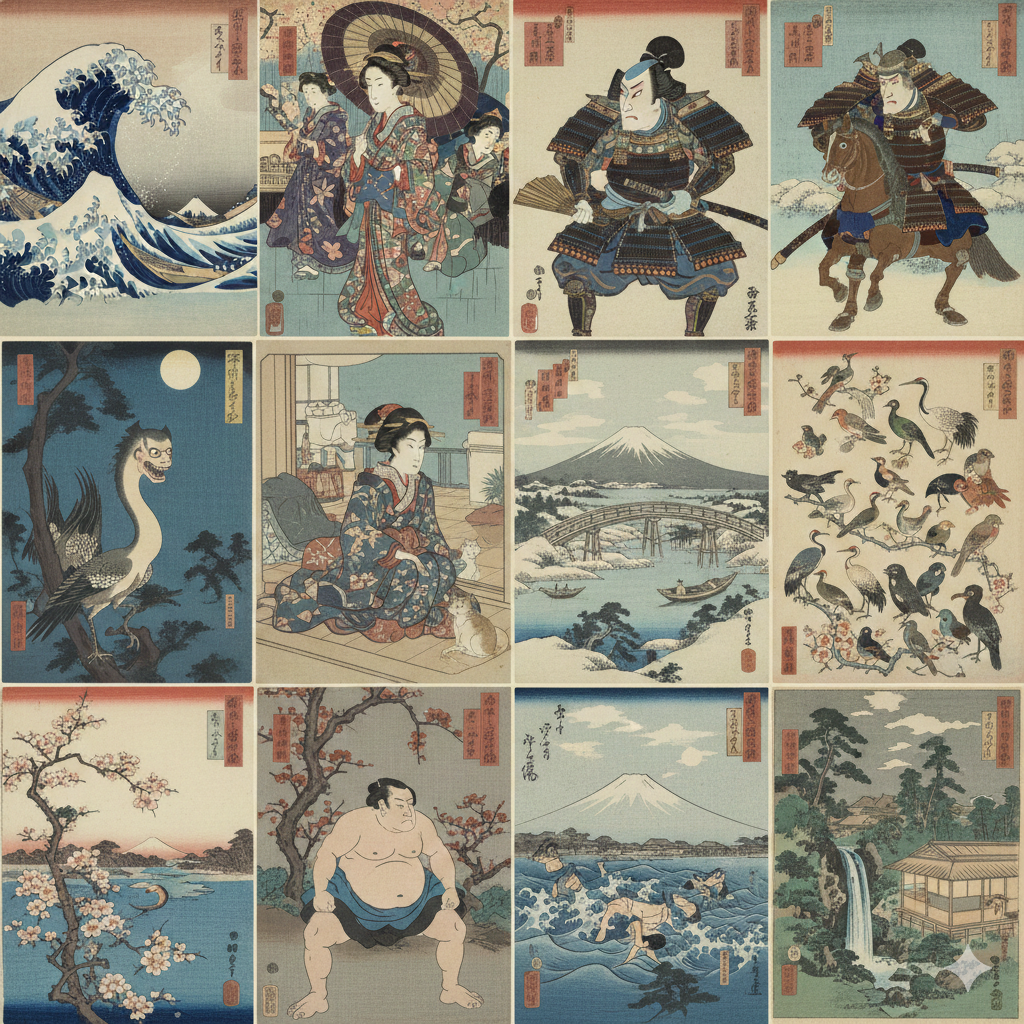
When Japan opened its doors to the West in the 1850s, few could have predicted the artistic earthquake that would follow. The influence of Japanese Ukiyo-e prints on Impressionism became one of the most fascinating cultural exchanges in art history, fundamentally changing how European artists saw the world. These colorful woodblock prints didn’t just inspire a few painters—they sparked a creative revolution that reshaped modern art forever.
Key Points:

- Ukiyo-e prints arrived in Europe as packaging material but became treasured art
- Japanese composition techniques revolutionized Western perspective and layout
- Artists like Monet, Van Gogh, and Degas collected and studied Japanese prints
- Bold colors, flat areas, and unusual viewpoints became hallmarks of Impressionism
- This cultural exchange launched the “Japonism” movement across Europe
- The influence extended beyond Impressionism into modern art movements
What Is Ukiyo-e? Understanding the Floating World
The term “Ukiyo-e” literally means “pictures of the floating world.” During Japan’s Edo period (1603-1868), these woodblock prints captured everyday life with stunning beauty and technical skill. Think of them as the Instagram of their time—images that showed what was cool, trendy, and exciting.
Artists created Ukiyo-e using innovative painting techniques that involved carving designs into wooden blocks, inking them, and pressing them onto paper. This mass production method made art affordable and accessible, unlike the expensive oil paintings that dominated European galleries.
Common subjects included:
- Beautiful courtesans in elaborate kimonos
- Famous Kabuki actors in dramatic poses
- Breathtaking landscapes like Mount Fuji
- Urban scenes showing Tokyo’s bustling streets
- Natural elements like waves, flowers, and birds
The prints featured vibrant colors, clean lines, and compositions that looked totally different from anything Europeans had seen before. Understanding color theory in art helps explain why these bold, flat color choices were so revolutionary.
The Birth of Impressionism in 19th Century France
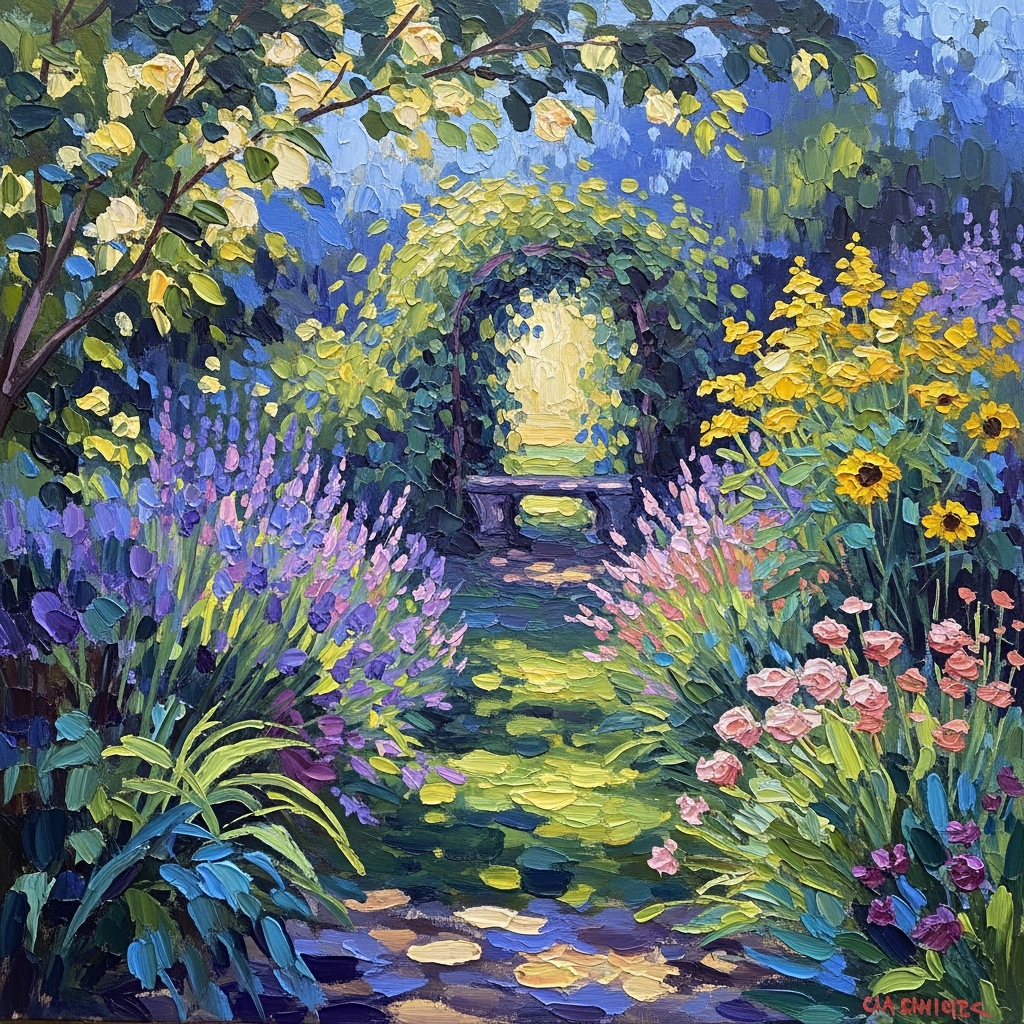
Before we dive into how Japanese art changed everything, let’s understand what Impressionism was all about. In mid-to-late 19th century France, a group of rebellious artists got tired of stuffy academic rules.
Impressionist artists wanted to:
- Show how light changes throughout the day
- Capture quick, fleeting moments
- Paint everyday people and places
- Use visible brushstrokes instead of smooth blending
- Work with bright, pure colors
The establishment hated it at first. Critics thought these paintings looked unfinished and messy. But these artists were onto something big—they were creating a whole new way of seeing.
How Did Ukiyo-e Reach Europe? The Story of Japonism
Here’s where things get interesting. When Japan opened to Western trade in 1854, Japanese goods started flowing into Europe. Ukiyo-e prints were so common in Japan that merchants used them as wrapping paper—imagine using the Mona Lisa to wrap your takeout!
European artists stumbled upon these “throwaway” papers and were absolutely blown away. The prints looked like nothing they’d ever seen. Colors popped. Compositions felt fresh and dynamic. Everything seemed so different from traditional Western art.
This discovery launched “Japonism”—a massive craze for all things Japanese. Suddenly, artists and collectors were hunting down these prints. Paris shops started selling Japanese art. Everyone who was anyone had to have Japanese prints decorating their studios.
The timing was perfect. Impressionist painters were already questioning old rules. When they saw how Japanese artists used color and arranged their compositions, it was like finding the missing puzzle piece.
“I envy the Japanese for the extreme clarity of their works… Their work is as simple as breathing.”
Edgar Degas
Revolutionary Composition: Breaking Western Perspective Rules
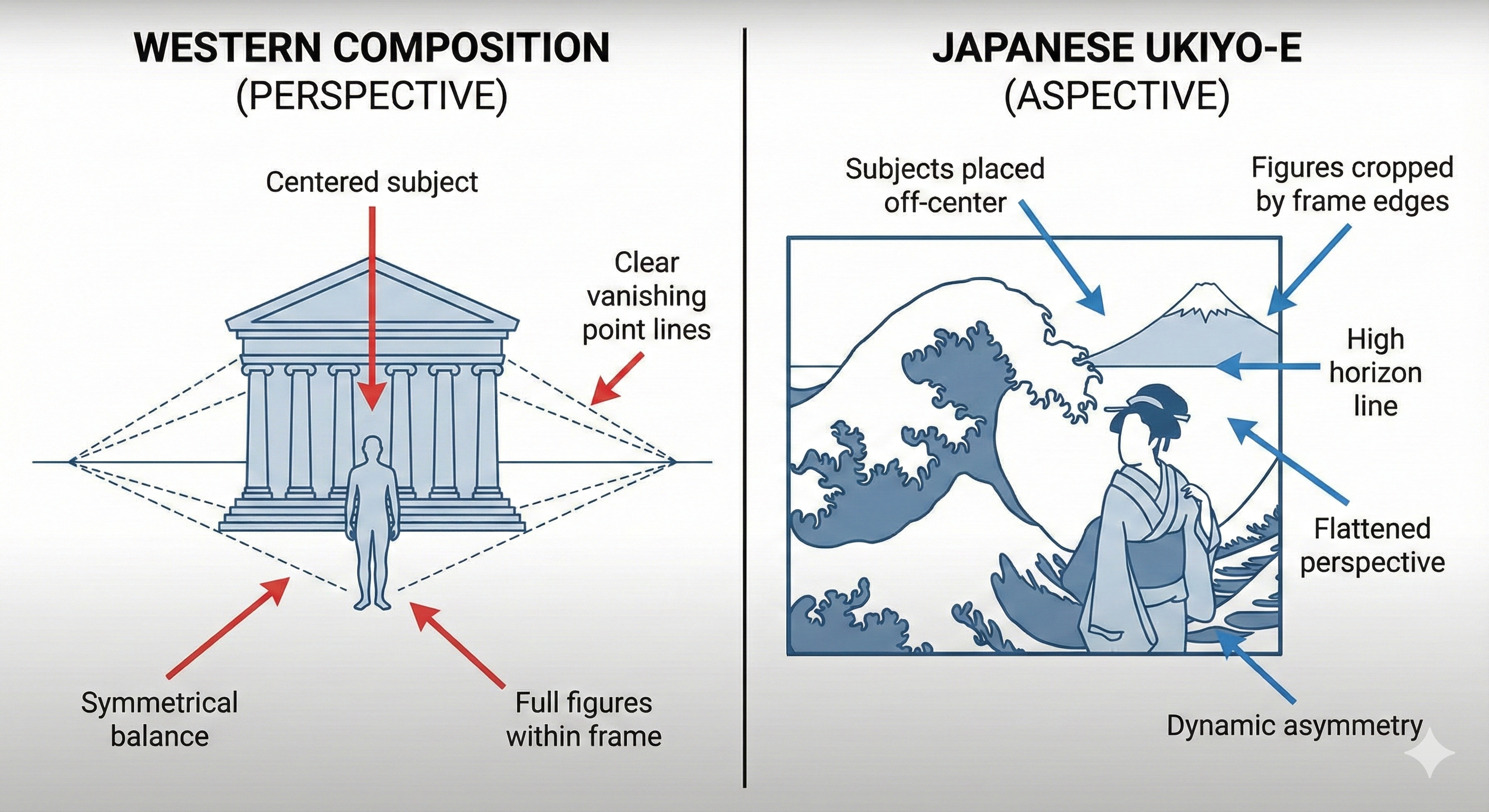
Perhaps the biggest way Japanese Ukiyo-e influence on Impressionism showed up was in composition. Western art had followed strict rules about perspective since the Renaissance. Every painting needed to follow a single vanishing point, with everything neatly arranged to guide the viewer’s eye.
Japanese artists said, “Forget all that!” and created compositions that felt totally fresh.
Asymmetrical Balance and Dynamic Layouts
Traditional Western paintings typically centered important subjects, creating balanced, symmetrical compositions. Ukiyo-e prints threw this out the window. Important elements might sit way off to one side. Empty space became just as important as filled space. This asymmetry created energy and movement that felt modern and exciting.
Impressionist painters loved this freedom. They started placing subjects off-center, cutting figures at the frame edge, and leaving large empty areas in their paintings. It made their work feel spontaneous and real, like a snapshot of actual life rather than a carefully posed scene.
Unusual Viewpoints and Cropped Figures
Japanese prints often showed scenes from weird angles—looking down from above (bird’s-eye view) or placing the horizon line super high. They’d crop people and objects at unexpected places, showing just part of a figure.
This was mind-blowing to European artists who’d been taught that you always show the whole subject in a predictable way. Edgar Degas especially embraced this approach, creating paintings of ballet dancers where bodies were cut off at strange angles, just like in Japanese prints.
Flattened Perspective
Western art used linear perspective to create depth—making things smaller as they receded into the distance. Japanese prints often used a flatter approach, with less emphasis on creating a three-dimensional illusion. Different elements might exist on different planes without a clear sense of depth.
This flattening influenced how Impressionists thought about space. They started emphasizing the picture plane itself rather than always trying to create a window into a realistic space.
Color Revolution: Bold, Flat, and Beautiful
If composition was the first shock, color theory was the second. Japanese prints used color in ways that made European art look muddy and dull by comparison.
Bold, Flat Areas of Color
Western oil painting typically used modeling—gradually shading colors from light to dark to create form. Japanese woodblock prints used large, flat areas of solid color with crisp outlines. There wasn’t much blending or gradation within shapes.
This flatness created a graphic quality that felt modern and bold. Impressionist painters started incorporating more flat color areas and crisp edges into their work, especially when painting certain subjects or trying to capture specific lighting effects.
Innovative Color Gradation
Despite using flat color overall, Ukiyo-e prints sometimes featured subtle gradations, especially in skies and water. These transitions were handled differently than Western blending—more linear and controlled.
Contrasting Hues and Unconventional Palettes
Japanese prints weren’t afraid of bold color combinations that European academic art would have considered garish or unnatural. Bright blues next to vibrant oranges. Pure yellows touching deep purples. These combinations taught Impressionists to be braver with their color choices.
The famous Prussian blue in Hokusai’s “Great Wave” particularly captivated European artists. It was so vivid and electric—nothing like the muted blues in traditional Western seascapes.
Artists learned they could use color mixing in new ways, creating emotional impact through bold contrasts rather than subtle harmonies.
Subject Matter: Celebrating Everyday Life
Japanese prints showed ordinary people doing ordinary things—actors, merchants, travelers, people caught in rainstorms. This focus on everyday life aligned perfectly with what Impressionists wanted to do.
Instead of painting gods, kings, and historical battles, both Japanese and Impressionist artists chose:
- People at leisure—picnics, boating, café scenes
- Urban landscapes and city streets
- Workers and common folks
- Natural landscapes and seasons
- Modern life and entertainment
This shared interest in the present moment rather than grand historical themes helped validate the Impressionist approach. If Japanese artists could make beautiful art from simple subjects, so could they.
Claude Monet: From Collector to Garden Designer
Claude Monet was perhaps the most dedicated Japanese art enthusiast among the Impressionists. He collected over 250 Japanese prints, which hung throughout his home in Giverny. But Monet didn’t just admire these prints—he lived with them and let them transform his entire approach to art and life.
The Japanese Garden at Giverny
Monet took his love of Japanese aesthetics beyond painting and actually built a Japanese garden at his home. The famous water lily pond with its Japanese bridge became one of the most iconic subjects in all of Impressionist art. This wasn’t just decoration—it was Monet’s attempt to bring the “floating world” of Ukiyo-e into his daily life.
The garden showed Japanese influence in:

- The curved wooden bridge inspired by Hiroshige’s prints
- The arrangement of willows, bamboo, and water lilies
- The careful attention to reflections and water surfaces
- The emphasis on seasonal changes and natural beauty
Influence on His Water Lily Series
Monet’s famous water lily paintings show direct Ukiyo-e influence. The flattened perspective, the way water and sky blend together, the bold cropping—all echo Japanese prints. Some of these later works have almost no horizon line, creating an immersive, abstract quality that was revolutionary for its time.
The surface of the water became like the surface of the canvas itself, with reflections and lily pads floating in ambiguous space. This approach would influence modern abstract art decades later.
Compositional Borrowings
Many of Monet’s paintings show clear Japanese compositional influence:
- Off-center focal points
- High horizon lines
- Cropped elements at frame edges
- Emphasis on decorative patterns in nature
- Flattened spatial relationships
Vincent van Gogh: The Ultimate Ukiyo-e Fanboy
If Monet was dedicated, Vincent van Gogh was obsessed. Van Gogh collected hundreds of Japanese prints and studied them intensely. He didn’t just admire them—he tried to paint like a Japanese artist and even made direct copies of several prints.
Direct Copies and Reinterpretations
Van Gogh created oil paintings that were direct copies of Ukiyo-e prints, adding his own colors and interpretations. His versions of prints by Hiroshige show how he used bold outlines and flat color areas, techniques that would become signature elements of his unique painting style.
These weren’t just copying exercises—Van Gogh was teaching himself to see differently. He wanted to understand how Japanese artists used:
- Bold, black outlines around forms
- Pure, unmixed colors
- Simplified shapes
- Decorative patterns
Bold Outlines and Vibrant Colors
The thick black outlines that became Van Gogh’s trademark came partly from Japanese prints. He started outlining figures and objects in dark contours, creating a graphic quality that made his paintings pop with energy.
His color choices also became bolder and more intense. Van Gogh admired how Japanese artists weren’t afraid to use pure, bright colors right out of the tube. His famous yellows, blues, and oranges reflect this Japanese influence.
Philosophical Connection
Van Gogh didn’t just copy techniques—he connected with the philosophy behind Japanese art. He loved how it celebrated simple beauty in everyday things. In letters to his brother Theo, he wrote about wanting to see the world “as simply as a Japanese artist.”
This perspective helped Van Gogh find beauty in ordinary subjects: a vase of sunflowers, his bedroom, café scenes, workers in fields. Like the Ukiyo-e artists, he found the extraordinary in the everyday.
Edgar Degas: Master of the Unexpected Angle
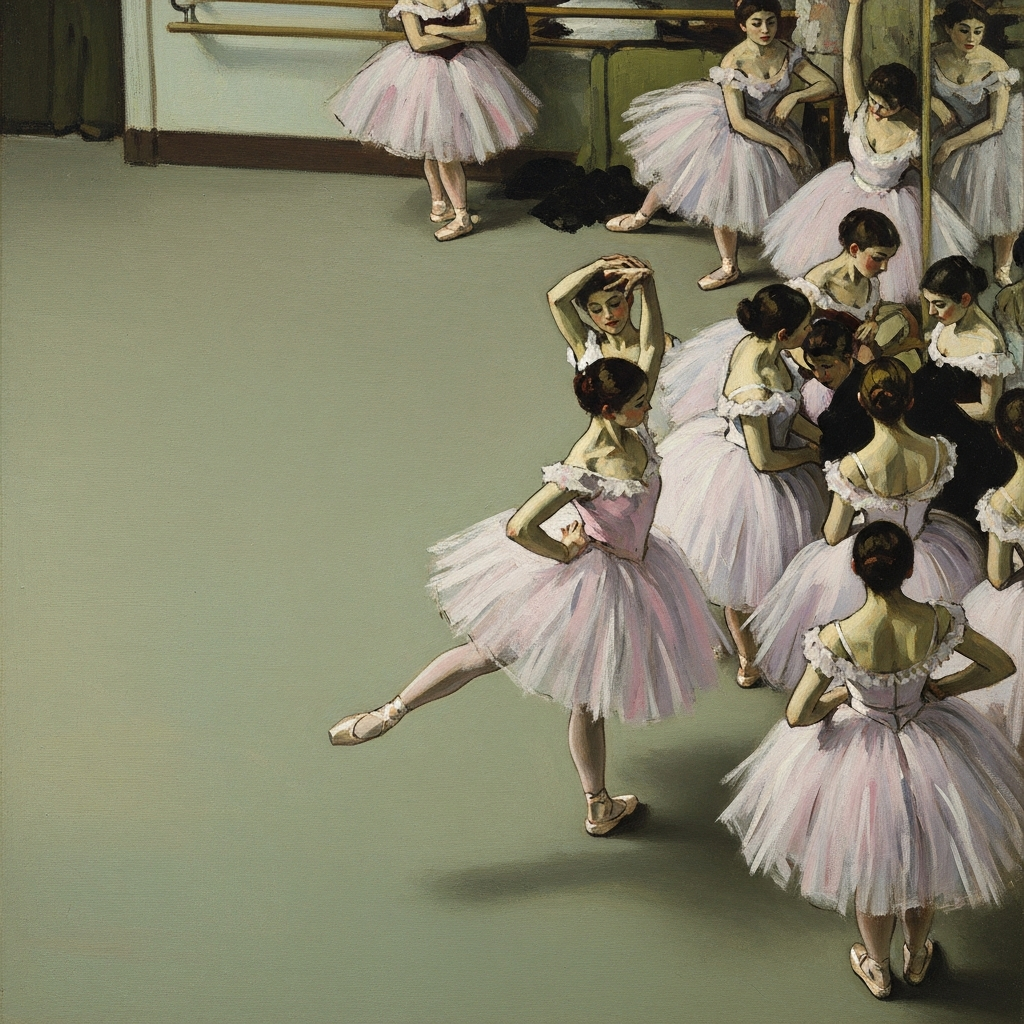
Edgar Degas was fascinated by how Japanese prints cropped figures and showed scenes from unusual viewpoints. This influence transformed his entire approach to composition.
Ballet Dancers and Urban Scenes
Degas’s famous ballet paintings show clear Japanese influence. Bodies are cut off at unexpected places—a leg disappears at the frame edge, a dancer’s head is cropped at the top. He shows scenes from above, looking down on the stage or rehearsal room.
This created a sense of intimacy and spontaneity, like we’re peeking into private moments. The compositions feel modern and photographic, even though photography was still new.
The Art of Cropping
Degas embraced the Japanese technique of radical cropping. Figures might be cut in half by the picture frame. Important elements might sit at the very edge of the canvas. This made his paintings feel like slices of real life rather than carefully arranged scenes.
He also loved asymmetry. A painting might show empty space on one side and crowded activity on the other. This dynamic imbalance created energy and movement that felt totally fresh.
Everyday Parisian Life
Like Japanese prints showing urban Edo, Degas painted modern Paris—café scenes, theater performances, working women. He shared the Ukiyo-e artists’ interest in capturing contemporary life with honesty and elegance.
Mary Cassatt: Breaking Boundaries with Japanese Techniques
Mary Cassatt was one of the few women in the Impressionist circle, and she embraced Japanese influence with particular enthusiasm. Her prints and paintings show how Ukiyo-e techniques could be adapted to Western subjects.
Mother and Child Compositions
Cassatt’s tender paintings of mothers and children show Japanese influence in their:
- Flattened perspective and simplified forms
- Bold, decorative patterns on clothing
- Intimate, cropped compositions
- Emphasis on the picture plane rather than deep space
She combined Western sensitivity to emotion with Japanese compositional boldness, creating a unique style that was completely her own.
Color Prints and Patterns
Cassatt even created her own series of color prints using techniques inspired by Japanese woodblock printing. These prints featured:
- Bold outlines and flat color areas
- Decorative patterns and textiles
- Simplified, graphic compositions
- Intimate domestic scenes
Her work proved that Japanese Ukiyo-e influence on Impressionism wasn’t just about copying techniques—it was about finding new ways to express universal human experiences.
Paul Cézanne: Subtle But Significant Influences
While Paul Cézanne is often grouped with Post-Impressionists, his work shows subtle Japanese influences that helped him develop his revolutionary approach to form and space.
Cézanne’s interest in flattening space and emphasizing the picture plane connects to Japanese aesthetics. His later works, which influenced Cubism and modern art, show a simplified, geometric approach that owes something to Japanese print-making’s clarity and simplification.
Beyond Impressionism: The Lasting Impact
The Japanese Ukiyo-e influence on Impressionism didn’t stop with that generation of artists. The ripple effects spread throughout modern art.
Post-Impressionism and Art Nouveau
Post-Impressionist artists continued exploring Japanese techniques. Art Nouveau designers embraced the flowing lines and organic forms found in Japanese prints. The decorative quality of Ukiyo-e influenced everything from posters to furniture design.
Modern Art Movements
The flattening of space, bold colors, and simplified forms that Japanese prints introduced became foundations of modern art. Artists like:
- Henri Matisse with his flat color planes
- Pablo Picasso with his multiple perspectives
- Abstract artists with their emphasis on the picture plane
All owed a debt to the East-meets-West exchange that began in the 1860s.
Contemporary Influence
Even today, artists continue drawing inspiration from Ukiyo-e. The bold graphics of modern illustration, the composition of contemporary painting, and even digital art show traces of this 19th-century cultural exchange.
The Bigger Picture: What This Cultural Exchange Teaches Us
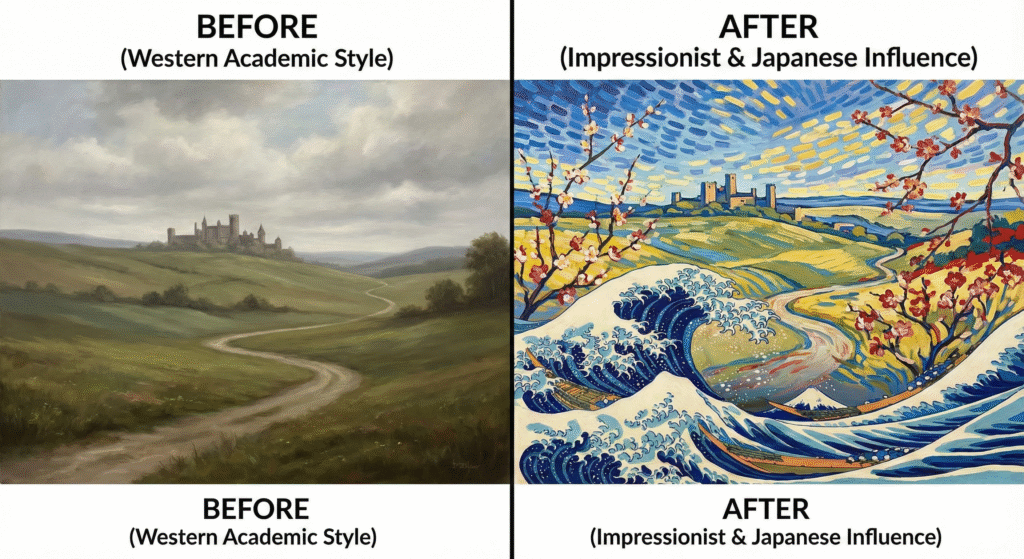
The story of Japanese Ukiyo-e influence on Impressionism shows us something important about creativity and innovation. When artists are willing to look outside their own traditions, amazing things happen.
Breaking Rules Leads to Innovation
Impressionists were already questioning Western art traditions. Japanese prints gave them permission to break rules and confidence that there were other ways to see and represent the world. This openness to different art movements and cultures sparked innovation.
The Power of Cross-Cultural Exchange
When different cultures share ideas, both sides benefit. Japanese art influenced Western painting, while Western techniques eventually influenced Japanese artists. This kind of cultural fusion in art continues to drive creativity today.
Questioning Assumptions
The biggest lesson might be about questioning assumptions. Western artists thought they knew the “right” way to create art. Japanese prints showed them that there are many right ways—and that sometimes the most exciting discoveries come from completely different perspectives.
How to See Japanese Influence in Impressionist Art
Want to spot Japanese influence when you visit a museum? Look for these telltale signs:
| Japanese Element | What to Look For | Example Artists |
|---|---|---|
| Asymmetrical Composition | Off-center subjects, unusual balance | Degas, Monet, Cassatt |
| Cropped Figures | Bodies cut off by frame edges | Degas, Toulouse-Lautrec |
| Flattened Perspective | Less depth, emphasis on surface | Gauguin, Van Gogh, Matisse |
| Bold Outlines | Strong contours around forms | Van Gogh, Toulouse-Lautrec |
| Pure, Bright Colors | Unmixed hues, bold contrasts | Van Gogh, Monet, Gauguin |
| High Horizon Lines | Bird’s-eye views, elevated perspective | Pissarro, Monet |
| Decorative Patterns | Emphasis on surface decoration | Cassatt, Vuillard, Bonnard |
| Everyday Subjects | Modern life, ordinary people | All Impressionists |
Conclusion: A Revolution That Changed Everything
Japanese Ukiyo-e influence on Impressionism represents one of the most important cultural exchanges in art history. What started with prints used as packing material evolved into a complete transformation of Western art. From Claude Monet’s water lilies to Van Gogh’s bold outlines, from Degas’s cropped dancers to Cassatt’s intimate prints, we see Japanese influence everywhere.
This wasn’t about copying—it was about learning, adapting, and creating something entirely new. The Impressionists took Japanese techniques and combined them with their own interests in light, color, and modern life. The result changed art forever, paving the way for all the modern movements that followed.
When you look at an Impressionist painting today, you’re seeing the beautiful result of two very different cultures coming together. That meeting of East and West didn’t just change how artists painted—it changed how the world sees art. And that’s the real power of Japanese Ukiyo-e influence on Impressionism: it showed us that art has no borders, and the best creativity comes from staying open to new ideas, no matter where they come from.
FAQs: Japanese Ukiyo-e Prints and Impressionism
How did Japanese art influence European art during the 19th century?
Japanese art influenced European art through the introduction of Ukiyo-e woodblock prints after Japan opened to Western trade in the 1850s. These prints introduced revolutionary concepts including asymmetrical composition, flattened perspective, bold use of color, unusual cropping, and emphasis on everyday subjects. European artists, particularly Impressionists, collected these prints and incorporated these techniques into their own work, fundamentally changing Western artistic conventions. This cross-cultural exchange, known as Japonism, affected not just painting but also decorative arts, poster design, and architecture throughout Europe.
What aspects of Ukiyo-e prints influenced Impressionist artists?
Ukiyo-e prints influenced Impressionists in several key ways: Composition – asymmetrical layouts, radical cropping of figures, high horizon lines, and bird’s-eye views; Color – bold, flat areas of pure color, crisp outlines, and unconventional color contrasts; Perspective – flattened spatial relationships rather than traditional linear perspective; Subject matter – focus on everyday life, urban scenes, and natural landscapes; and Decorative quality – emphasis on surface patterns and graphic clarity. These elements combined to create a fresh, modern approach that broke from centuries of Western artistic conventions.
Which Impressionist artists were most influenced by Japanese Ukiyo-e?
Vincent van Gogh was perhaps the most profoundly influenced, collecting hundreds of prints and creating direct copies of Japanese works. Claude Monet collected over 250 prints and built a Japanese garden that inspired his famous water lily series. Edgar Degas adopted Japanese cropping techniques and unusual viewpoints in his ballet paintings. Mary Cassatt created color prints using Japanese-inspired techniques. Paul Gauguin and Henri de Toulouse-Lautrec also showed significant Japanese influence in their flattened perspectives and bold compositions. Each artist adapted Japanese techniques in unique ways while maintaining their individual styles.
What is Japonism in art history?
Japonism (or Japonisme) refers to the widespread fascination with Japanese art and culture that swept through Europe, particularly France, from the 1860s through the early 1900s. It began when Japanese goods, including Ukiyo-e prints, became available in Europe after Japan ended its isolation in 1854. Artists, collectors, and designers eagerly collected Japanese art, and its influence appeared in painting, decorative arts, fashion, and design. Japonism wasn’t merely imitation but rather a creative dialogue where Western artists adapted Japanese aesthetic principles to create entirely new artistic approaches. This movement significantly impacted Impressionism, Post-Impressionism, Art Nouveau, and early modern art.
How did Ukiyo-e challenge traditional Western art conventions?
Ukiyo-e challenged Western conventions in fundamental ways: Perspective – Japanese prints used flattened space and multiple viewpoints instead of single-point linear perspective; Composition – asymmetrical arrangements and radical cropping replaced balanced, centered compositions; Color – bold, flat areas of pure color contrasted with Western modeling and subtle blending; Subject matter – focus on everyday contemporary life challenged the academic hierarchy that privileged historical and religious themes; Space – emphasis on the picture plane as a decorative surface rather than a window into illusionistic depth; and Line – strong outlines and graphic clarity replaced smooth blending. These differences showed European artists that their traditions were choices, not universal truths, opening possibilities for innovation.
Citations
- The Impact of Japanese Prints on Western Art – The Metropolitan Museum of Art
- Japonism Movement Overview | TheArtStory – The Art Story
- How Japanese Art Influenced Impressionism – Christie’s
- Japanese Influence on Monet – Fondation Claude Monet at Giverny
- Vincent van Gogh and Japan – Van Gogh Museum
- The Floating World: Ukiyo-e Prints – The British Museum