Welcome, art explorers! Get ready to travel back in time to the Italian Renaissance, a period bursting with creativity and genius. Our guide is the incredible Sandro Botticelli, a superstar artist from Florence. While many artists of his time focused on realism, Botticelli was all about beauty, grace, and flowing lines. His work is like a beautiful dream you can look at. In this post, we’ll dive into the top 10 Botticelli paintings, uncovering the stories and secrets that make them timeless masterpieces. Prepare to be amazed by the elegance and imagination that define Botticelli’s art.
The Birth of Venus (c. 1484–1486)
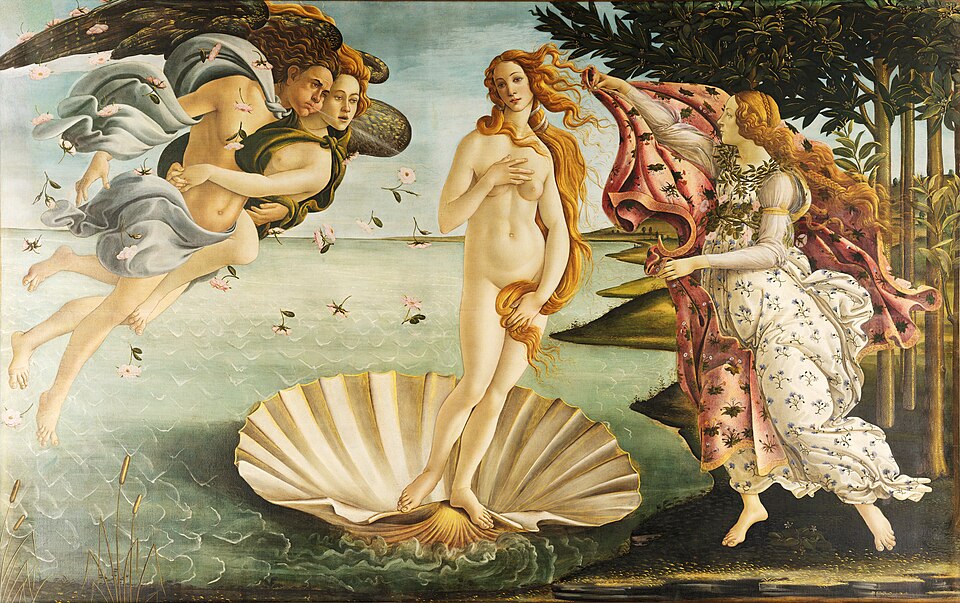
The iconic ‘The Birth of Venus’ by Sandro Botticelli, a masterpiece of the Italian Renaissance.
Imagine a goddess born from a giant seashell! That’s the stunning scene in ‘The Birth of Venus.’ Venus, the Roman goddess of love and beauty, floats ashore on a shell, pushed by the wind gods Zephyr and Aura. A gentle nymph waits on the shore to cover her with a star-covered cloak. This painting is famous for its delicate beauty and is one of the most recognizable artworks in the world. The pose of Venus was likely inspired by ancient Roman statues of the goddess, which Botticelli would have seen in the collections of his wealthy patrons, the Medici family.
Primavera (c. 1480)
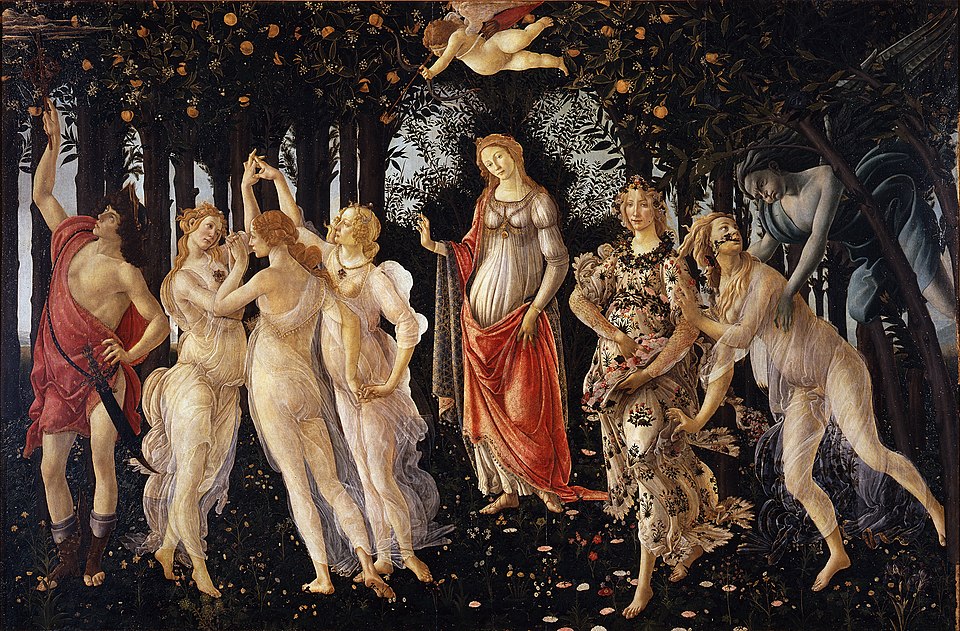
Sandro Botticelli’s ‘Primavera,’ a vibrant and allegorical celebration of spring.
Step into an enchanted garden with ‘Primavera,’ which means ‘Spring’ in Italian. This huge, complex painting is like a puzzle filled with characters from mythology. In the center stands Venus, while above her, Cupid aims his arrow. The scene is a celebration of spring, love, and fertility, filled with over 500 identified plant species painted with incredible detail. The figure of Mercury on the far left is poking the clouds with his staff, not to bring rain, but to magically keep the garden of Venus eternal and free from storms.
Venus and Mars (c. 1485)
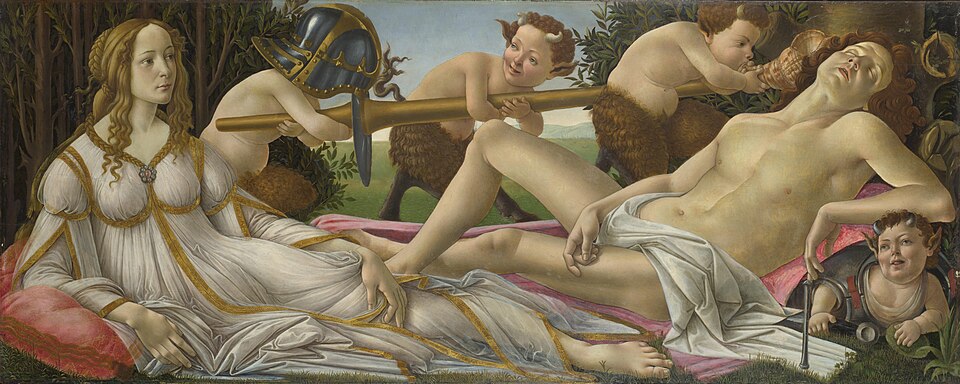
The playful and symbolic ‘Venus and Mars’ by Sandro Botticelli, showing love’s power over conflict.
What happens after a big battle? A nap! In this painting, Mars, the god of war, is fast asleep, completely exhausted. Venus, the goddess of love, watches over him calmly. Mischievous little satyrs play with Mars’s armor and even blow a conch shell in his ear to try and wake him up. It’s a humorous and charming painting that shows love triumphing over war. The wasps buzzing around the hollow tree trunk in the upper right corner may be a clever pun on the Vespucci family, who likely commissioned the painting, as their name sounds like ‘vespe,’ the Italian word for wasps.
The Adoration of the Magi (c. 1475–1476)
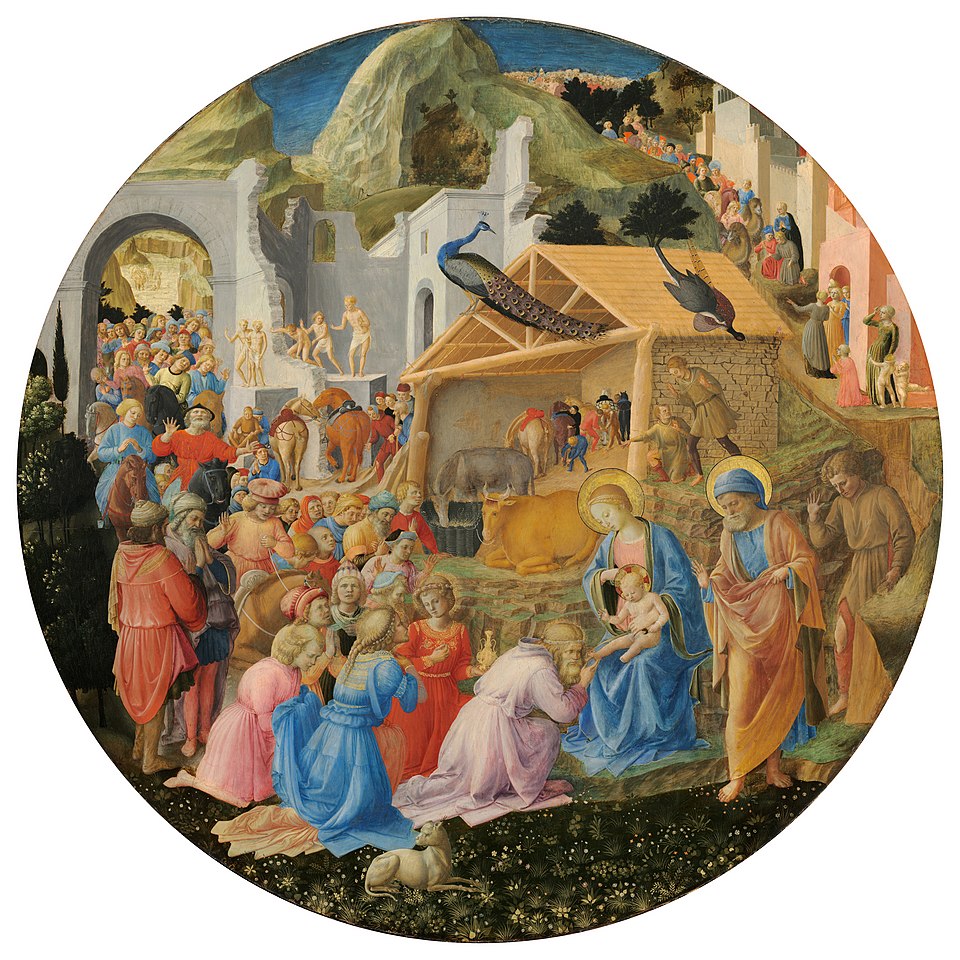
A star-studded religious scene: ‘The Adoration of the Magi’ by Sandro Botticelli.
This isn’t just any religious scene; it’s a who’s who of Florence’s most powerful family, the Medici. Botticelli cleverly painted members of the Medici family as the three wise men and their entourage, honoring his patrons. It’s like a celebrity cameo in an old movie! The artist even included a self-portrait; he’s the young man in the golden-brown robe on the far right, looking directly at us. This painting broke tradition by placing the Holy Family in the center with other figures forming a pyramid shape around them, creating a more dynamic and engaging composition.
Pallas and the Centaur (c. 1482)
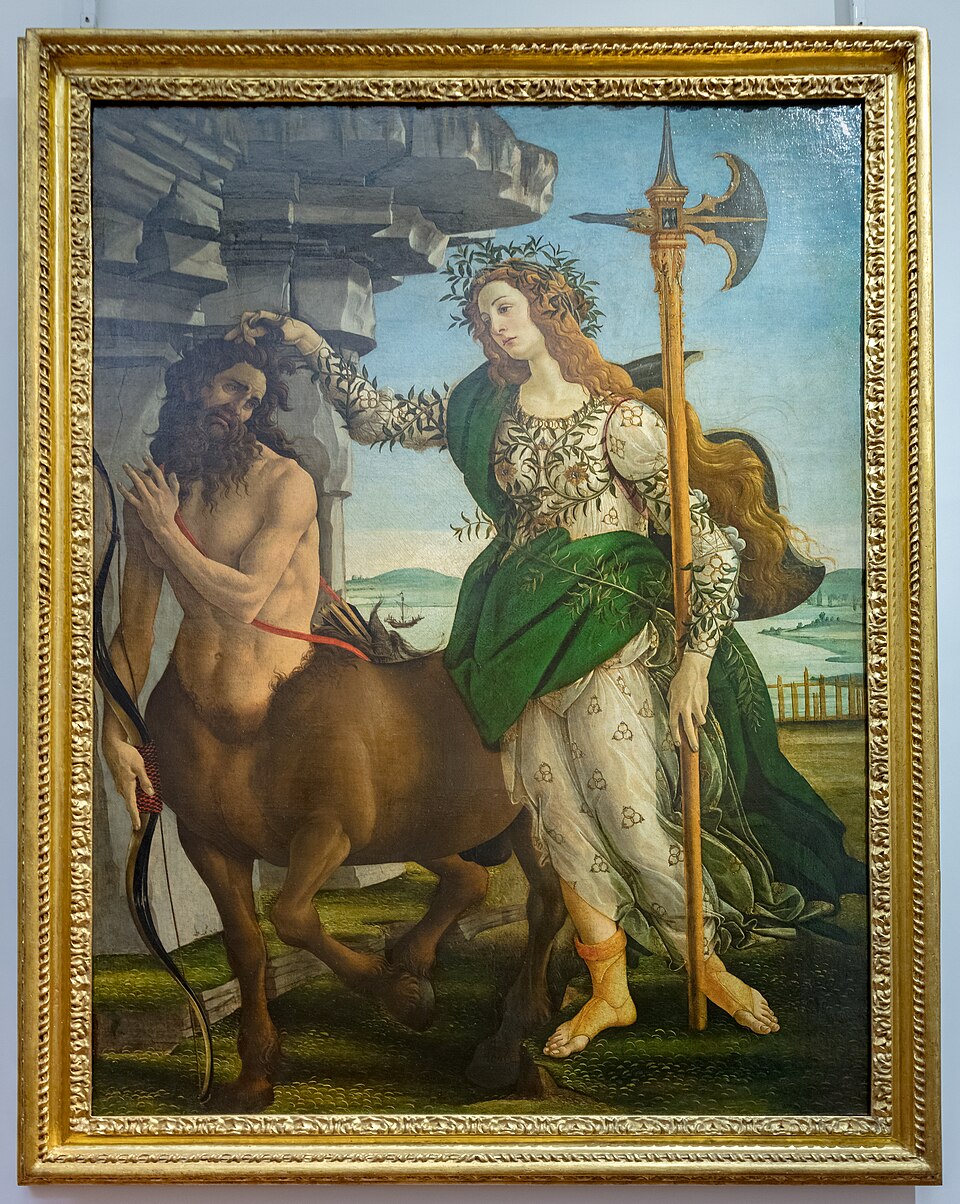
Wisdom tames instinct in ‘Pallas and the Centaur,’ a powerful allegory by Sandro Botticelli.
Here we see the warrior goddess Pallas Athena (also known as Minerva) gently taming a centaur, a creature that is half-human, half-horse. The centaur, representing our wild instincts, looks submissive as Pallas, representing reason and wisdom, holds him by the hair. The painting is an allegory, a story with a hidden meaning, about wisdom conquering passion. Pallas’s dress is decorated with the interlocking diamond ring emblem of the Medici family, suggesting the painting celebrated a Medici diplomatic victory.
Mystic Nativity (1500)
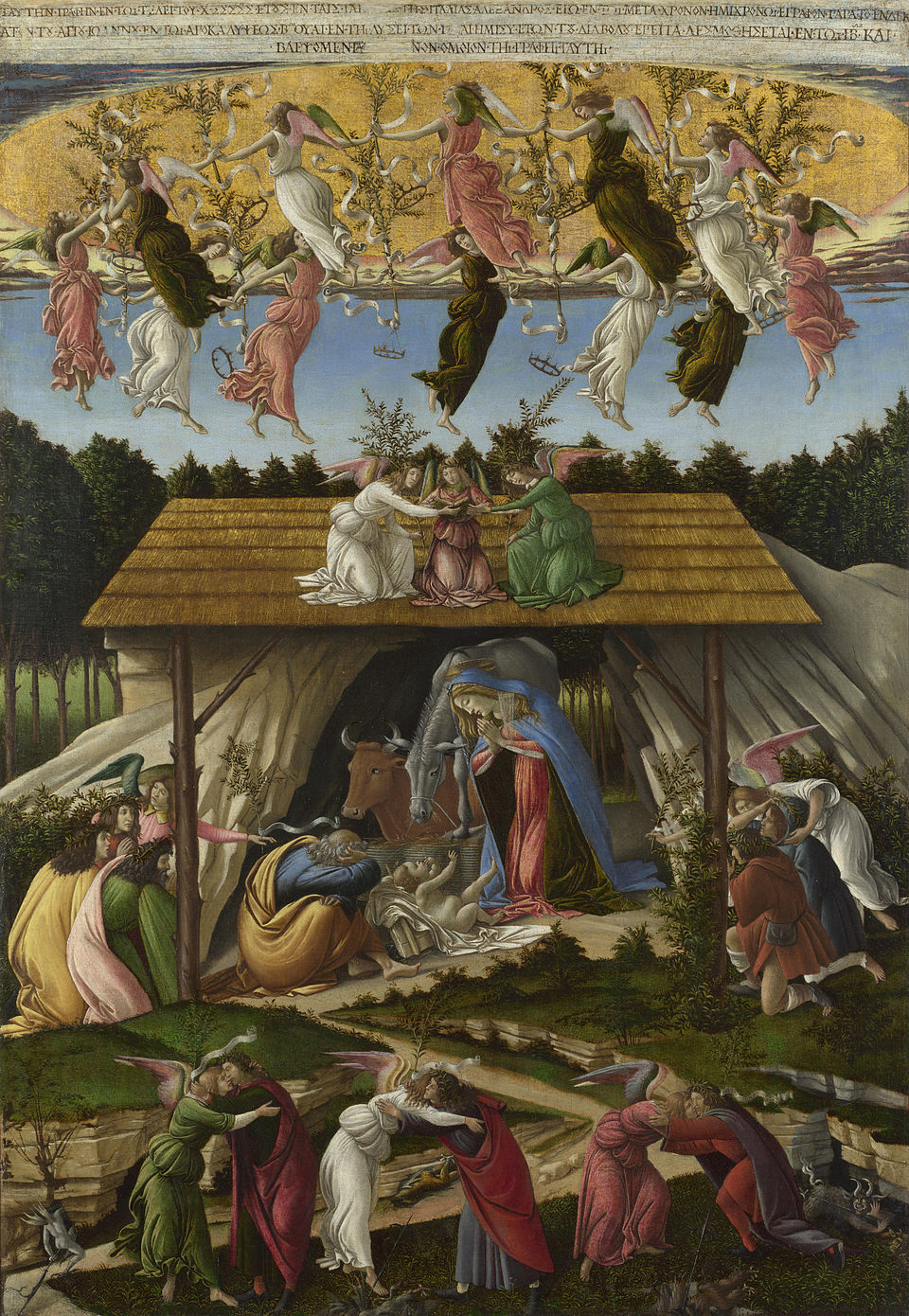
The intensely spiritual and unique ‘Mystic Nativity’ by Sandro Botticelli.
This is one of Botticelli’s most unusual and emotional works. It shows the birth of Jesus, but with a twist. Angels dance in the heavens, and on Earth, angels and men embrace, while devils flee into the underworld. It’s a powerful vision of peace and turmoil, painted during a time of great political and religious unrest in Florence. This is the only painting Botticelli ever signed and dated, with a long Greek inscription at the top that speaks of the troubles of Italy and predicts the end of the world.
Madonna of the Magnificat (c. 1481)
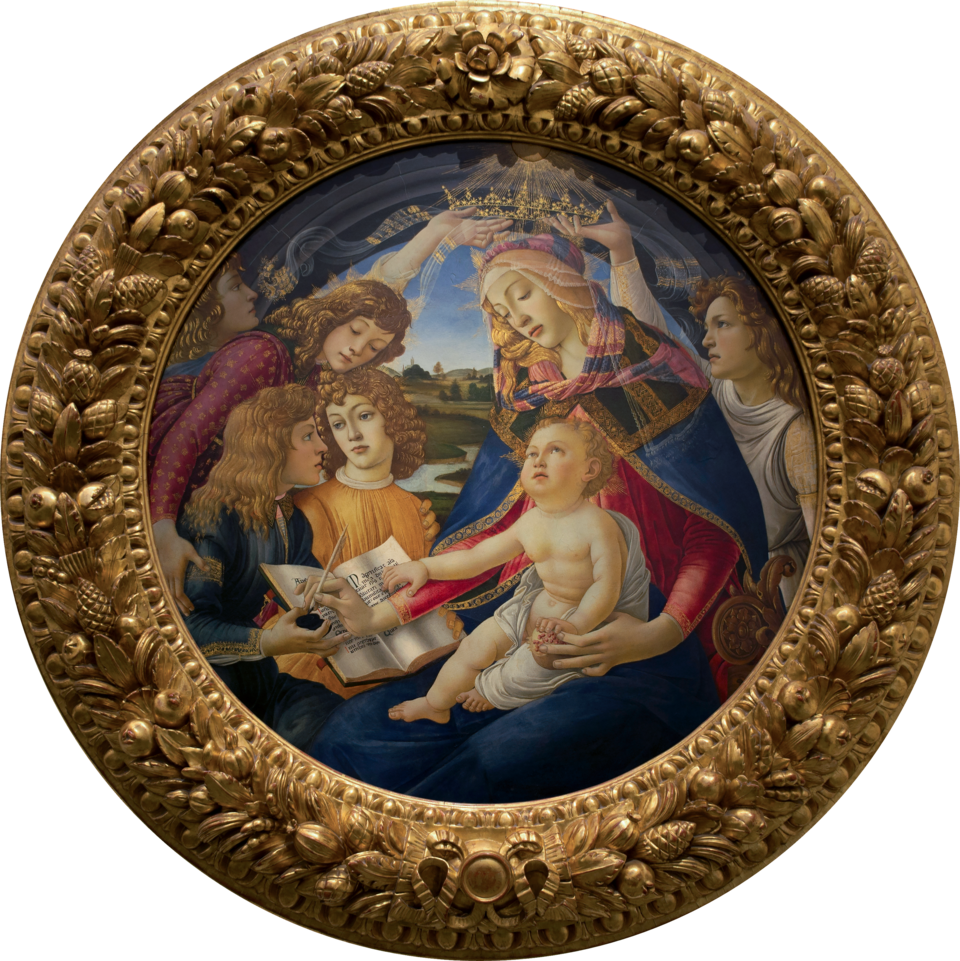
The divine and detailed ‘Madonna of the Magnificat,’ a circular masterpiece by Sandro Botticelli.
This beautiful, circular painting (called a ‘tondo’) shows the Virgin Mary writing the ‘Magnificat,’ a hymn from the Bible. The infant Jesus guides her hand as two angels hold a crown above her head. The painting is incredibly detailed, from the transparent veil on Mary’s head to the golden light radiating from the figures. It was one of Botticelli’s most popular works. The pomegranate held by Mary and Jesus is a symbol with multiple meanings, including Christ’s future suffering and resurrection, as well as the unity of the Church.
The Calumny of Apelles (c. 1494–1495)
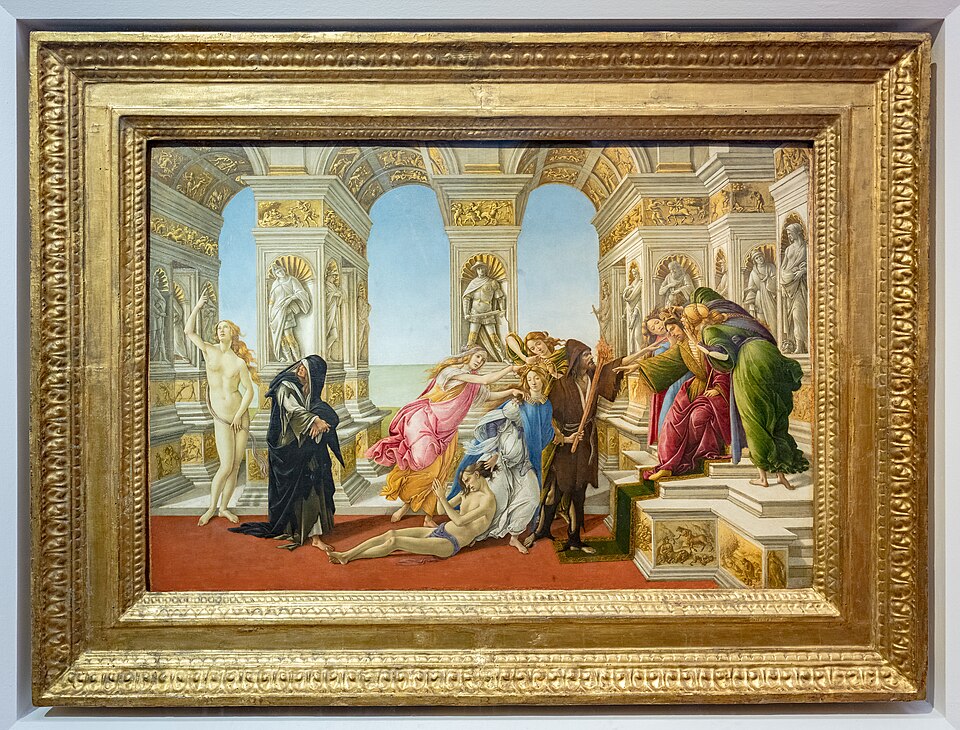
Sandro Botticelli’s dramatic allegorical painting, ‘The Calumny of Apelles.’
This dramatic and crowded scene is based on a description of a lost ancient Greek painting. It tells a story about ‘Calumny’ (or slander), a lie told to hurt someone’s reputation. A man with donkey ears, representing a foolish judge, listens to Ignorance and Suspicion. Meanwhile, Calumny, guided by Fraud and Envy, drags an innocent man by his hair. On the left, a naked woman representing Truth points to the heavens, appealing for justice. Botticelli painted this complex allegory late in his life, possibly as a personal defense against slanderous rumors that were circulating about him.
Portrait of a Young Man with a Roundel (c. 1480–1485)
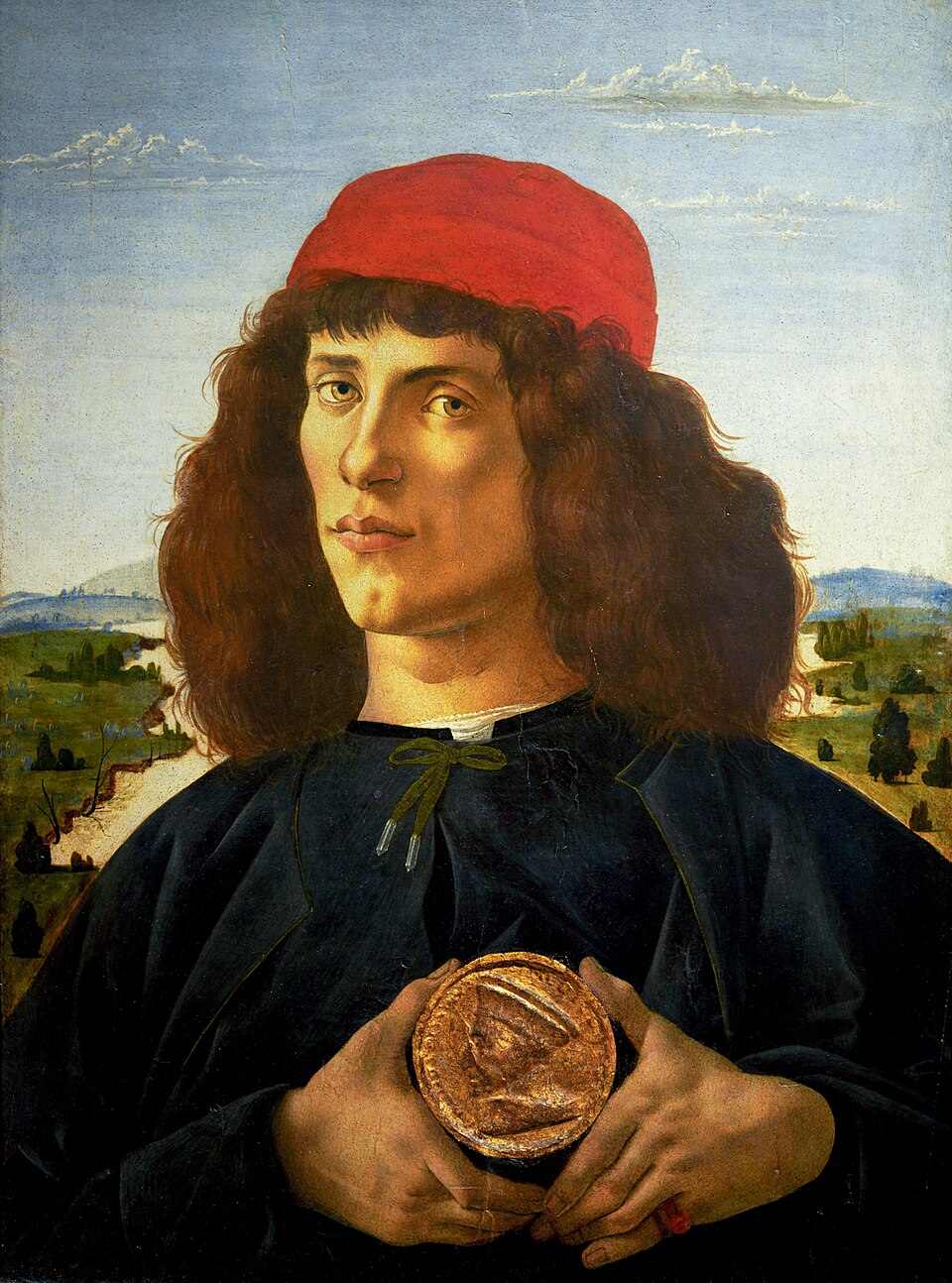
The record-breaking ‘Portrait of a Young Man with a Roundel’ by Sandro Botticelli.
This striking portrait shows a handsome young man from the Florentine elite, holding a small circular painting, or ’roundel,’ of a saint. The man’s gaze is direct and a little mysterious, while his perfectly styled hair and fine clothes show his high status. Botticelli was a master at capturing not just what people looked like, but a sense of their personality, too. This work set a new auction record for the artist, becoming one of the most expensive portraits from any era ever sold.
Fortitude (c. 1470)
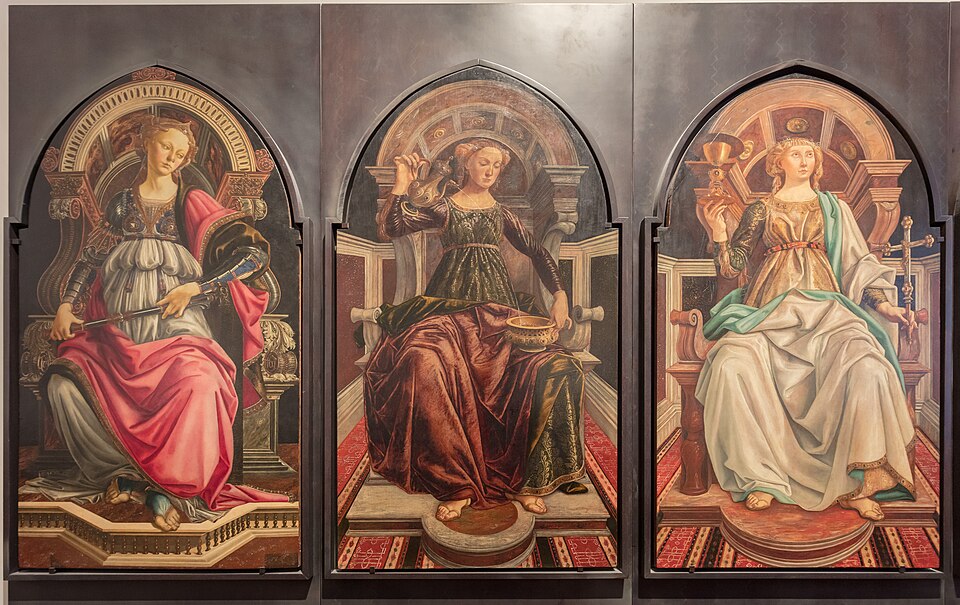
A display of inner strength: ‘Fortitude’ by Sandro Botticelli.
Meet ‘Fortitude,’ a painting of one of the seven virtues. She isn’t shown as a fierce warrior but as a thoughtful and weary young woman. Dressed in armor but holding a commander’s baton, she looks tired but determined. This was an early commission for Botticelli and it showed Florence that a new artistic talent had arrived. He proved he could create figures that were not only beautiful but also had deep inner strength. This painting was originally part of a series of seven virtues commissioned for a courthouse, and the job was first given to another artist; Botticelli’s successful completion of this single panel helped launch his career.
Inspiration and Legacy
Sandro Botticelli didn’t just appear out of nowhere; he learned from the best. His primary teacher was Fra Filippo Lippi, a master painter from whom Botticelli learned to create delicate, graceful figures. He was also influenced by the sculptor Andrea del Verrocchio, in whose workshop a young Leonardo da Vinci also trained. Botticelli’s own legacy is fascinating. After his death, his fame faded, and he was largely forgotten for over 300 years. It wasn’t until the 19th century that a group of English artists called the Pre-Raphaelites rediscovered his work. They fell in love with his flowing lines and mythological subjects, bringing Botticelli back into the spotlight and securing his place as one of the greatest artists of the Renaissance.
Final Thoughts
Sandro Botticelli’s art is a window into a world of myth, beauty, and profound emotion. He wasn’t just painting pictures; he was telling stories with a grace and elegance that was uniquely his own. From the divine ‘Birth of Venus’ to the complex ‘Primavera,’ his work continues to captivate us centuries later. The enduring popularity of Botticelli paintings is a testament to his incredible skill and imagination, proving that true beauty never goes out of style. His legacy is not just in the Uffizi Gallery but in the hearts of everyone who has ever been touched by his dreamy, unforgettable art.
FAQs about Botticelli
What is Sandro Botticelli famous for?
Sandro Botticelli is most famous for his large-scale mythological paintings like ‘The Birth of Venus’ and ‘Primavera.’ He is celebrated for his graceful, elegant style and the flowing lines of his figures, which set him apart from the more scientific realism of other Renaissance artists.
What art style did Botticelli use?
Botticelli was a leading artist of the Early Italian Renaissance. His style is known as Florentine School painting, characterized by strong outlines (linear style), delicate features, and a focus on beauty and grace over strict anatomical accuracy.
Where can I see most of Botticelli’s paintings?
The largest and most important collection of Botticelli’s work is housed in the Uffizi Gallery in Florence, Italy. This is where you can see masterpieces like ‘The Birth of Venus,’ ‘Primavera,’ and ‘The Adoration of the Magi’ in person.
Did Botticelli really burn some of his paintings?
It is believed that Botticelli became a follower of the fiery preacher Girolamo Savonarola. Savonarola led a campaign against what he considered sinful art and luxury, culminating in the ‘Bonfire of the Vanities.’ Some art historians believe Botticelli may have destroyed some of his earlier, more secular mythological works during this time, though there is no definitive proof.