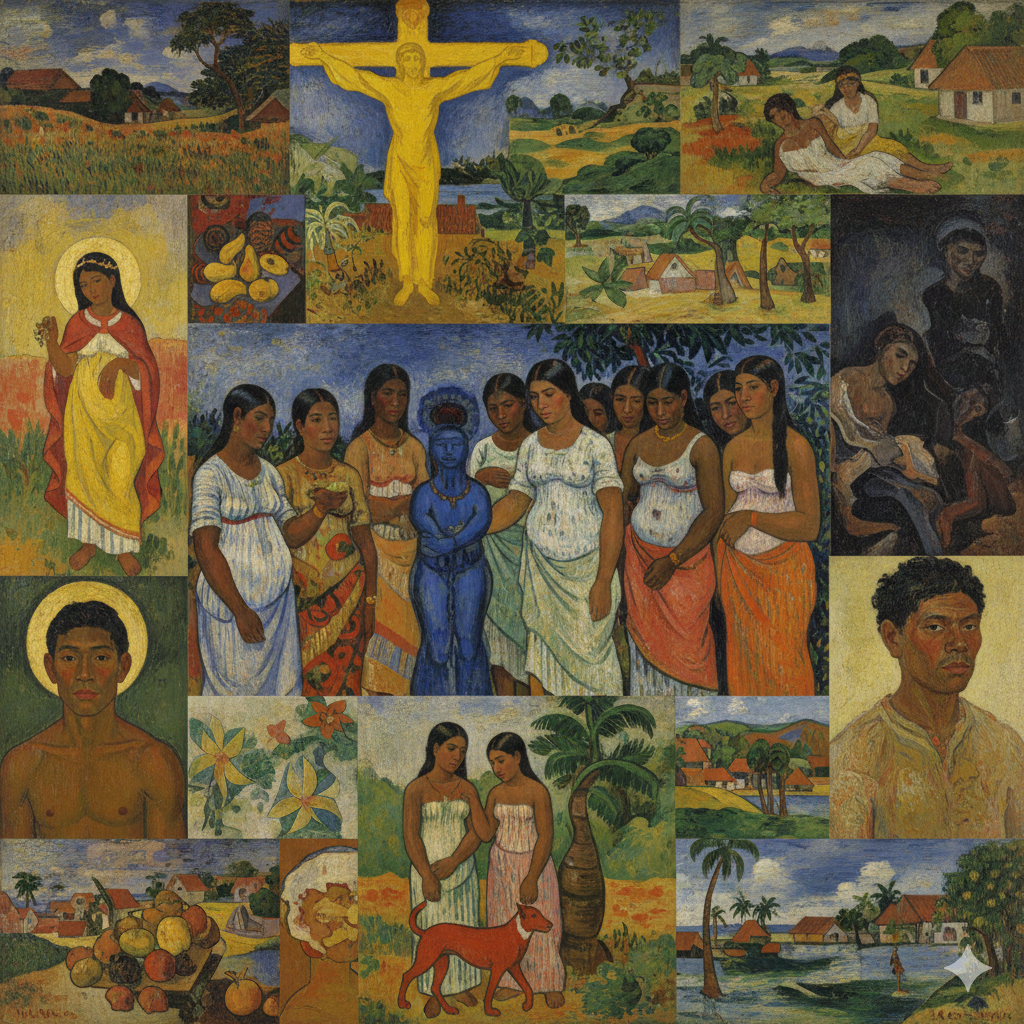
Imagine leaving your job as a stockbroker to sail across the world and paint on a tropical island. That’s exactly what Paul Gauguin did! He was a rebel artist who broke all the rules to create a style that was completely new and exciting. The incredible collection of Paul Gauguin paintings tells the story of his search for a simpler, more ‘primitive’ world, far away from modern Paris. As a leading figure in the Post-Impressionist movement, Gauguin used color not just to show what he saw, but what he felt. His art is like a portal to the vibrant, mysterious islands of Tahiti and a window into his own complex soul. Let’s dive into the stories behind the Top 10 Paul Gauguin Paintings.
Where Do We Come From? What Are We? Where Are We Going? (1897-1898)
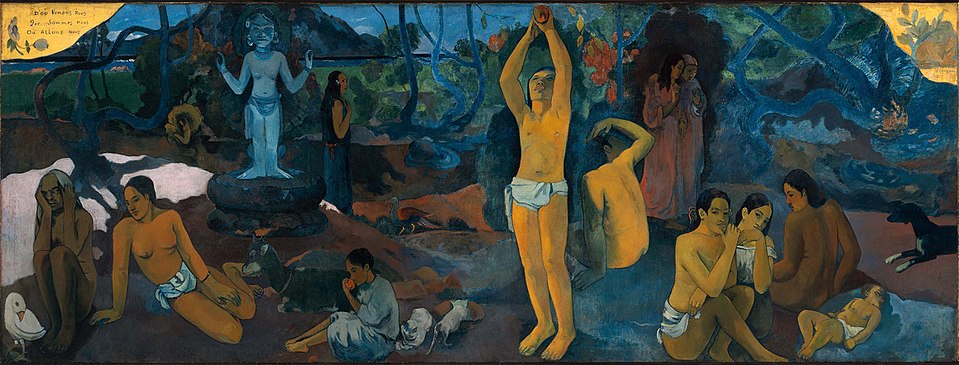
Description: This is Gauguin’s massive masterpiece, like a giant comic book that you read from right to left. It shows the entire cycle of life, from a sleeping baby on the right to an old woman on the left who seems ready for the end. In the center, a figure picks fruit, representing adulthood. It’s a deeply philosophical painting that Gauguin considered his final artistic statement. Gauguin painted this monumental work in a single month, intending for it to be his final masterpiece before a planned suicide attempt, which he thankfully survived.
Painting Techniques: Gauguin used bold, flat areas of color and strong outlines, a style known as Cloisonnism. The figures are simplified and symbolic, painted on a rough, heavy canvas to give it a ‘primitive’ feel.
Location: Museum of Fine Arts, Boston, USA
Estimated Value: Priceless
The Yellow Christ (Le Christ jaune) (1889)

Description: In this striking painting, Gauguin imagines Jesus on the cross in the middle of a field in Brittany, France, surrounded by local women in prayer. The most shocking part is the color—Jesus is bright yellow! This wasn’t to be realistic, but to express the simple, rustic faith of the peasant women and connect it to the golden colors of the autumn harvest. The figure of Christ was inspired by a simple wooden crucifix Gauguin saw hanging in a local chapel in Pont-Aven, Brittany.
Painting Techniques: This is a prime example of Cloisonnism, where flat planes of pure color are separated by heavy black outlines, much like a stained-glass window or a ‘cloisonné’ enamel piece.
Location: Albright-Knox Art Gallery, Buffalo, USA
Estimated Value: Priceless
Vision After the Sermon (Jacob Wrestling with the Angel) (1888)

Description: This painting shows a group of Breton women, fresh from church, having a shared vision of a biblical story. In their minds, they see Jacob wrestling with an angel in a field that is painted a shocking, fiery red. Gauguin separates the real world (the women) from the spiritual world (the wrestlers) with a strong diagonal tree trunk, showing us that this is happening in their imagination. Gauguin tried to donate this painting to a local church in Brittany, but the priest rejected it, likely finding its modern style too strange and radical.
Painting Techniques: Gauguin completely abandoned naturalism here, using a flat, blood-red ground to symbolize the internal struggle. The composition is heavily influenced by Japanese woodblock prints.
Location: Scottish National Gallery, Edinburgh, Scotland
Estimated Value: Priceless
When Will You Marry? (Nafea Faa Ipoipo) (1892)
_1892,_oil_on_canvas,_101_x_77_cm.jpg "Top 10 Paul Gauguin Paintings: An Explorer's Guide to a Rebel Artist 6")
Description: Two Tahitian women sit in a lush, colorful landscape. The woman in the foreground is dressed in traditional clothing, while the one behind her wears a more formal, Western-style missionary dress. The painting captures the beauty of the Tahitian people but also hints at the cultural changes happening on the island. For many years, this was believed to be the most expensive painting ever sold, a testament to Gauguin’s enduring fame and appeal.
Painting Techniques: Gauguin used a vibrant palette of tropical greens, blues, and oranges to create a sense of paradise. The figures are simplified with a flattened perspective, emphasizing pattern and color over realistic depth.
Location: Private Collection (on loan to the Beyeler Foundation, Riehen, Switzerland)
Estimated Value: Sold for approximately $210 million in 2015.
The Spirit of the Dead Watching (Manao tupapau) (1892)
.JPG "Top 10 Paul Gauguin Paintings: An Explorer's Guide to a Rebel Artist 7")
Description: This is one of Gauguin’s most mysterious and haunting paintings. It shows his young Tahitian companion, Teha’amana, lying on a bed, her eyes wide with fear as she senses a spirit in the darkness behind her. The dark, shadowy figure represents the Tahitian belief in ‘tupapau’, spirits of the dead. Gauguin wrote that the title has a double meaning: it could mean the girl is thinking of the spirit, or the spirit is thinking of her.
Painting Techniques: Gauguin masterfully uses color to create mood, contrasting the dark, spooky purples and blues of the background with the bright yellow of the bedspread, which only makes the scene feel more unsettling.
Location: Albright-Knox Art Gallery, Buffalo, USA
Estimated Value: Priceless
Tahitian Women on the Beach (Femmes de Tahiti) (1891)

Description: In this calm and beautiful scene, two women rest on a black sand beach. One is wearing a traditional pareo, while the other wears a pink missionary dress, showing the mix of cultures in Tahiti. The painting captures a quiet, everyday moment, but Gauguin fills it with a sense of timeless dignity and peace. The woman on the left gazes out at the viewer with a melancholy expression, which some art historians interpret as a commentary on the changing Tahitian way of life.
Painting Techniques: Gauguin simplifies the forms of the women, almost like ancient statues. He uses large areas of flat color and a rhythmic composition to create a feeling of harmony and tranquility.
Location: Musée d’Orsay, Paris, France
Estimated Value: Priceless
Self-Portrait with Halo and Snake (1889)
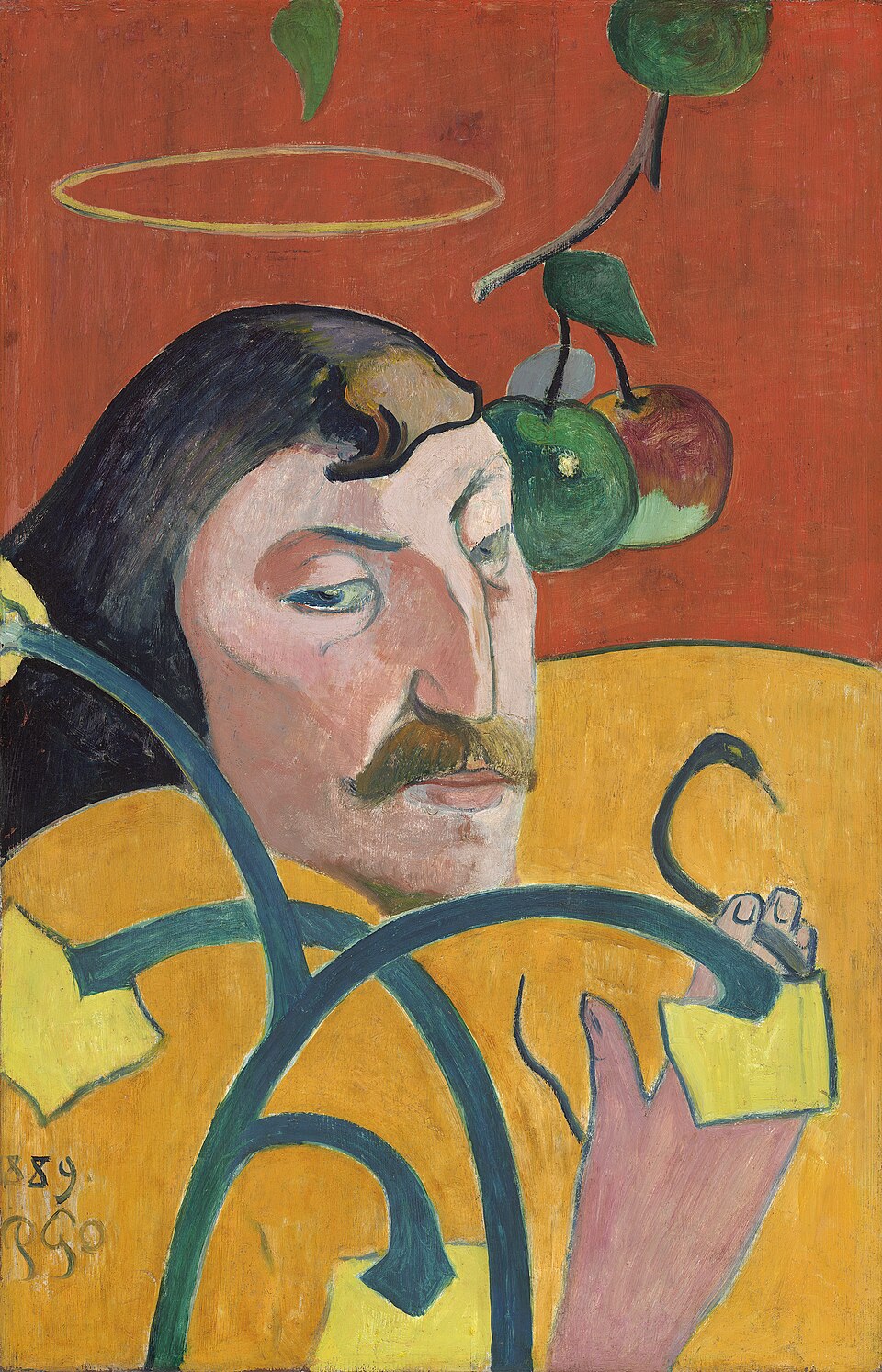
Description: This isn’t your average self-portrait! Gauguin paints himself as a complex character, part saint (the halo) and part sinner (the snake). He holds the snake, which represents temptation, while the apples in the background remind us of the Garden of Eden. He’s showing us his two sides: the spiritual artist and the man full of earthly desires. The halo above his head is not a perfect circle but is slightly lopsided, suggesting that his ‘sainthood’ as an artist is imperfect and self-proclaimed.
Painting Techniques: The painting uses the symbolic and colorful style of his Pont-Aven period. The background is divided into two distinct color fields, yellow and red, further emphasizing his dual nature.
Location: National Gallery of Art, Washington D.C., USA
Estimated Value: Priceless
Two Tahitian Women (1899)
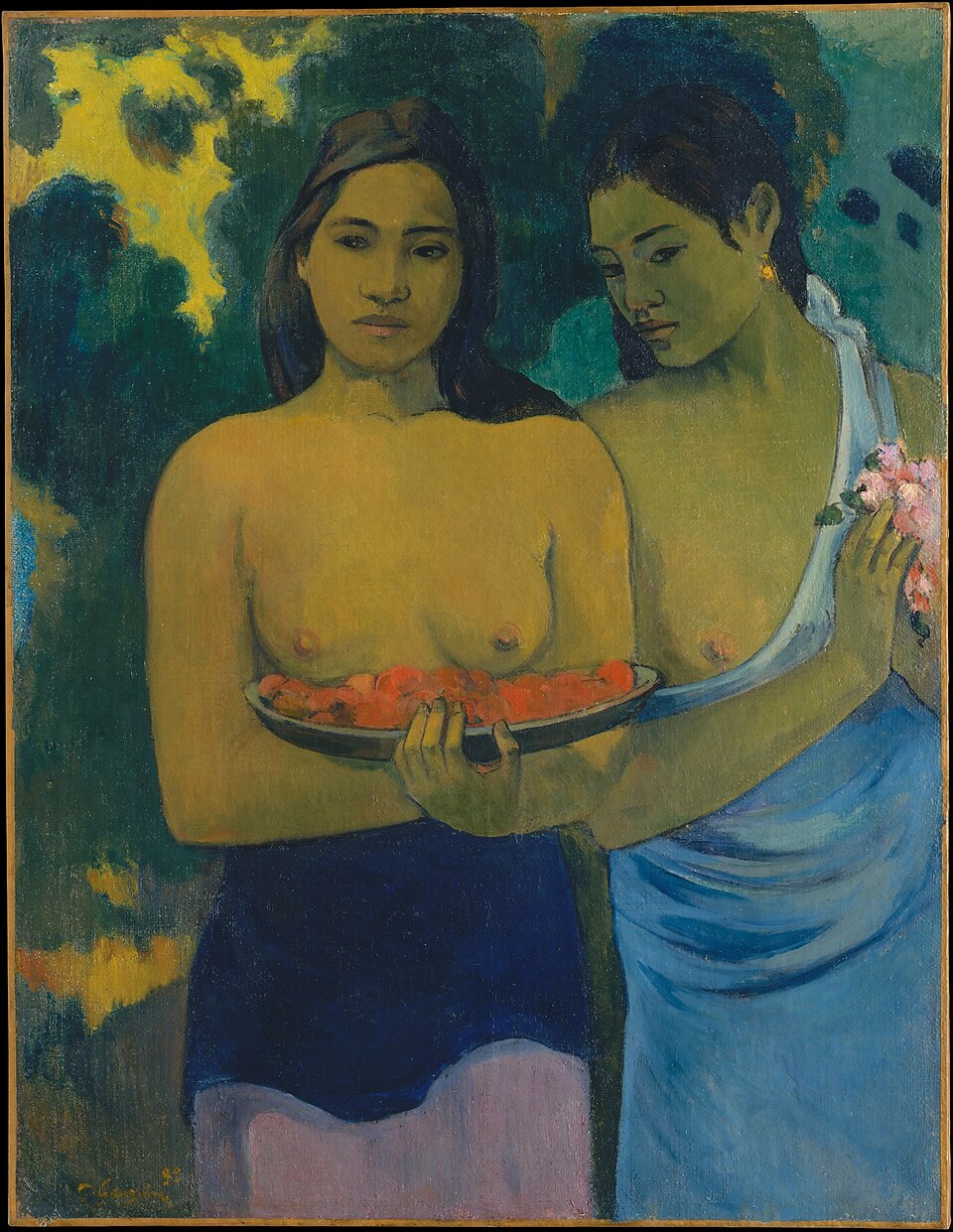
Description: In this later work from Tahiti, Gauguin presents two women, one holding mango blossoms, in a composition that feels as grand as a royal portrait. Their calm, strong poses give them a monumental quality, as if they are goddesses of the island. The rich colors and patterns of their dresses and the background create a lush, decorative effect. The poses of the two women were inspired by a frieze from the ancient Javanese temple of Borobudur, which Gauguin had seen in photographs.
Painting Techniques: Gauguin’s technique here is mature and confident, with rich, harmonious colors and a flattened perspective that emphasizes the surface pattern. The brushwork is smooth and controlled.
Location: The Metropolitan Museum of Art, New York, USA
Estimated Value: Priceless
Still Life with Three Puppies (1888)
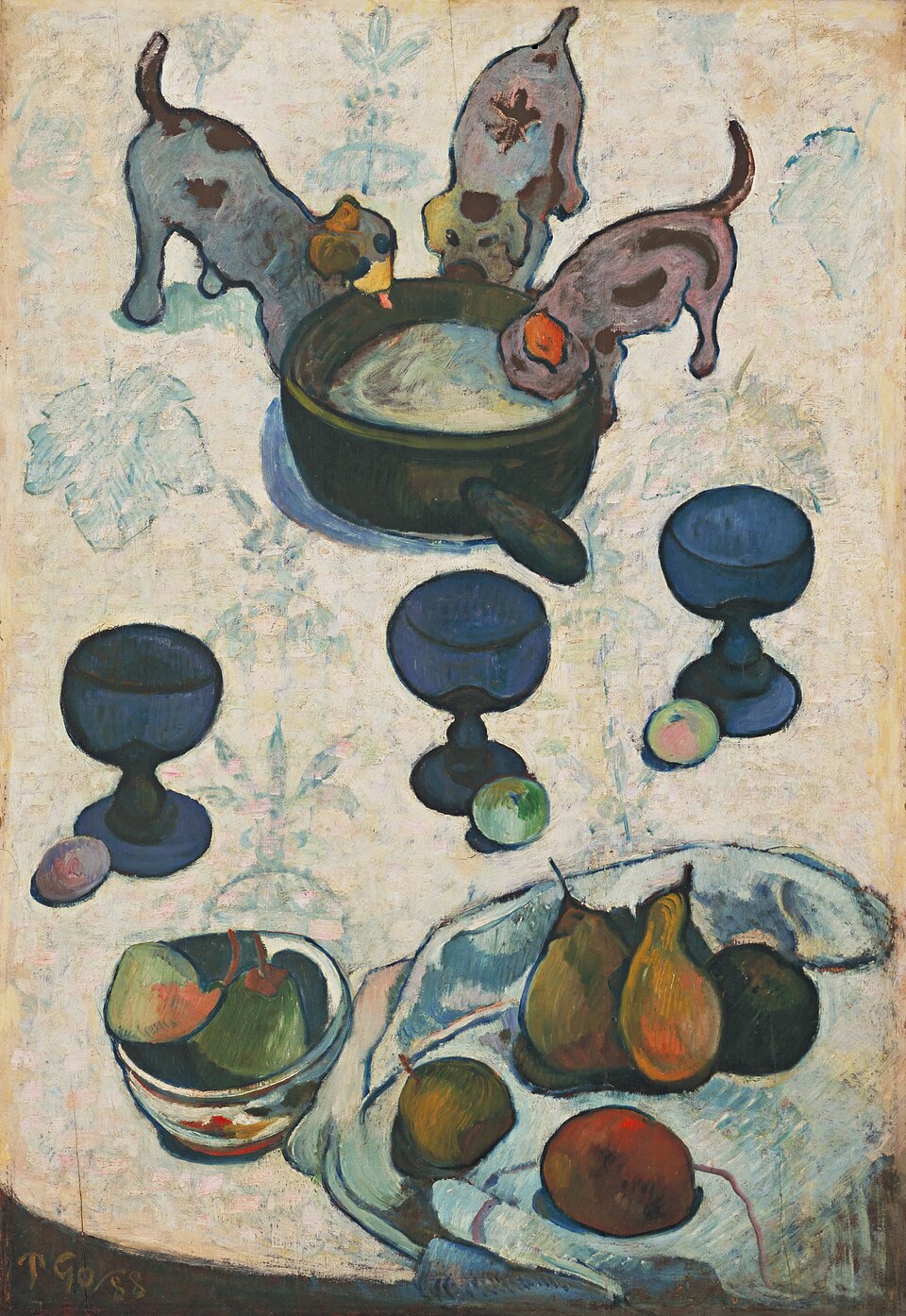
Description: Before he was famous for his Tahitian scenes, Gauguin painted in Brittany, France. This charming still life shows a more playful side of his work. Three puppies drink milk from a bowl, surrounded by fruit and a fancy glass. It’s a snapshot of a cozy, domestic moment, but with his signature bold colors and unusual angles. The Japanese fan and the blue-and-white porcelain in the background demonstrate the craze for Japanese art, known as Japonisme, that swept through Paris in the late 19th century.
Painting Techniques: The painting shows the influence of both Impressionism in its subject matter and Japanese prints in its high viewpoint and cropped composition. The colors are brighter and more separated than in his later work.
Location: The Museum of Modern Art (MoMA), New York, USA
Estimated Value: Priceless
The Siesta (1892-1894)
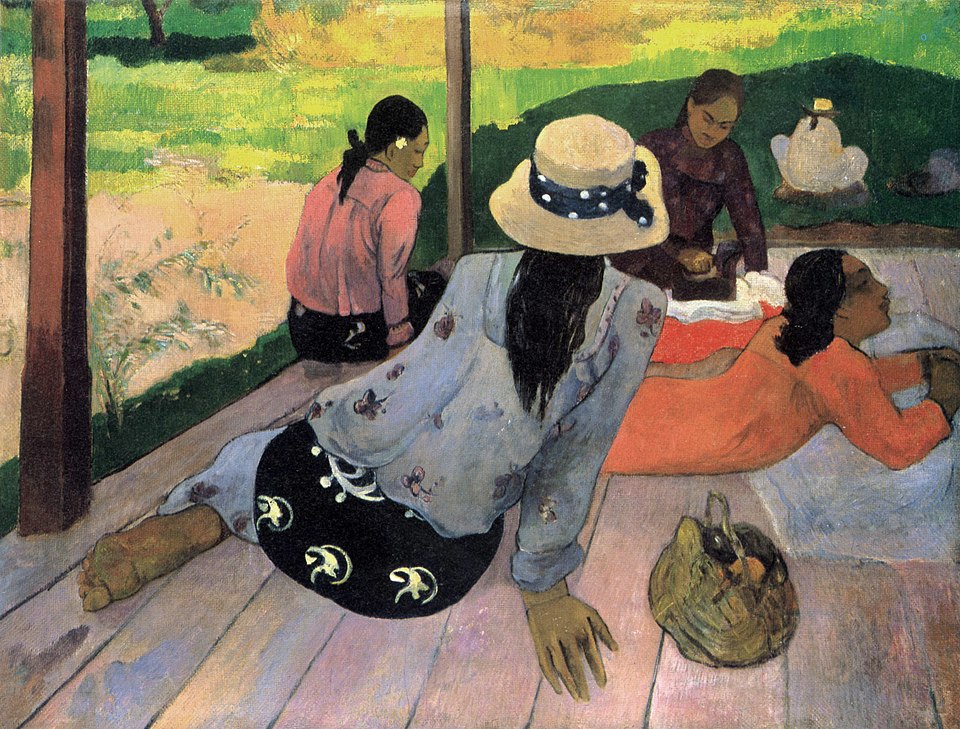
Description: This painting captures a peaceful afternoon nap, or siesta, in Tahiti. A group of women in colorful missionary dresses are gathered on a veranda, relaxing in the heat of the day. It’s a scene of simple community and rest, bathed in the warm, golden light of the tropics. Gauguin invites us into this quiet, intimate moment. Unlike many of his other works that focus on just one or two figures, this painting shows a group, giving a broader sense of daily life and community on the island.
Painting Techniques: Gauguin uses a palette of warm yellows, oranges, and reds to convey the tropical heat. The composition is structured with strong horizontal and vertical lines, giving the scene a sense of stability and calm.
Location: The Metropolitan Museum of Art, New York, USA
Estimated Value: Priceless
Inspiration and Legacy
Paul Gauguin didn’t just appear out of nowhere; he was part of a great artistic conversation. Early in his career, he was inspired by Impressionists like Camille Pissarro, who taught him to paint outdoors. He also deeply admired Paul Cézanne for his solid, structured forms. But Gauguin soon looked further afield, drawing inspiration from the bold compositions of Japanese woodblock prints and the simple, powerful forms of ‘primitive’ art from around the world. In turn, Gauguin’s own radical use of color and emotional expression became a huge inspiration for the next generation. Artists like Henri Matisse and the Fauves (‘wild beasts’) took his color experiments to a whole new level, while Pablo Picasso was fascinated by the raw power of his ‘primitive’ style. Gauguin’s legacy is that of a trailblazer who showed that art could be more about inner feeling than outer reality.
Final Thoughts on Top 10 Paul Gauguin Paintings
Paul Gauguin was more than just a painter; he was an explorer of art and life. He journeyed to the ends of the earth searching for something pure and authentic, and he poured that quest into his work. His art is a rebellion against the gray, industrial world he left behind. The collection of Paul Gauguin paintings remains so powerful today because it offers us an escape into a world of intense color, deep emotion, and timeless mystery. He taught artists that they didn’t have to paint what they saw, but could paint what they felt, changing the course of modern art forever.
FAQs: Paul Gauguin paintings
What art movement is Paul Gauguin associated with?
Paul Gauguin is a key figure in Post-Impressionism. He was also a leader in the Symbolist movement and developed a style called Cloisonnism, characterized by flat areas of bold color and dark outlines.
Why did Paul Gauguin move to Tahiti?
Gauguin moved to Tahiti in 1891 seeking a more ‘primitive’ and authentic society, away from what he saw as the artificial and conventional nature of European civilization. He hoped to find inspiration in a less-developed culture and live a simpler life.
Who was Paul Gauguin’s famous artist friend?
Paul Gauguin had a famously turbulent friendship with Vincent van Gogh. In 1888, Gauguin spent nine weeks living and working with van Gogh in the ‘Yellow House’ in Arles, France, an intense period that ended dramatically with van Gogh’s self-mutilation.
What is Cloisonnism?
Cloisonnism is a painting style developed by Gauguin and his circle. It involves using flat areas of pure, bright color that are separated by dark, heavy outlines, similar to the look of medieval stained-glass windows or cloisonné enamelwork.