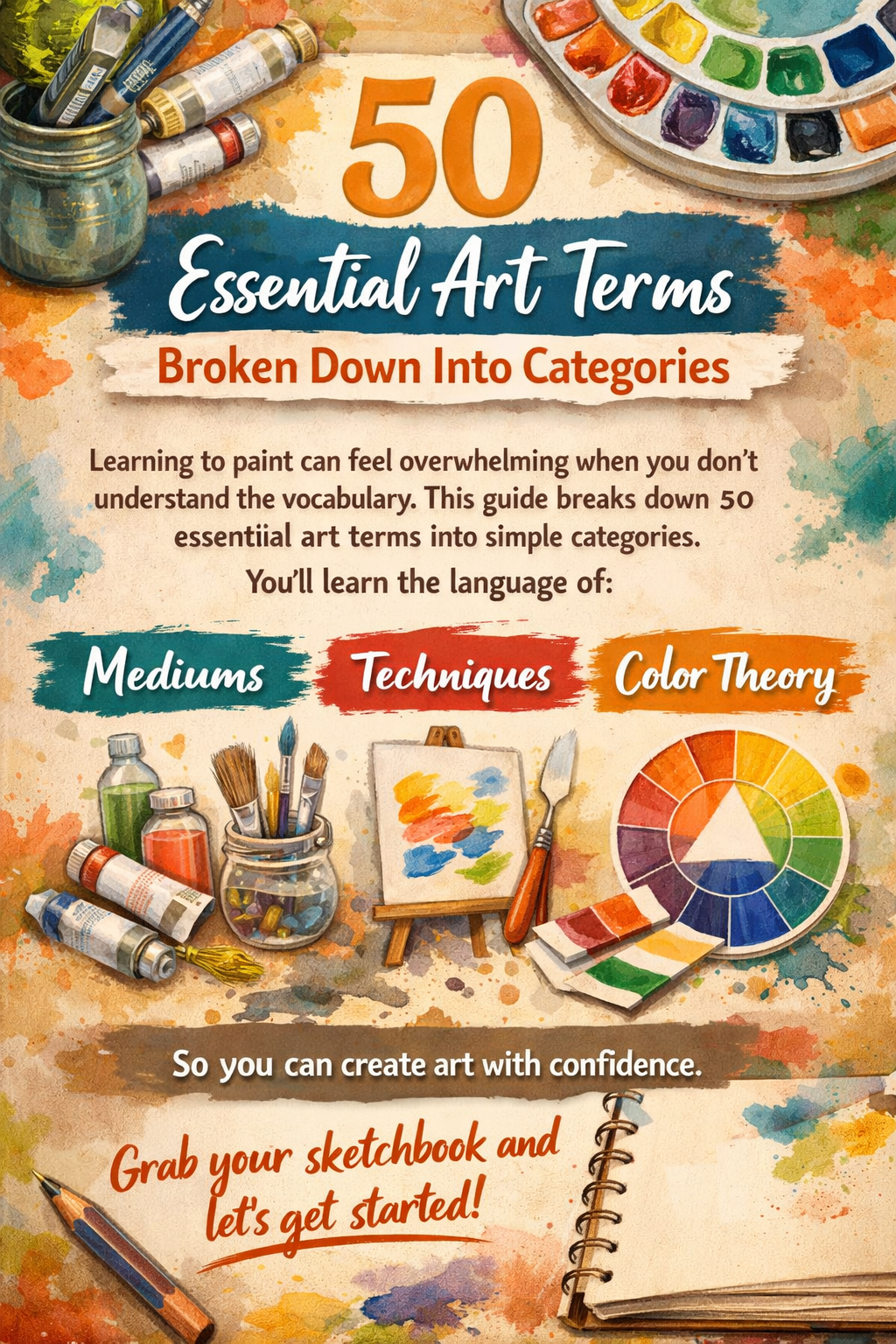
Learning to paint can feel overwhelming when you don’t understand the vocabulary. This guide breaks down 50 essential art terms into simple categories. You’ll learn the language of mediums, techniques, and color theory so you can create art with confidence. Grab your sketchbook and let’s get started.
Have you ever read an art tutorial and felt completely lost? Complex jargon acts as a major barrier for new artists. In fact, studies show that unclear language often discourages adults from participating in the arts. As an arts educator and the Founder of ProminentPainting.com, I see this all the time. Backed by over a decade of teaching experience, I know how frustrating it is. You just want to paint, but the words get in the way.
That’s why I created this list of 50 essential art terms broken down into categories. My goal is to make painting accessible and therapeutic for artists of all levels. When we break down the language, the intimidation fades away. You can finally relax and dive into a beginners guide to painting. This plain-English dictionary will help you understand tutorials, browse gallery descriptions, and shop for supplies with total confidence.
What Are The Most Common Art Medium Terms?
Art medium terms describe the specific materials and tools an artist uses to create their work. The most common mediums include acrylic, oil, watercolor, and gouache. Understanding these terms helps you choose the right supplies for your creative projects.
The materials you use form the foundation of your artwork. If you want to dive deeper, you can check out my complete guide to art mediums. Here are ten fundamental terms you’ll see in every art store.
- Medium: The actual material used to create art, such as paint, charcoal, or clay.
- Acrylic Paint: A fast-drying paint made of pigment suspended in an acrylic polymer resin.
- Oil Paint: A slow-drying paint made of pigment mixed with a drying oil, usually linseed.
- Watercolor: Paint made of pigment suspended in a water-soluble binder that relies on water for transparency.
- Gouache: An opaque watercolor paint that dries to a flat, matte finish.
- Gesso: A thick white paint mixture used to prepare a surface for painting. Historically, artists have used gesso for centuries to prevent paint from soaking into wood or canvas.
- Canvas: A heavy woven fabric stretched tightly over a wooden frame, used as a traditional painting surface.
- Primer: A base substance applied to a canvas to prepare it to hold paint evenly.
- Palette: The flat surface where an artist mixes their paint colors before applying them.
- Pigment: The finely ground powder that actually gives paint its specific color.
What Do Painting Technique Terms Mean?
Painting technique terms describe the physical methods an artist uses to apply paint to a surface. These words explain how a painter creates texture, blends colors, or builds layers to achieve a specific visual effect.
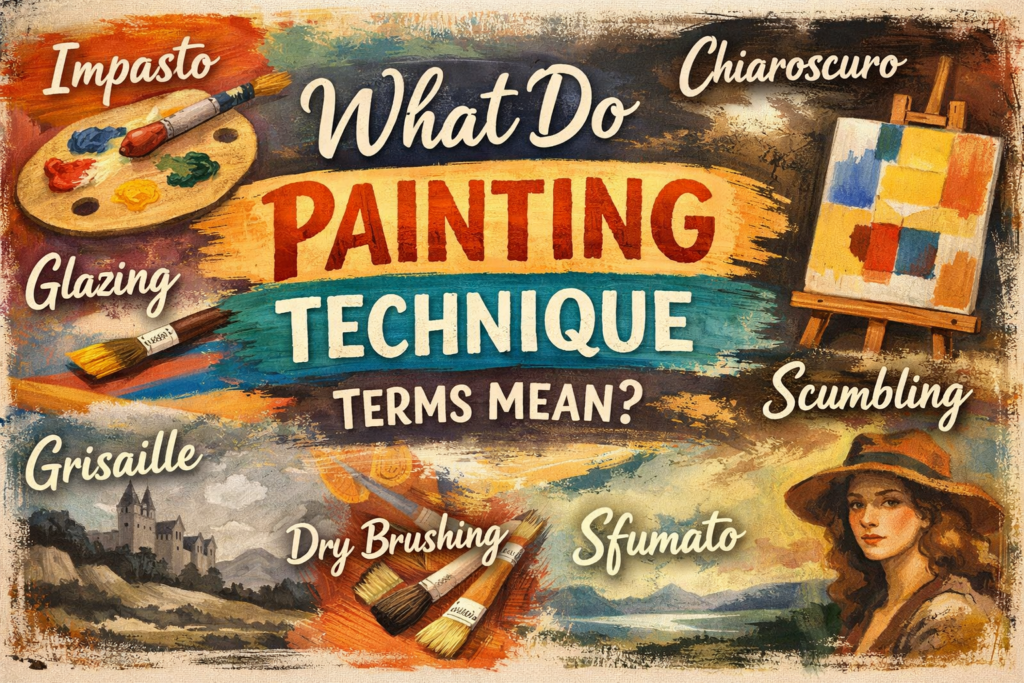
Knowing how to apply your paint is just as important as the paint itself. These ten terms describe the most popular application methods.
- Impasto: Applying paint thickly so it stands out heavily from the canvas. This technique creates highly visible, physical brushstrokes.
- Glazing: Applying a thin, transparent layer of paint over a dry layer to alter its color slightly.
- Scumbling: Applying a very thin layer of opaque paint over a darker base to soften the colors.
- Wet-on-wet: Applying wet paint directly onto a wet surface to create soft, bleeding edges.
- Dry brush: Using a stiff brush with very little paint and no water to create scratchy, textured marks.
- Underpainting: The initial layer of paint applied to a canvas to establish the basic light and dark tones.
- Wash: A highly diluted, watery layer of paint applied quickly across a large area.
- Blending: Smoothly mixing two wet colors together right on the canvas to create a seamless transition.
- Sfumato: A technique of blurring edges to create soft transitions, famously used in Renaissance art.
- Alla Prima: Completing a painting entirely in a single sitting while the paint is still wet.
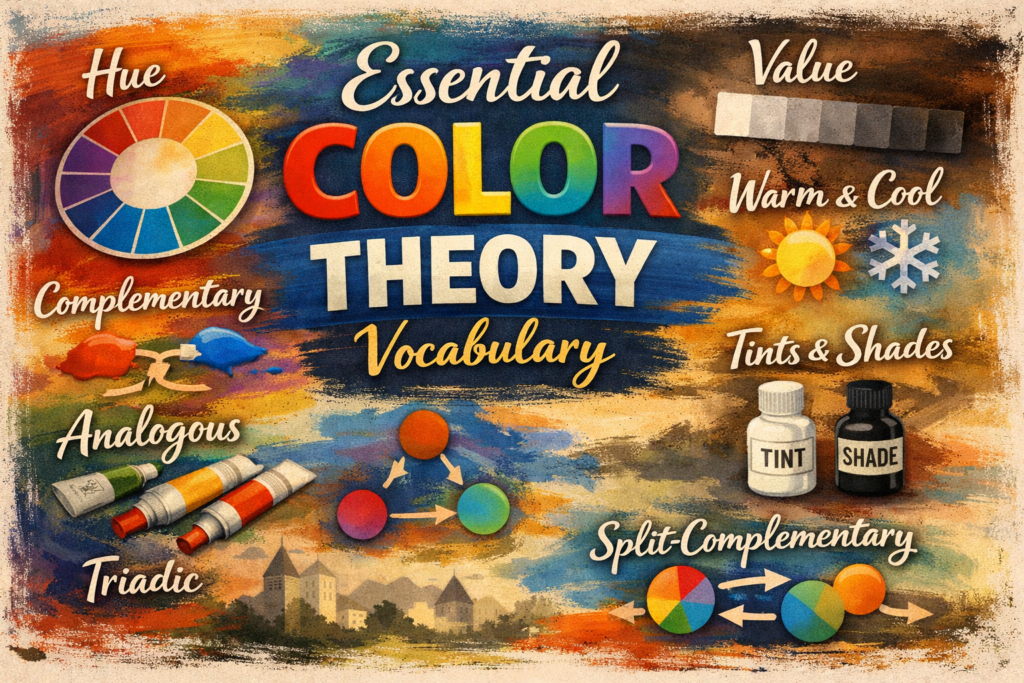
Essential Color Theory Vocabulary
Color is how we express deep emotion in our artwork. If you don’t understand color, your paintings can easily look muddy and dull. You can read more about this in my guide on color theory basics. Here are ten terms to help you master your palette.
- Hue: The traditional name of a color family, like red, blue, or yellow.
- Value: How light or how dark a specific color is.
- Saturation: The intensity, brightness, or purity of a color.
- Primary Colors: Red, yellow, and blue. You can’t mix other colors to make these.
- Secondary Colors: Colors made by mixing two primary colors together, like green or orange.
- Tertiary Colors: Colors made by mixing a primary color and a secondary color together.
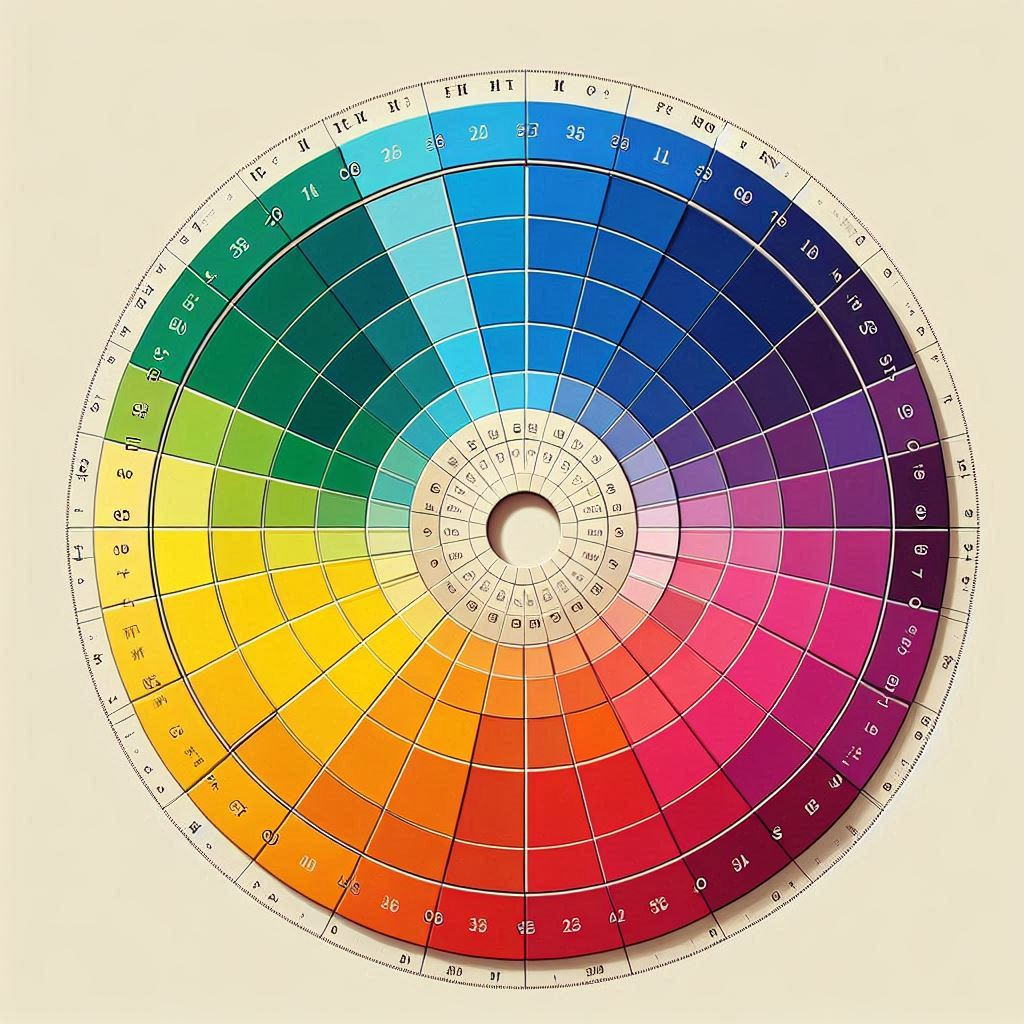
- Complementary Colors: Colors directly opposite each other on the color wheel. They create striking, high contrast when placed side by side.
- Analogous Colors: A group of colors that sit right next to each other on the color wheel.
- Warm Colors: Colors that remind us of heat and sunlight, like reds, oranges, and yellows.
- Cool Colors: Colors that remind us of cold and water, like blues, greens, and purples.
How Do You Describe Composition In Art?
Composition in art refers to the deliberate arrangement of visual elements within a piece. It describes how an artist places shapes, lines, and colors to guide the viewer’s eye and create a balanced, engaging image.
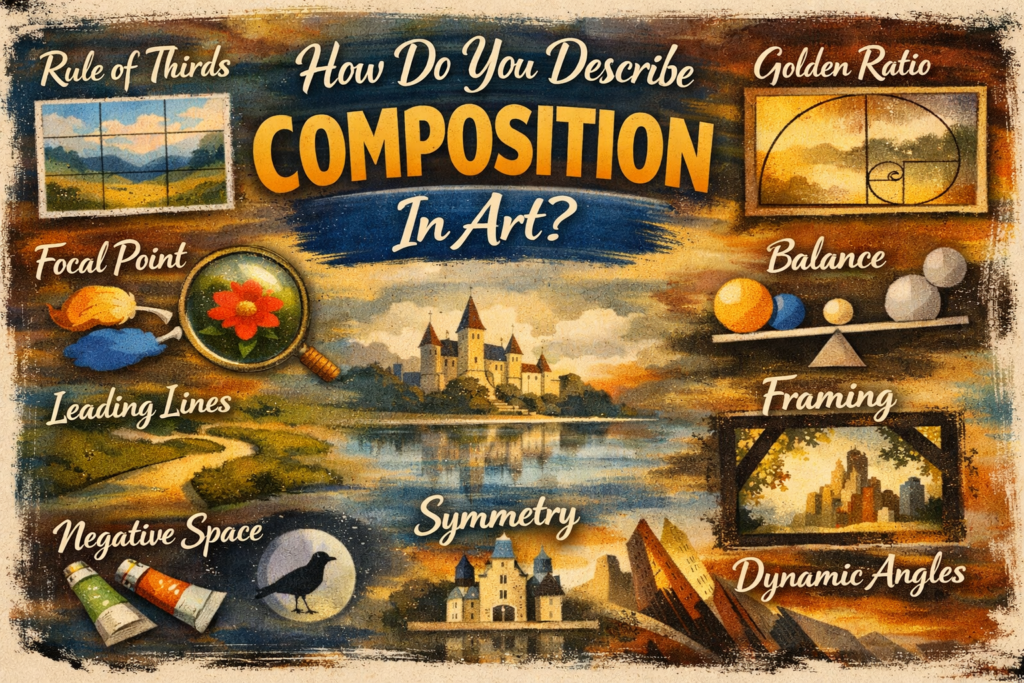
A great painting needs a solid structural foundation to work well. Understanding these ten terms will help you build stronger artworks. You can also explore the elements of composition in much more detail.
- Composition: The overall visual layout and arrangement of a painting.
- Focal Point: The specific area of the artwork that draws the viewer’s eye first.
- Rule of Thirds: Dividing a canvas into a grid of nine equal squares and placing key elements on the intersecting lines.
- Negative Space: The empty areas around and between the main subjects of an image. This space is crucial for visual clarity and balance.
- Positive Space: The actual areas of an artwork occupied by the main subjects or objects.
- Perspective: The technique used to represent three-dimensional distance and depth on a flat, two-dimensional surface.
- Foreground: The part of the painting that appears closest to the viewer.
- Background: The part of the painting that appears furthest away from the viewer.
- Midground: The visual space resting directly between the foreground and the background.
- Symmetry: When visual elements are arranged equally and evenly on both sides of a central line.
Popular Art Movement Terms Explained
Art history is full of distinct periods and creative styles. Knowing these ten terms gives you vital context for the art you see in museums. It also helps you define your own favorites among popular art styles.
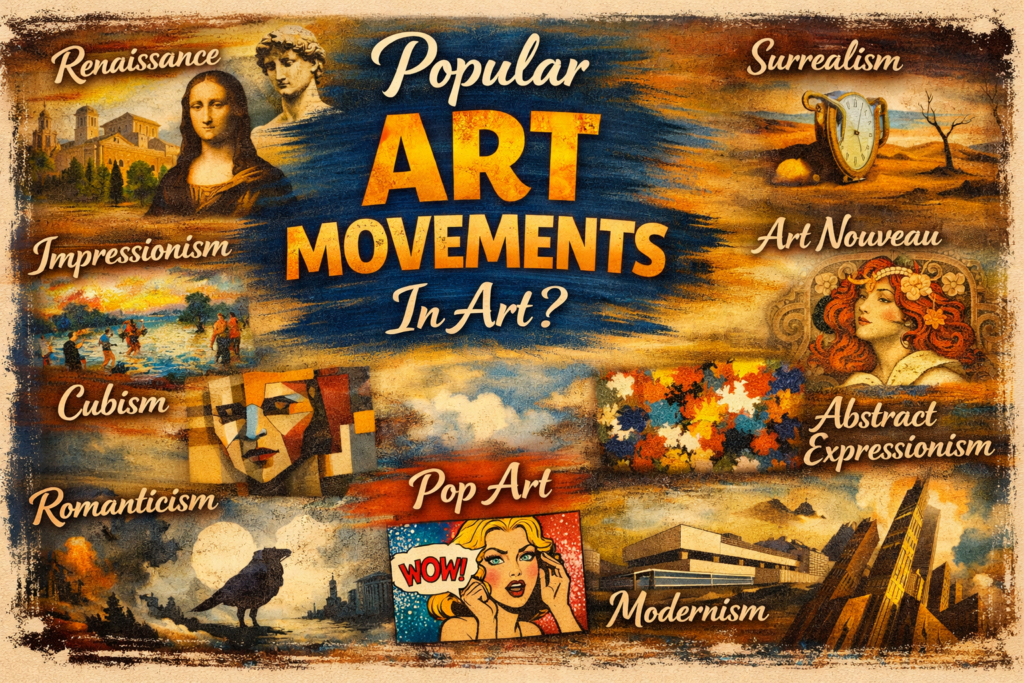
- Realism: An artistic attempt to represent subject matter truthfully, completely avoiding artificial elements.
- Impressionism: A 19th-century movement focused on capturing the visual impression of a moment, especially the shifting effect of light.
- Expressionism: A style where the artist seeks to express raw emotional experience rather than physical reality.
- Abstract Art: Art that doesn’t attempt to represent external reality accurately. It uses abstract shapes, colors, and textures to achieve its effect.
- Surrealism: A 20th-century movement that sought to release the bizarre, creative potential of the unconscious mind and dreams.
- Cubism: An early 20th-century style where subjects are analyzed, broken up into geometric shapes, and reassembled.
- Pop Art: Art heavily based on modern popular culture, consumerism, and the mass media.
- Renaissance: The massive revival of European art and literature under the influence of classical models in the 14th to 16th centuries.
- Baroque: A highly ornate and often extravagant style of art and architecture that flourished in Europe in the 17th century.
- Minimalism: A movement in which artwork is stripped down completely to its most fundamental, basic features.
Conclusion
Learning the language of art doesn’t have to be scary or intimidating. By breaking down these 50 essential art terms into categories, you now have a solid creative foundation. You understand the differences between mediums, the mechanics of painting techniques, and the basic rules of color theory. You also know exactly how to talk about composition and art history.
Keep this list saved as a handy reference guide for the future. You absolutely don’t need to memorize it all today. Your vocabulary will naturally grow the more you create and experiment. Pick one new technique from this list, like impasto or a wet-on-wet wash, to try in your next painting session. Keep painting, keep learning, and don’t let the jargon hold you back.
Frequently Asked Questions
What is the difference between an art medium and a technique?
An art medium is the physical material you use, like acrylic paint or charcoal. A technique is the specific physical method you use to apply that material to the canvas.
Do I need to learn all these terms to be a good artist?
No, you don’t need to memorize every single term to create beautiful art. However, knowing the basic vocabulary makes it much easier to follow tutorials and buy the correct supplies.
What does archival quality mean when buying supplies?
Archival quality means the materials are acid-free and designed to last a very long time without fading or degrading. Museums and professional artists prefer archival materials to safely preserve their work.
How can understanding color theory improve my paintings?
Color theory teaches you exactly how colors interact and contrast with one another. When you understand these rules, you can mix vibrant colors and avoid making your paintings look accidentally muddy or dull.
What is the best way to remember art vocabulary?
The absolute easiest way to remember these terms is to actually use them while you paint. Practice a new technique or consciously mix a specific color scheme, and the words will stick in your memory naturally.