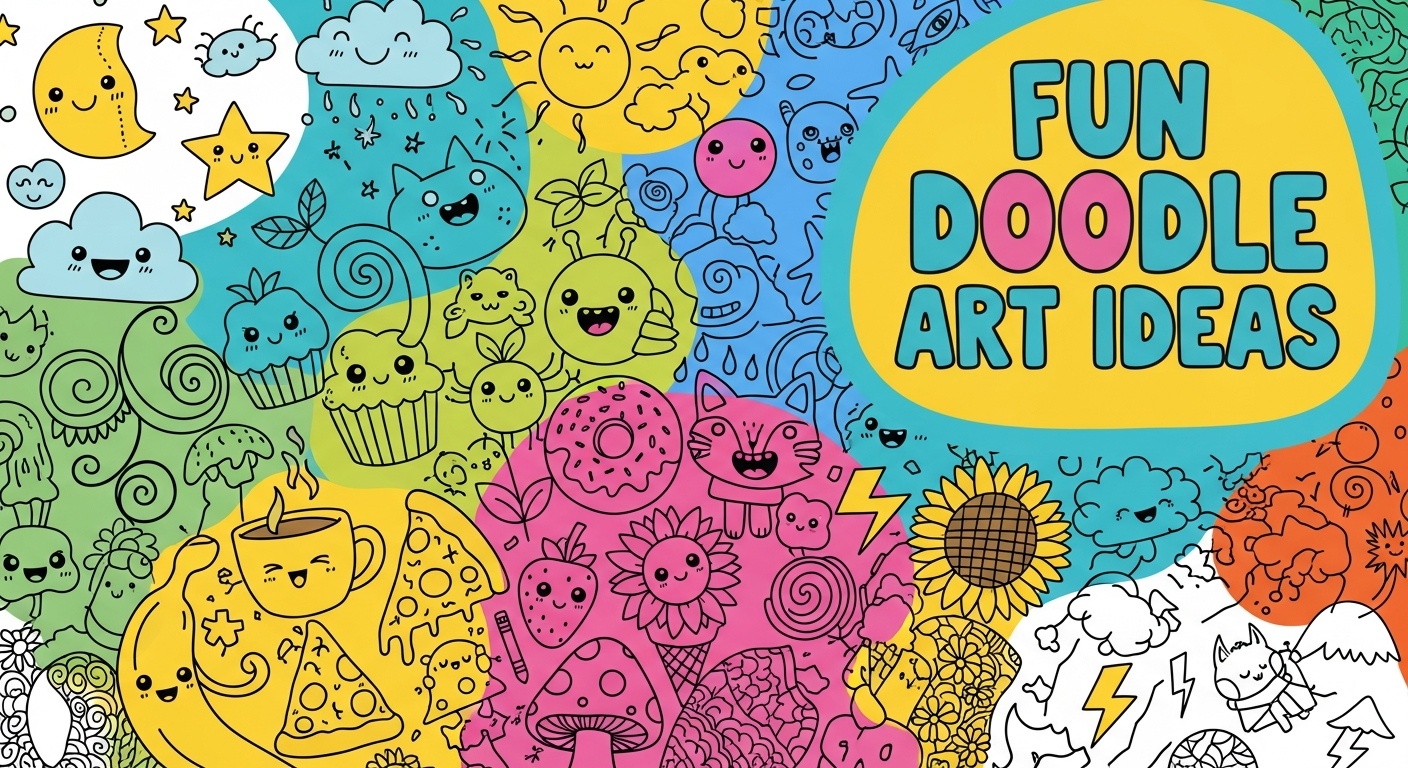
Doodle art is more than just absentmindedly scribbling on paper. It’s a fantastic way to unleash your creativity, reduce stress, and even improve your focus. Whether you’re a complete beginner or an experienced artist looking for fresh inspiration, the world of doodles offers endless possibilities for fun and self-expression. In this comprehensive guide, we’ll dive into a treasure trove of fun doodle art ideas, providing easy-to-follow, step-by-step drawing guides. Get ready to transform simple lines and shapes into captivating designs, learn new techniques, and discover how doodling can become a rewarding part of your daily routine. Grab your favorite pen and paper – let’s start doodling!
Key Points:
- Doodling helps reduce stress, improve focus, and boost creativity
- Start with simple shapes like circles, swirls, and basic lines
- Only basic supplies needed: pens and paper
- 25+ themed doodle ideas from nature to food to whimsical creatures
- Advanced techniques include shading, layering, and adding color
- Practice regularly to build confidence and develop your unique style
The Magic of Doodling: Why Everyone Should Try It
Before we jump into the ‘how-to,’ let’s explore why doodling is so beneficial. It’s not just for children or for passing time during boring meetings. Scientific studies suggest that doodling can actually help with memory retention, improve concentration, and serve as an excellent stress-relief tool. According to research published in Applied Cognitive Psychology, doodlers performed 29% better on memory tests than non-doodlers.
Doodling encourages spontaneity and helps you break free from perfectionism. It’s a low-stakes activity that builds confidence in your artistic abilities, similar to how drawing for beginners helps develop fundamental skills. Plus, it’s incredibly accessible – all you need is a pen and paper! Discover how a few minutes of daily doodling can positively impact your mood and cognitive functions.
As Psychology Today notes, doodling activates different neurological pathways in our brains, promoting creative thinking and problem-solving. It’s like giving your mind a gentle workout while having fun!
Doodling Essentials: Pens & Paper Comparison

A guide to the best pens and paper types for starting your doodle art journey, considering various factors.
For those interested in exploring different painting and drawing mediums, these basic supplies serve as an excellent starting point before investing in more specialized materials.
Getting Started: Basic Doodle Elements (Step-by-Step)
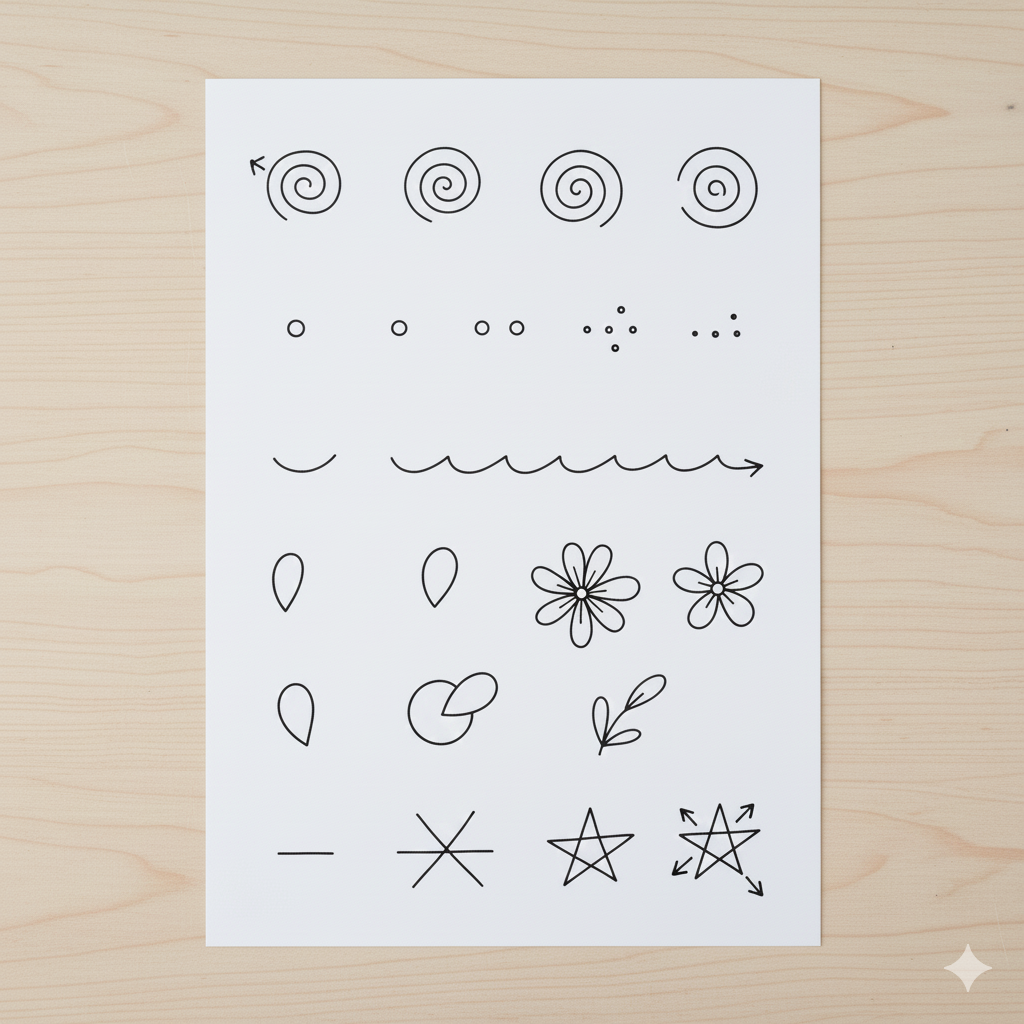
Every great doodle begins with simple shapes and lines. Mastering these foundational elements will give you the confidence to build more complex designs, just like learning easy things to draw helps build your artistic foundation. Let’s start with some easy shapes you can practice right now.
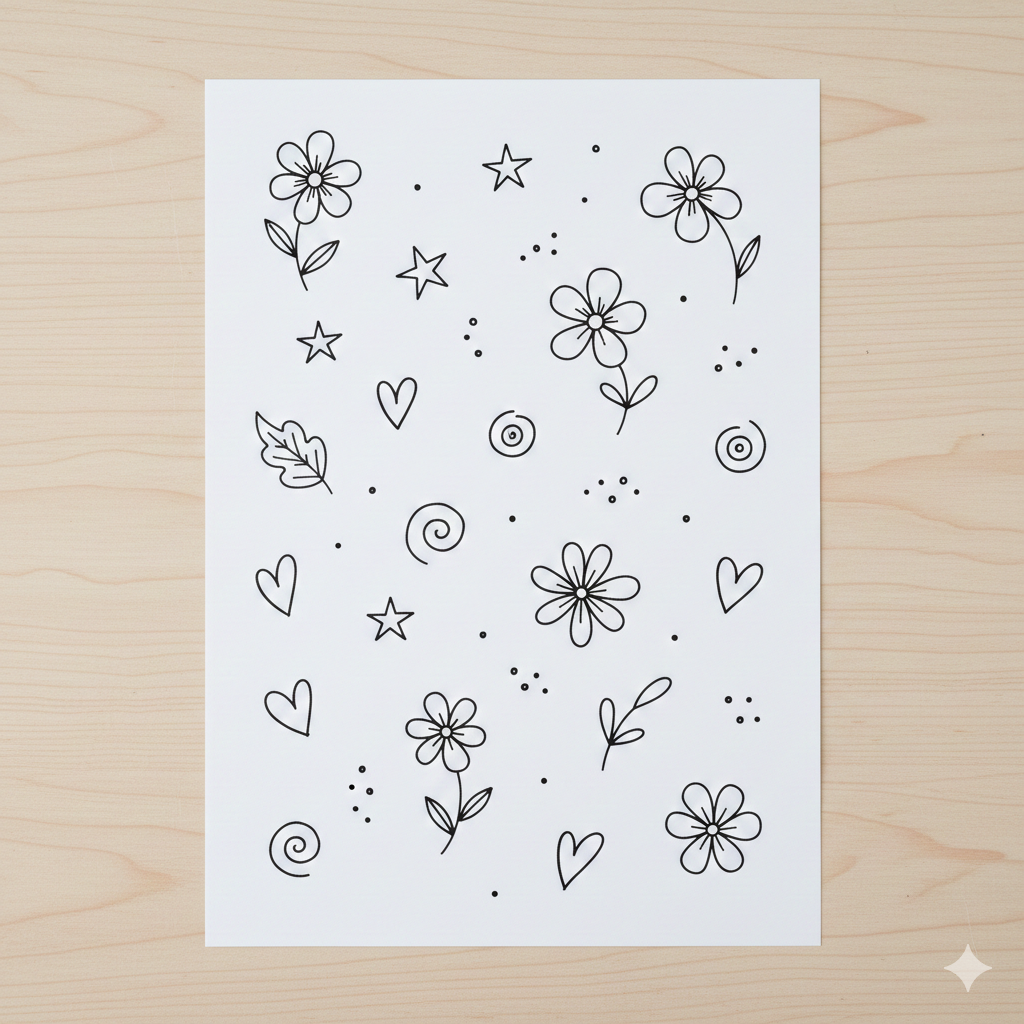
1. Swirls & Spirals Start at the center of your page and draw a continuous line spiraling outwards. Experiment with tight spirals, loose swirls, and even overlapping ones. These flowing elements add movement and elegance to any doodle composition.
2. Dots & Dashes Simple, yet powerful! Use varying sizes of dots to create textures, or arrange dashes in patterns. Stippling (using dots to create shading) is an advanced technique you can explore once you’re comfortable with basic dots.
3. Zigzags & Waves Practice drawing sharp zigzags and smooth, flowing waves. These are great for borders or filling spaces. Try varying the height and frequency to create different visual effects.
4. Petals & Leaves Start with a simple teardrop shape for a petal, then add more around a central point to form a flower. Leaves can be basic ovals or more intricate shapes with veins. These natural elements appear frequently in doodle art.
5. Stars & Hearts These classic shapes are easy to draw and add a touch of charm to any doodle. Practice drawing them in different sizes and arrangements to create interesting patterns.
“The secret to getting ahead is getting started. The secret of getting started is breaking your complex overwhelming tasks into small manageable tasks, and starting on the first one.”
Mark Twain
This quote perfectly captures the essence of learning doodle art – start simple, and build from there!
Fun Doodle Art Ideas: Themed Drawing Guides
Now for the exciting part – specific fun doodle art ideas! We’ll explore various themes, each broken down into manageable steps. Remember, the goal is to have fun and let your imagination flow, not to achieve perfection. These ideas work wonderfully as creative art prompts when you need inspiration.
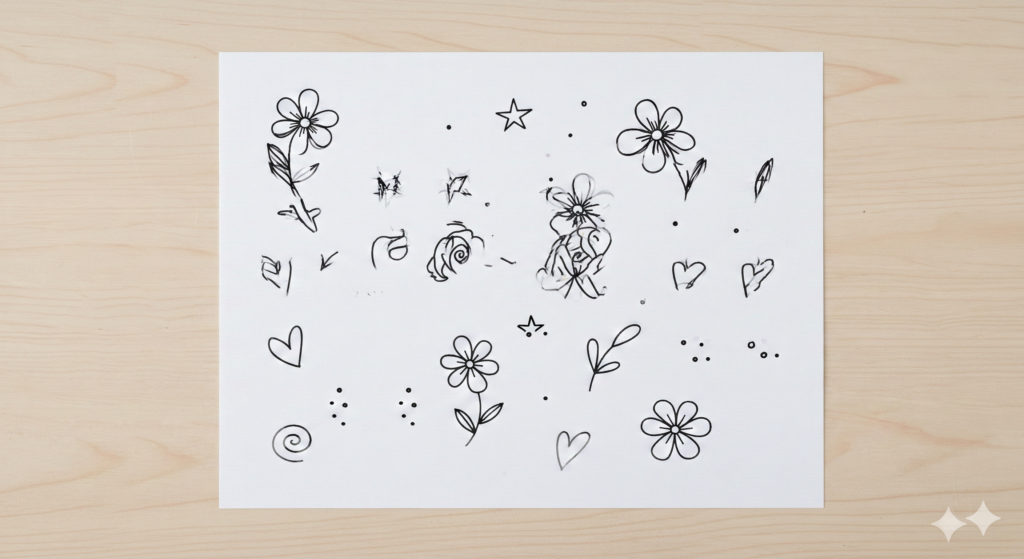
1. Nature Doodles: Flowers, Leaves & Clouds
Simple Flower:
- Draw a small circle for the center
- Draw five overlapping ‘U’ shapes around it for petals
- Add a stem and two simple leaves
- Optional: Add dots to the center or lines on the petals for detail
Fluffy Cloud:
- Draw a series of connected bumps or scallops in an irregular shape
- Add a few small lines at the bottom for definition
- Experiment with different cloud sizes and shapes
Cute Mushroom:
- Draw a semi-circle for the cap
- Add a cylindrical stem underneath
- Add small dots to the cap for a classic look
- Draw a curved line under the cap for dimension
For those interested in more detailed botanical artwork, check out our guide on flower painting techniques to see how doodles can evolve into full paintings.
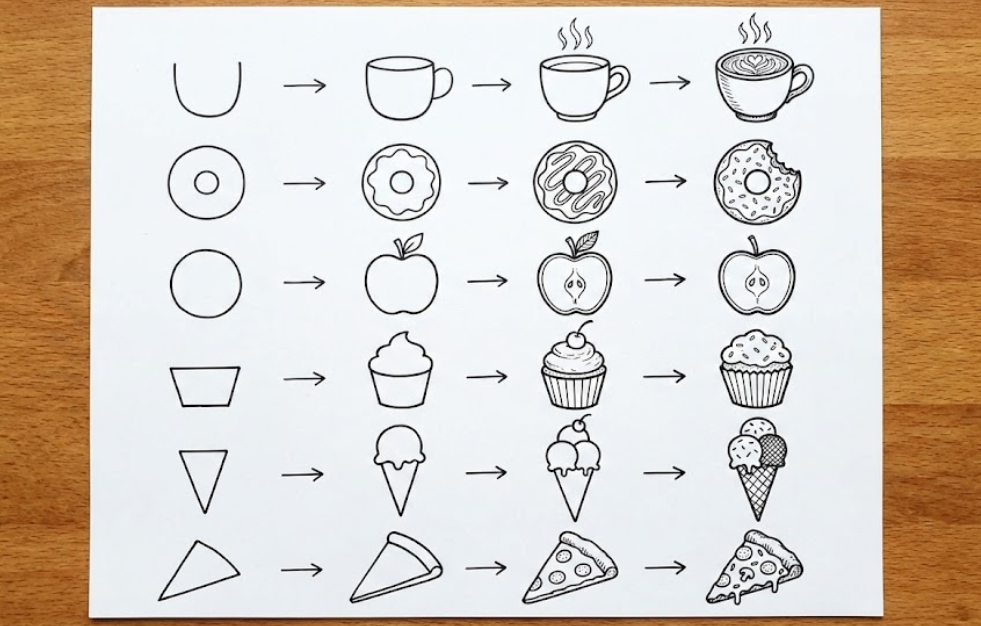
2. Food & Drink Doodles: Coffee Cups, Donuts & Fruits
Coffee Cup:
- Draw a tall ‘U’ shape
- Close the top with a curved line
- Add a small handle on the side
- Add steam lines above using curved, wavy lines
Donut:
- Draw two concentric circles
- Add small squiggles on the top circle for frosting
- Add tiny dots for sprinkles
- Draw lines radiating from the center for dimension
Apple:
- Draw a slightly irregular circle with a small indentation at the top
- Add a tiny stem
- Add a leaf next to the stem
- Optional: Add a highlight spot for shine
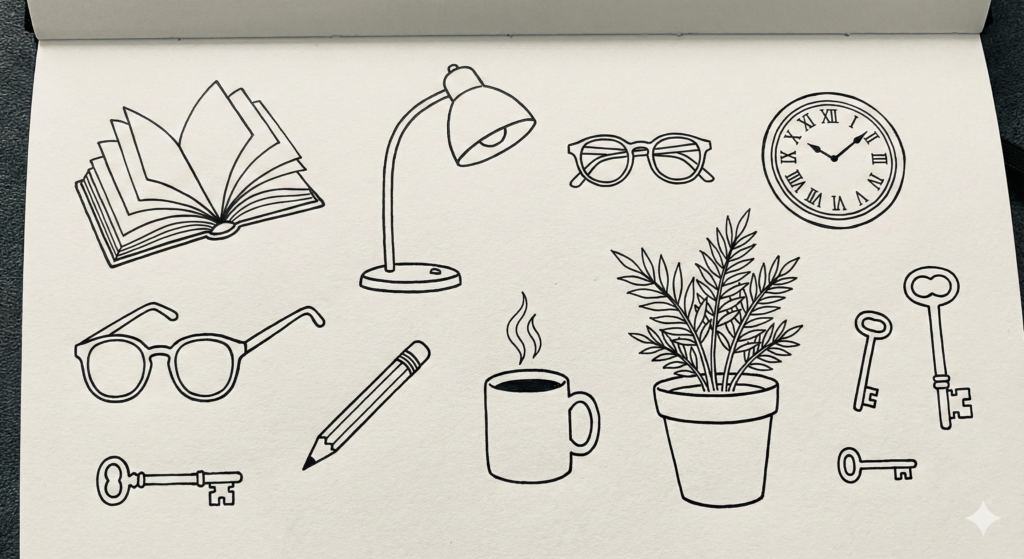
3. Everyday Object Doodles: Books, Lamps & Glasses
Open Book:
- Draw two overlapping rectangles for the pages
- Connect them at the spine with a curved line
- Add horizontal lines for text
- Optional: Draw a bookmark ribbon
Desk Lamp:
- Draw a curved base
- Add a straight line for the stand
- Draw a half-oval for the lampshade
- Add small lines for light rays
Eyeglasses:
- Draw two circles or ovals side-by-side
- Connect them with a small bridge
- Add earpieces extending from each side
- Optional: Add highlights to show reflection
These everyday objects make excellent subjects for unique drawing ideas when you’re looking to expand your artistic repertoire.
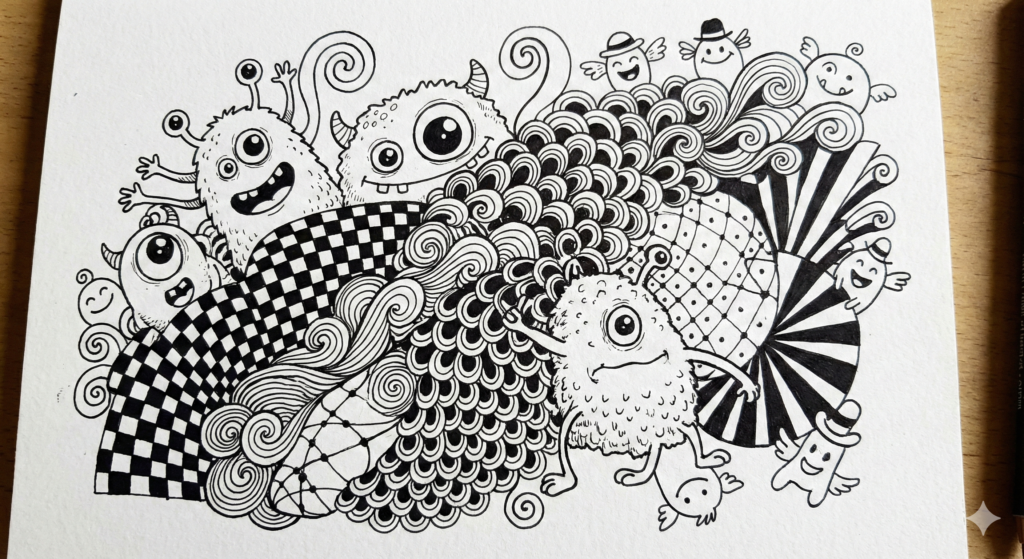
4. Whimsical & Abstract Doodles: Patterns & Monsters
Zentangle-Inspired Pattern:
- Choose a small section of your paper
- Divide it into smaller sections using curved or straight lines
- Fill each section with repetitive patterns like checkerboards, stripes, scales, or dots
- Don’t overthink it – let your hand move naturally
Friendly Monster:
- Draw an irregular blob shape for the body
- Add one or more big eyes (circles with smaller circles inside)
- Draw a quirky smile or wavy mouth
- Add small horns, spikes, or antennae
- Optional: Add arms, legs, or spots
Abstract and whimsical doodles connect beautifully with expressive art techniques, allowing you to explore creativity without rules.
Advanced Doodling Techniques & Inspiration
Once you’re comfortable with basic elements, you can elevate your doodles with some more advanced techniques. These methods add depth, texture, and visual interest to your creations, making them truly stand out. Many of these concepts build on fundamental painting techniques that apply across artistic mediums.
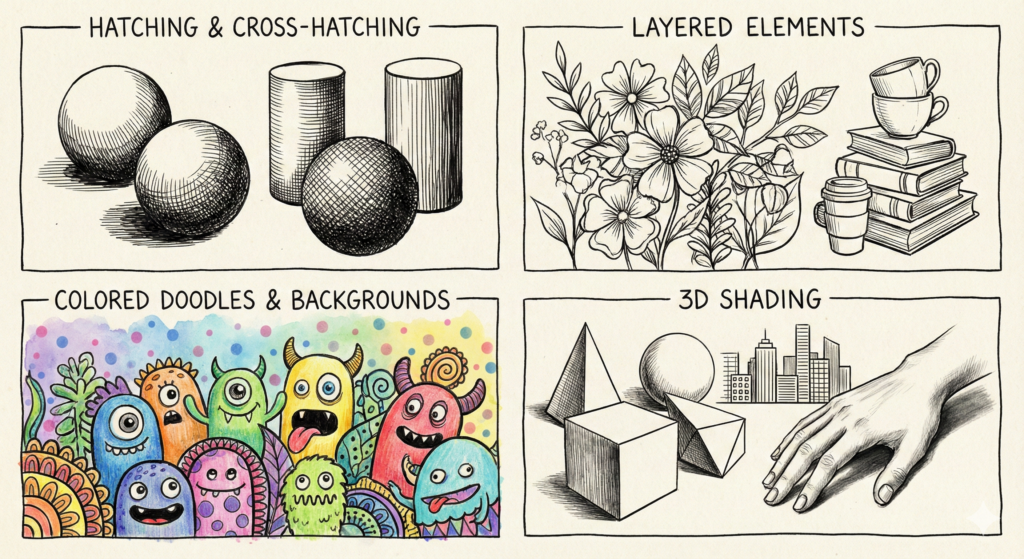
1. Shading & Cross-hatching
Use lighter or darker strokes to create shadows and volume. Cross-hatching involves drawing intersecting lines to build up tone. This can make your doodles look three-dimensional.
How to practice:
- Draw a simple circle
- Add parallel lines on one side (hatching)
- Add perpendicular lines over those (cross-hatching)
- The more lines you add, the darker the area becomes
2. Layering & Overlapping
Don’t be afraid to draw elements on top of each other. This creates a sense of depth and complexity. Think of a stack of books or leaves overlapping. Objects in the foreground can partially hide objects in the background.
3. Adding Color
While many doodles are black and white, adding color with colored pencils, markers, or even watercolors can bring them to life. Experiment with different color palettes:
- Monochromatic: Use different shades of one color
- Complementary: Use colors opposite on the color wheel
- Analogous: Use colors next to each other on the color wheel
4. Creating Backgrounds & Borders
Don’t leave your doodles floating in space! Add simple backgrounds like dots, stripes, or a wash of color. Decorative borders can frame your artwork beautifully. Try these border ideas:
- Repeating geometric shapes
- Vine-like patterns with leaves
- Wave or scallop patterns
- Dotted or dashed lines
5. Visual Storytelling
Try to create doodles that tell a small story or represent a concept. Connect different elements to form a narrative, even if it’s just a sequence of emotions or events. For example, draw a sun rising over mountains with birds flying – it tells a story of morning.
Creating Your Doodle Practice Routine
Consistency is key to improving your doodling skills. Here’s a simple routine to help you develop your abilities:
Daily Practice (10-15 minutes):
- Monday: Basic shapes and lines
- Tuesday: Nature doodles
- Wednesday: Food and objects
- Thursday: Patterns and textures
- Friday: Whimsical creatures
- Weekend: Free doodling – combine everything you’ve learned!
Similar to how cute easy drawings help build confidence, regular doodle practice develops your artistic muscle memory and creativity.
Pro Tips for Progress:
- Keep all your doodles in one sketchbook to track improvement
- Date your pages to see how you’ve grown
- Don’t erase mistakes – they often lead to creative discoveries
- Share your doodles with friends or online communities for feedback
- Challenge yourself with themed weeks (ocean week, space week, etc.)
Fun Doodle Art Ideas for Special Occasions
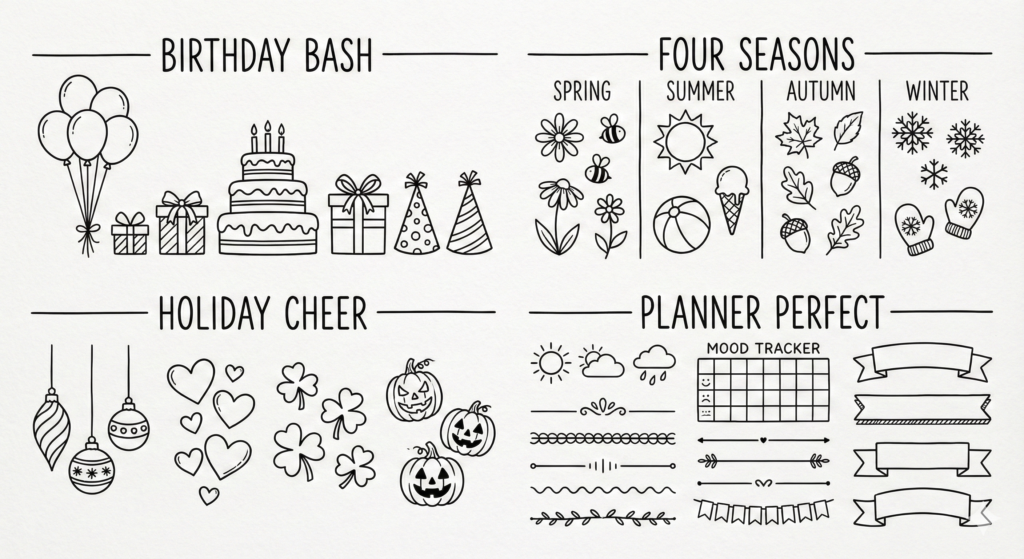
Doodling isn’t just for practice – it’s perfect for personalizing cards, decorating journals, and creating handmade gifts. Here are some occasion-specific ideas:
Birthday Cards:
- Balloons with strings
- Birthday cakes with candles
- Party hats and confetti
- Gift boxes with bows
Holiday Doodles:
- Snowflakes and mittens (winter)
- Flowers and butterflies (spring)
- Beach scenes and sunglasses (summer)
- Leaves and pumpkins (autumn)
Planner & Journal Decoration:
- Weather icons
- Mood trackers
- Habit tracker designs
- Monthly calendar headers
Digital Doodling: Taking Your Art Online
While traditional pen-and-paper doodling is wonderful, digital doodling opens up new possibilities. Apps like Procreate, Adobe Fresco, or even simple note-taking apps offer:
Benefits of Digital Doodling:
- Unlimited “undo” options
- Easy color changes
- Ability to resize and rearrange elements
- Simple sharing on social media
- No physical supplies needed
Getting Started with Digital Doodling:
- Start with free apps like Autodesk SketchBook or Krita
- Use your finger or invest in a stylus for better control
- Experiment with different brush settings
- Save your work in layers for easy editing
Many artists combine traditional and digital techniques, starting with hand-drawn doodles that they scan and enhance digitally.
Building Confidence Through Doodling
One of the most beautiful aspects of doodle art is how it builds artistic confidence. Unlike formal drawing or painting, doodling has no strict rules. This freedom allows you to:
Develop Your Unique Style:
- Everyone’s doodles look different
- Your personal quirks become your signature style
- Embrace “imperfections” as character
Overcome Creative Blocks:
- Doodling loosens up a tight creative mind
- Random doodles often spark bigger ideas
- It’s easier to start doodling than starting a “serious” artwork
Practice Without Pressure:
- No one expects doodles to be perfect
- Low-stakes practice builds real skills
- Mistakes become happy accidents
As you progress in your doodle art journey, you might find yourself wanting to explore more structured approaches to drawing. Our introduction to painting can help you transition from doodling to more formal artistic practice when you’re ready.
Conclusion
Doodle art is a powerful, accessible, and incredibly fun way to tap into your creative potential. From simple shapes to complex patterns, these fun doodle art ideas and step-by-step guides have hopefully equipped you with the inspiration and tools to start your doodling journey. Remember, there’s no right or wrong way to doodle; it’s all about enjoying the process, letting your imagination run wild, and finding joy in spontaneous creation.
Whether you’re filling the margins of your notebook during a meeting, decorating your journal, or creating elaborate Zentangle-inspired artwork, doodling offers something valuable to everyone. The best part? You already have everything you need to get started – just grab a pen and paper, and let your creativity flow.
Keep practicing, keep exploring, and let your doodles tell your unique story. Happy doodling! For more inspiration and artistic guidance, explore our collection of free online art courses to continue your creative journey.
Frequently Asked Questions (FAQs)
What are the benefits of doodling?
Doodling can reduce stress, improve focus and memory, spark creativity, and help with problem-solving. Research shows that doodlers retain 29% more information than non-doodlers. It’s a mindful activity that offers mental breaks and encourages free expression without the pressure of perfectionism.
Do I need special art supplies to start doodling?
Not at all! You can start with just a pen and any piece of paper. As you progress, you might enjoy experimenting with fineliner pens like Sakura Pigma Micron, different colored inks, gel pens, or various types of sketchbooks, but they aren’t necessary for beginners. The most important thing is to just start drawing.
Is doodling the same as drawing?
While doodling is a form of drawing, it typically refers to spontaneous, often unconscious drawing that doesn’t aim for a perfect or realistic outcome. It’s more about the process and free expression rather than a finished product. Drawing can be more structured and intentional, while doodling is casual and exploratory.
How can I get more doodle ideas?
Look for inspiration everywhere! Observe everyday objects, nature, or even abstract patterns. Browse social media platforms like Pinterest and Instagram for ‘doodle prompts’ or ‘simple drawing ideas.’ You can also challenge yourself with themed doodling sessions like “food week” or “nature week.” Keep a small notebook to jot down ideas whenever inspiration strikes.
Can doodling improve my artistic skills?
Absolutely! Regular doodling helps develop hand-eye coordination, muscle memory, and a better understanding of shapes and composition. It’s a low-pressure way to practice and build foundational skills that transfer to more formal drawing and painting. Many professional artists use doodling as a warm-up exercise and for generating ideas.
What’s the difference between doodling and Zentangle?
Zentangle is a specific, structured method of doodling that follows certain rules and patterns. While regular doodling is spontaneous and free-form, Zentangle involves creating deliberate patterns within defined spaces using specific strokes. Both are relaxing and creative, but Zentangle is more meditative and follows a particular methodology.
How long should I practice doodling each day?
Even 10-15 minutes of daily doodling can make a significant difference in your skills and provide stress-relief benefits. The key is consistency rather than length. Start with whatever time feels comfortable, and gradually increase as doodling becomes a natural part of your routine.
Can kids benefit from doodling?
Yes! Doodling is excellent for children as it develops fine motor skills, encourages creativity, improves concentration, and builds confidence. It’s a non-pressured form of artistic expression that allows kids to explore their imagination freely. Many educators use doodling as a learning tool in classrooms.
What should I do if my doodles don’t look good?
Remember that doodling isn’t about creating perfect artwork – it’s about the process and expression. Every artist starts somewhere, and what looks “not good” today will improve with practice. Focus on enjoying the creative process rather than judging the results. Keep all your doodles to see your progress over time.
Where can I share my doodles and get feedback?
Online communities like Instagram (using hashtags like #doodleart or #dailydoodle), Reddit’s r/doodles, DeviantArt, and dedicated Facebook groups for doodle artists are great places to share your work and connect with others. Local art groups and classes also provide supportive environments for sharing and receiving feedback.
Citations:
- The New York Times – The Power of Doodling: Discusses the cognitive benefits of doodling and its impact on memory retention. https://www.nytimes.com/2009/04/28/science/28doodle.html
- Psychology Today – Why Doodling Is Good For You: Explores the psychological and neurological benefits of doodling, including stress relief and creative thinking. https://www.psychologytoday.com/us/blog/the-mind-body-connection/201212/why-doodling-is-good-you
- Skillshare Blog – Getting Started with Doodle Art: Provides practical advice and techniques for beginners interested in doodle art. https://www.skillshare.com/blog/drawing/getting-started-with-doodle-art/
- Applied Cognitive Psychology Journal: Research study showing that doodlers performed 29% better on memory tests, demonstrating the cognitive benefits of doodling during information retention tasks.